How do you cope when your employer asks you to take unpaid leave?
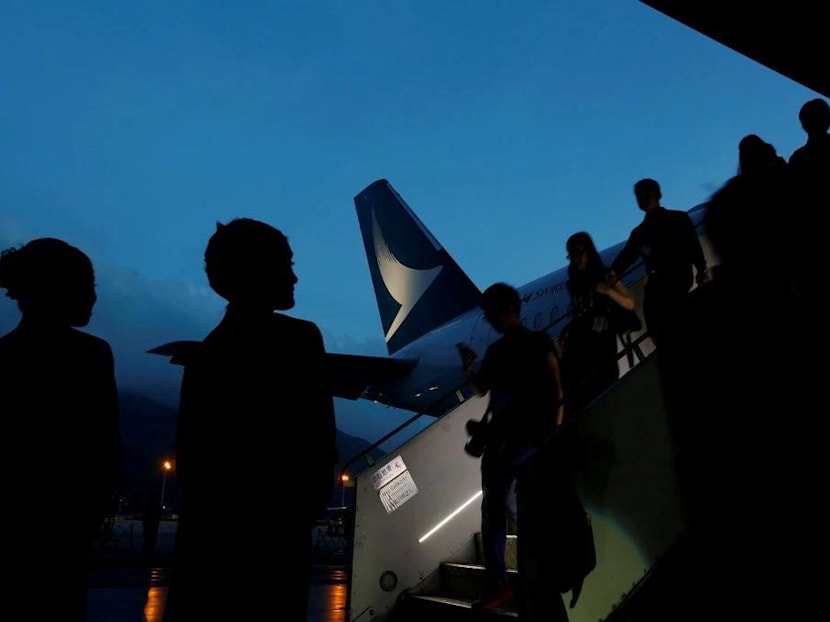
“Why make the frontline employees suffer?” asks one Hong Kong-based flight attendant at Cathay Pacific.
His response is to the Hong Kong flag carrier’s request last week that its 27,000 employees take three weeks of unpaid leave in an attempt to stem losses resulting from reduced flights because of the coronavirus epidemic.
Management “should take responsibility” and shoulder the financial hit instead, says the flight attendant who wishes to remain anonymous.
“I have to maintain my income to support my parents.”





While he has money to buffer a few weeks’ lost income, he is worried the request is only the start of further demands from his employer. “You can’t predict what will happen in Hong Kong in one month’s time. I have savings but not enough for a whole year.”
Moreover, he fears the company will retaliate against those who do not apply for the voluntary leave. “If you don’t request the leave, they will ask you why. We don’t know the consequences.”
Rebecca Sy, general secretary of the Hong Kong Dragon Airlines Flight Attendants’ Association, the cabin crew union at Cathay Dragon, a regional airline owned by Cathay, says that members are upset.
“They would know if you didn’t apply to show support. It [is a] pressure.”
Employee morale at the airline is already low after some staff were fired last year because they allegedly participated in anti-government protests in the semi-autonomous Chinese territory.
The carrier was plunged into a political crisis after Beijing demanded it suspend staff who were involved in, or supportive of, the protests.
The airline’s business has also been hit by a drop in passenger traffic because of the long-running demonstrations.
In general, a company should only implement this type of human resource cost strategy after exhausting all other mechanisms, says Anthony Wheeler, professor of management at West Chester University.
“It’s unclear as to what other cost-saving mechanisms Cathay Pacific has implemented other than cancelling flights. However, the research on cost saving mechanisms suggests that a furlough like Cathay is proposing is a better option than reducing its workforce through lay-offs,” he adds.
“That strategy as a first or early response to economic instability has been found to lead to bankruptcy and closure. At some point, companies that need to recover will need their employees.”
Peter Cappelli, director of the Center for Human Resources at Wharton Business School, University of Pennsylvania, says in the last recession the issue of unpaid leave or reduced hours became a hot topic in the United States.
“Top executives in the US seemed to think it was better to lay people off because they thought reduced hours [and] unpaid leave would cause [their] best performers to quit.”
Elsewhere, during the recession in 2009 there was increased use of public-funded short time work schemes in countries including Germany and Italy, used to keep employees in work. Workers reduced their hours and the state covered the shortfall in wages.
While for some employers, reducing hours might in the long-term save jobs and money, there are costs to the workforce.
During last year’s US federal government shutdown, triggered by a political row over President Donald Trump’s plans for border security, more than 380,000 federal workers went without income for 35 days from December 2018.
During that time, food banks and charities reported an increase in demand. One food bank worker told the Financial Times that they had seen a shift in the typical profile of a user from one hovering above the poverty line to people who earn between US$40,000 and US$60,000 a year.
Yet while those workers were eventually compensated for their lost income, it is not only the financial costs that hurts workers.
Lisa Baranik is an assistant professor at the school of business at the University at Albany who researched the impact of a previous US federal government shutdown in 2013 on workers.
She says that unpaid leave, especially when unexpected, is very hard on employees.
“Two of the most challenging circumstances for workers are financial stressors and dealing with uncertainty. An unexpected unpaid leave combines both of those, making it a particularly difficult hardship to overcome.”
While the financial impact of unpaid leave is clear, she says, what gets lost in debates over furloughs is the psychological impact.
“Many people get a lot of intangible benefits from work, like feeling good about themselves and doing work that is meaningful to them,” she adds.
“When employees have to suddenly stop going to work they miss out on those benefits and suffer psychologically. The experience makes it harder for them to manage their work and family lives and is linked to higher levels of burnout.”
During last year’s shutdown, Sharon Stiteler, a national park ranger, published a blog she had written in the 2013 shutdown about how to cope with the stress of not working, which included advice such as “be physically active”, “rage knit” and seeing friends.
Reflecting on the experience, she says that “being out of work and uncertain if or when I would get paid was hard. My sense of security was lost. I couldn’t plan anything because I was so uncertain about money”.
In Hong Kong, the uncertainty surrounding the coronavirus will also mean that employees worry about their long-term job security.
Prof Wheeler says that employees who do take the leave may not return to work well-rested but will be stressed out, burnt out, and perform more poorly.
“Upon returning to work, they will be on edge and worried about the next economic shock that might hit the airline,” she says.
“This is the challenge for Cathay. It can create a reinforcing drain spiral where poorer performing employees affect customer service, which leads to fewer customers and more cost-cutting mechanisms.”
Prof Capelli says asking staff to reduce their hours or take unpaid leave only works if the organisation’s culture makes employees feel they are all in it together.
“It may well give employees greater commitment to the company after, if they can feel like, ‘We saved the company’. Of course, asking the employees to do this does suggest that the company should do things to look after [them] in the future.”
In cases such as Cathay’s, employees might expect some kind of “thank you” after the crisis fades in recognition of the sacrifice, he says.
“That might be bonuses when things pick up or something that looks like a benefit that they would not otherwise have secured. It would be irritating to employees if they didn’t get that.”
The Hong Kong flight attendant is sceptical. “If they are in a financial [mess], they could give us a promise to pay us back. Or they should ask the government to support the company.” FINANCIAL TIMES
ABOUT THE AUTHOR:
Emma Jacobs is a features writer for the Financial Times, with a particular focus on workplace trends, business culture and entrepreneurship.