How to get ahead? Buy an office bed
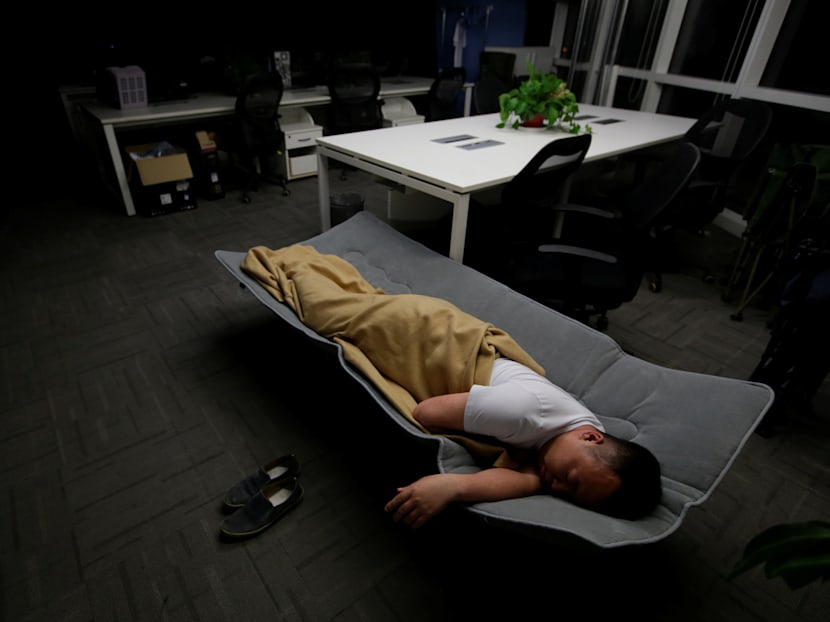
Most people aren’t natural short sleepers and because they do not get enough sleep, likely underperform at work every day.
About the time when my children learnt to sleep through the night, I lost the knack. Waking up tired is one of the quiet horrors of middle age.
I’ve recently become addicted to my Fitbit watch, which tracks sleep, and my new first-thing ritual is to scan the dismal numbers from the night before: the hour-plus awake, the preponderance of light sleep and the struggle to reach seven hours.
Fitbit (I’ve come to think of him as a friend) offers benchmarks to reassure me that all this is pretty typical for my peer group.
By middle age, we have fewer deep-sleep brain waves, more body pain and weaker bladders, explains Matthew Walker, a sleep expert at the University of California, Berkeley.





Victor Horta, the great Brussels architect of art nouveau, seems to have been so plagued by night-time toilet trips that he built a urinal into his bedside wardrobe.
Old people sleep even worse but they generally have more time to spend trying, which might explain why 45- to 54-year-olds emerged as “the most sleep-deprived age group” in a survey of 5,007 Britons for the United Kingdom’s Sleep Council in 2013.
Good or bad nights can shape careers.
I increasingly suspect that the key to success — certainly in middle age — isn’t talent, luck, nepotism or even showing up. It’s getting enough sleep. Fewer than 1 per cent of people are natural “short sleepers”, who need less than six hours sleep a night, estimates Ying-Hui Fu, neurologist at the University of California, San Francisco.
Yet this tiny cohort seems to enjoy disproportionate professional success, especially in managerial jobs.
One short sleeper I know, an academic, says that throughout his career he worked three hours every morning before everyone else got up.
He became a legend in his field, and remains productive in his 80s. Emmanuel Macron— famous for his 2am text messages — is today’s most prominent short sleeper.
One reason he charms people is that he has time to chat (since he has several extra hours a day) and doesn’t get distracted and irritable.
A man who worked with him in his days as President François Hollande’s aide recalls that at 7am after all-night crisis meetings, Mr Macron was the only pleasant person in the room.
Marissa Mayer, who was Google’s 20th employee and its first female engineer, and later became chief executive of Yahoo, told Bloomberg Businessweek that early Google was built on all-nighters.
“Could you work 130 hours in a week? The answer is yes, if you’re strategic about when you sleep, when you shower and how often you go to the bathroom.” (Bowel control may be another underrated career asset.)
Lots of people nowadays sleep as little as Ms Mayer and Mr Macron. Charles Czeisler of Harvard Medical School estimates that average American sleep on work nights has declined over the past 50 years from eight-and-a-half hours to seven.
More than a third of Britons in the Sleep Council’s survey reported sleeping five to six hours a night.
But most of these people aren’t natural short sleepers. They need normal quantities of sleep; they just aren’t getting it.
They probably underperform every day, and the long-term health consequences are terrifying.
The question about Donald Trump — who claims to sleep only four hours a night — is whether he’s in Mr Macron’s category, or simply chronically underslept.
I am not a short sleeper. But since I work alone (and here comes the secret of my extraordinary success), I can nap.
After dropping the kids at school, I regularly grab 20 extra minutes at home. After lunch, I catch another 20 in my office bed.
When I get up, I am not a million miles off my legendary best.
If I had to get through every day in a typical office where napping is for wimps, I doubt I could cope.
I would probably now be thinking of quitting and downshifting.
From my long-gone office days, I dimly remember middle-aged colleagues wandering around in the post-lunch phase having desultory chats.
The modern equivalent would be pointlessly spinning through websites because you’re too tired to produce.
Exhaustion is surely one reason why salaries of American male college graduates peak at the age of 49.
In old-style factories, your career ended when your back went; in today’s offices, perhaps it is when your sleep goes.
If I ran an office, I would equip every employee with the sort of first-class airline seat that (or so I gather from the advertisements) fully reclines. Happily, more and more companies are installing nap rooms, though often these consist of just a couple of sticky mattresses intended to replace rather than supplement the bed at home.
Ms Mayer recalls: “The nap rooms at Google were there because it was safer to stay in the office than walk to your car at 3am.”
Still, napping at work remains a rarity, which is why nap cafés are popping up in workaholic South Korea.
New York, the city that never sleeps but probably ought to, got its first one, Nap York, in February.
A pod in “business class” — stacked, like a bunk bed — costs US$10 for 30 minutes.
Given that my generation is going to have to work into our 70s, some lucky chain of nap cafés could become the next Starbucks. THE FINANCIAL TIMES
ABOUT THE AUTHOR:
Simon Kuper is a life and arts columnist for The Financial Times.