

Indonesia-S’pore business ties face complex challenges
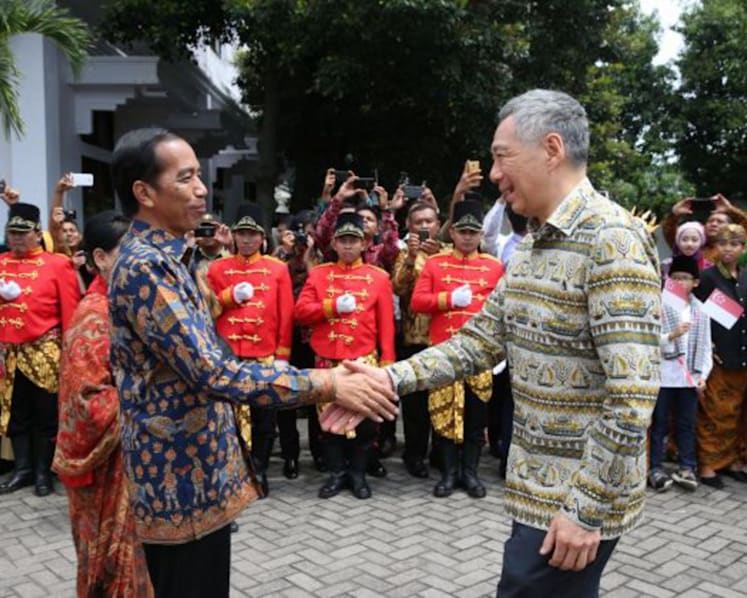
President Joko Widodo and PM Lee Hsien Loong at a leaders’ retreat in Semarang, Indonesia, last November. Singapore is Indonesia’s largest investor. Photo: MCI


Deputy Prime Minister Teo Chee Hean is making a three-day visit to Indonesia starting today to meet Indonesian leaders. This is part of a series of high-level visits by Singapore leaders to commemorate Rising 50, the 50th anniversary of the establishment of diplomatic relations between the two countries. It is therefore timely to take stock of what both countries have achieved and identify areas to further strengthen ties.
In terms of economic relations, the two countries have grown to be strong trading and investment partners, driven by mutual complementarities. This is made possible thanks to mutual efforts by both sides to manage and maintain an economic, political and security environment conducive to regional cooperation, including under the Association of South-east Asian Nations (Asean) framework.
Security and stability have contributed to improved economic relations, thus increasing the welfare of the people in both countries.
Singapore has become the largest source of investment for Indonesia. Last year, according to data from the Investment Coordinating Board (BKPM), Indonesia received a total of US$9.2 billion (S$12.5 billion) in foreign direct investment from Singapore, a 55 per cent increase amid the global economic slowdown.





Singapore as a global financial and logistics hub has indeed played an important role in directing the needed investment flow to Indonesia. At the same time, Indonesia’s growing middle-class market has contributed to the growth of Singapore’s economy.
Recently, Indonesia’s and Singapore’s business associations signed a new initiative to jointly develop the tourism sector in both countries. The initiative is designed to guide tourists who plan to visit Singapore to extend their holidays to Indonesia.
Several tourism destinations have been prepared, including Bintan Island in Riau Islands Province; Lake Toba in North Sumatra; Borobudur temple in Magelang, Central Java; Mandalika beach in Lombok, West Nusa Tenggara; and Bali.
In addition to tourism, the two countries have common interests in several areas, including the Batam-Bintan-Karimun Special Economic Zone (BBK SEZ), energy, transportation, manpower and agribusiness. Specifically, BBK has a strategic economic importance for the two countries.
It can be argued that future bilateral economic cooperation will be determined by the development in the BBK area. If the declining economic environment in the BBK area persists, this may hinder more investment from Singapore. Batam in particular, the industrial motor of the region and home to many Singaporean business, has been facing greater challenges externally and internally.
The Indonesian government, led by the Coordinating Economic Minister, together with the Riau Island regional administration and the Batam Indonesia Free Zone Authority (BP Batam) have been discussing several options to solve the legal and management uncertainty over Batam’s Free Trade Zone (FTZ) status.
Based on the minister’s statement, there is an option for the private sector to be invited to manage the area. This is where Singapore business could potentially play a role, such as to develop the infrastructure and to provide international customers to the region.
However, this can happen only if the Indonesian authorities make a quick and clear decision regarding the status of Batam. The current FTZ status may not be suitable any more as an incentive given the already low tariff environment within Asean. In fact, the FTZ status sets a barrier for products from Batam to access the Indonesian market.
This is because Batam’s FTZ is designed as an export-processing zone and not to cater for the local market. As an FTZ, Batam can freely import goods at 0 per cent tariff for their inputs. But if it sells its products domestically, it will be charged an import tariff plus value-added taxes. Thus, Batam’s products become more expensive if sold to the domestic market.
Given the long bureaucratic process in the country, it seems the decision will take some time and may be challenged by some vested interests. If the legal uncertainty continues, Batam stands to lose its attractiveness as an investment destination.
While BBK offers close proximity to Singapore, other parts of Indonesia should also be considered if the Singapore business sector would like to target the growing domestic market in Indonesia. McKinsey estimates that Indonesia’s middle-class will reach 135 million people in 2030.
Singapore business can also take part in many infrastructure projects under the current administration.
This has, in fact, already been happening. For example, Singapore has cooperated with a local partner, PT Jababeka, to develop Kendal industrial park in Central Java. One Singapore company has also signed a deal with Indonesia state-owned electricity company PLN to construct some small-scale power plants in Sumatra. The digital economy is another area in which Singapore businesses should be able to play a leading role. However, there is one important risk for future bilateral economic relations: Indonesia and Singapore are facing a delicate issue in relation to tax evasion.
According to Indonesian Finance Minister Sri Mulyani, there is about US$75 billion (S$102 billion) in Indonesian wealth parked overseas, with the majority, or 60 per cent, in Singapore. The Indonesian government has been trying to lure back these assets through a tax amnesty programme.
However, according to a report from the Ministry of Finance, of the estimated S$84.7 billion parked in Singapore that was declared during the tax amnesty, only S$8.6 billion has been repatriated.
This is not encouraging news for the Indonesian side, which is currently facing a fiscal crunch, caused by weak tax revenue collection and huge spending commitments (infrastructure, education, health, social). As a result, government spending is approaching the 3 per cent deficit limit mandated by law.
As the Indonesian government continues its efforts to increase tax revenue collection, it has the option of seeking Singapore’s assistance to expedite the signing of the Bilateral Competent Authority Agreement to implement the Automatic Exchange of Information (AEoI) between the two countries.
But this issue needs to be managed carefully. Unlike Singapore, Indonesia has not completed all the necessary instruments to implement the AEoI. Some key legislative and regulatory requirements have not been completed, including the Multilateral Competent Authority Agreement, which sets out an international framework to facilitate the AEoI and its common reporting standards.
While Indonesia is struggling to meet the needed requirements to be able to implement the AEoI, Singapore may be able to provide necessary technical assistance and advice.
Going forward, the bilateral relations between Indonesia and Singapore will continue to grow. And each side will benefit from mutual complementarities.
At the same time, the challenges facing the two countries are becoming more complex, and the two sides thus also need to grow their mutual trust. The initiative to open the exchange of information between Indonesia and Singapore is thus an important endeavour in managing the trust component of the relationship.
ABOUT THE AUTHOR:
Dr Siwage Dharma Negara is Fellow & Assistant Coordinator, Indonesia Studies Programme at ISEAS Yusof Ishak Institute.




