

IS-inspired militancy in Mindanao is far from over
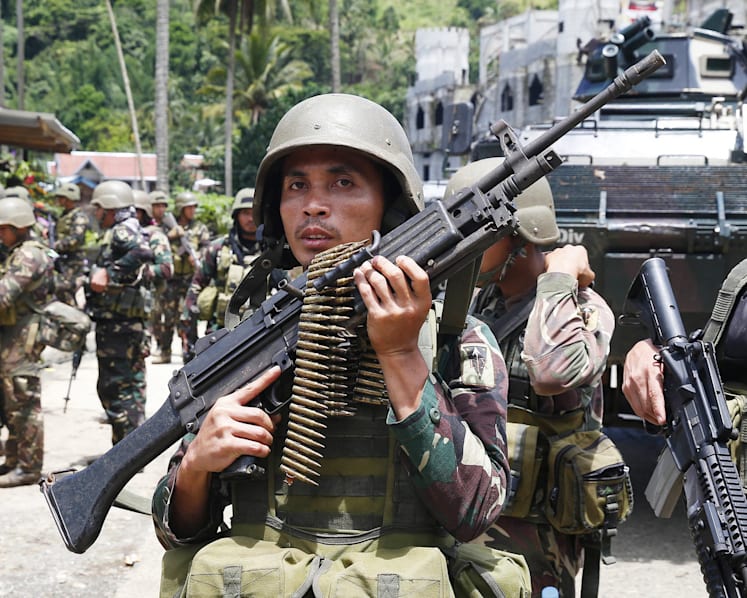
Government troops heading to the frontline as fighting between security forces and the militants laying siege to Marawi enters its second week. About 60,000 people were displaced and 100 people have lost their lives in the latest conflict. Photo: AP
As the crisis in Marawi enters its second week, the Philippines’ security forces have regained control of most of the city. But while the battle may soon be over, the war is not.
On May 23, terrorists affiliated with the Islamic State (IS), including the Maute Group and the Abu Sayyaf Group, attempted to take control of Marawi. An estimated 60,000 people were displaced, and 100 people have lost their lives. Philippine President Rodrigo Duterte placed Mindanao under martial law.
But Maute and Abu Sayyaf are not the only IS-affiliated terrorist groups in the area; others include the Bangsamoro Islamic Freedom Fighters, Katibah al-Muhajir — a terrorist group claiming to consist of Malaysians and Indonesians — and the Jama’at al-Muhajirin wa al-Ansar bi al-Filibin, formed in April 2017 and operating in Davao. They remain a serious security threat.





Underestimating Militants
The crisis started as a last stand by the militants to protect Isnilon Hapilon, the Abu Sayyaf leader and amir of the “Soldiers of the Caliphate” in East Asia. Isnilon, who has a US$5 million (S$6.9 million) bounty on his head, was supposedly on a visit to Marawi City when security forces thought they were ready to capture him.
Instead, they struck a hornet’s nest. Despite door-to-door raids on suspected Maute members, security forces were caught unawares by the size and influence of Maute in Marawi City. In August 2016, after eight of its members were arrested by soldiers, Maute, as a testimony to its strength, managed to stage a “raid” on the Lanao del Sur jail in Marawi to free the eight members and 15 others without firing a single bullet. It has been cultivating a growing membership under the radar, and the same could be said of other terrorist groups in the region.
The terrorist groups in Mindanao, born into the various local tongues, are familiar with the terrain and rely on familial or tribal ties and linkages that span neighbouring East Malaysia and Indonesia.
They have shown that they possess the tactical know-how to conduct urban warfare. Marawi City was not the first time IS-aligned terrorists attempted to take over urban territory. Following the Davao bombing in September 2016, the Maute Group laid siege to Butig town and occupied the town hall, displacing 16,000 residents. It took the Armed Forces of the Philippines five days to recapture Butig.
YOUTH RADICALISATION
Foreign fighters have existed in Southern Philippines since the Jemaah Islamiyah days. Back then, Mindanao and the nearby islands in the tri-border area were used for training and as a sanctuary for those evading arrest. In recent times, IS-inspired foreign fighters see Mindanao as a theatre for “jihad”. Prospective IS fighters who are unable to make the journey to the Middle East have also been advised to travel to Mindanao.
But while the authorities have pointed to the presence of foreign fighters in the latest unrest in Marawi, it is the locals that lead and form the bulk of the terrorist groups. Since IS-inspired violence began in Mindanao, disenfranchised youths in the area have flocked to embrace IS ideology.
In Marawi, a majority of madrasahs and tahfiz centres receive funding from Gulf states. The Gulf-based Muslim World League even funds the King Faisal Centre for Islamic, Arabic and Asian studies within the Marawi campus of the Mindanao State University. Marawi is also home to a large following of the Tablighi Jamaat, which funds the remaining madrasahs and tahfiz centres. The Tablighi Jamaat is a global Islamic missionary movement with a large following in South Asia and a significant presence in Southeast Asia. Hence, it is unsurprising many residents would self-identify as Salafis or owe the opportunity of religious education to the Tablighis.
The presence of Gulf-linked and Tablighi institutions in Marawi explains why there were reports of Arabs, Malaysians, Indonesians and Pakistanis who were travelling to the city when the crisis happened.
It is often the case for Gulf institutions to send representatives to ensure that organisations receiving their funding are adhering to the agreed curriculum. The Tablighi Jamaat, on the other hand, often hold large gatherings of followers from the region and beyond.
To some extent, it also explains an aspect of youth radicalisation in Marawi City and in Mindanao. While many Salafis and Tablighis may reject terrorism, IS and its affiliated groups use Salafi-jihadist doctrines and Tablighi networks to appeal to followers of these movements.
The Maute leaders hold sway over youths enrolled at the tahfiz centres because of the fervour with which they uphold Salafi beliefs. To these youths, carrying guns and fighting are an extension of their foundational Salafist beliefs. As for the Tablighis in Marawi City, they have long complained of “intruders” who would attend Tablighi events at the Abu Bakar Mosque.
These “intruders” call on the vulnerable few to support violence instead of focusing on da’wah (preaching). In some cases, these “intruders” may be visiting Tablighi followers from South Asia with sympathies to foreign terrorist organisations. In other cases, the “intruders” may even be locals, suspected of being recruiters, with links to various homegrown terrorist groups.
IS ideology also appeals to an entrenched culture of militant-heroism. Support for IS ranges from tactical expediency — in the case of Abu Sayyaf requiring a global terrorist financial backer — to politics: Maute transforming from a private militia to a “jihadist” group.
The common thread is the reliance on violence to achieve economic or political goals. For 20 years, the Moro Islamic Liberation Front has been trying to negotiate with Manila to end the cycle of violence. Negotiations have culminated in a peace agreement with Manila in 2014 that projects the passing of the Bangsamoro Basic Law, which would create an autonomous political entity in Mindanao and pave the way for better governance. Until this law passes and the region begins to prosper, local NGOs and activists argue that youths will continue to be able to identify only with violence and militancy.
The toxic brew of disenfranchisement and religion to inspire violence played out in the streets of Marawi as Muslims and non-Muslims became victims of the IS-inspired occupants, who also reportedly used children as soldiers. Maute leaders justified their actions by claiming that Marawi City deserved to be occupied because of the prevalence of, among others, “zina (non-marital relations), gambling, video-karaoke, alcohol, pork and prostitution”.
Yet Maute’s characterisation of Marawi as un-Islamic contradicts reality. They picked on posters of young Muslim women who have achieved academic success as lawyers, doctors or engineers instead of joining militant groups. Unlike Maute, Marawi’s Muslim residents are working hard to improve the condition of Muslims and relations with non-Muslims in Mindanao. Maute’s occupation of Marawi and future IS-affiliated activities — which, according to the self-styled IS-spokesperson there, Abu Hafs, was meant to establish God’s law — will set progress in Mindanao back.
Unfortunately, although the Marawi crisis may soon draw to a close, IS-inspired militancy is far from over. Even if the armed forces manage to eliminate every IS-inspired fighter in the ongoing battle in Marawi, many more await in other parts of Mindanao. Unlike the Philippines Armed Forces, the government in Manila and Marawi residents, the terrorists have ideology and time on their side.
ABOUT THE AUTHORS:
Jasminder Singh is a Senior Analyst and Muhammad Haziq Jani a Research Analyst with the International Centre for Political Violence and Terrorism Research, at the S Rajaratnam School of International Studies, Nanyang Technological University, Singapore.




