Japan turns to robots to fuel its next boom
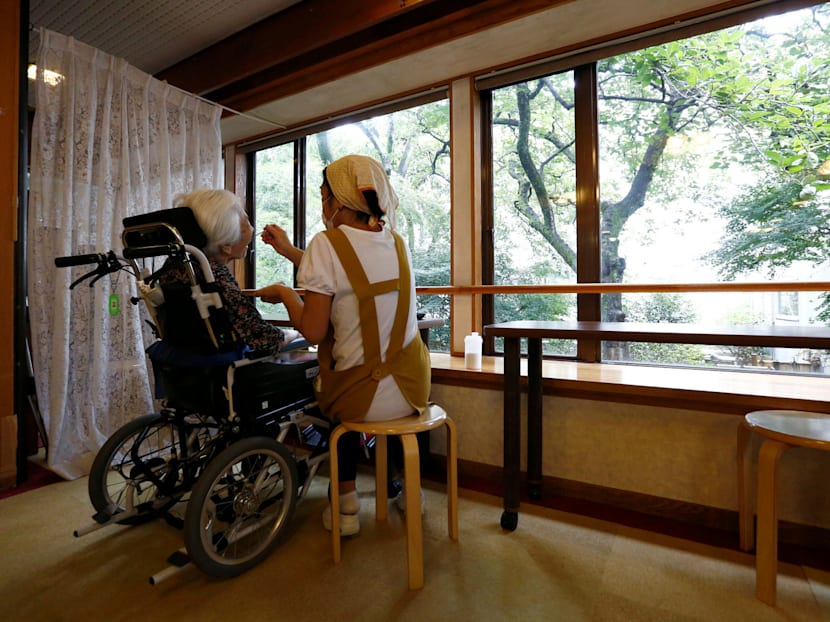
A carer feeding a resident at the Silver Villa Koyama nursing home in Tokyo. An owner of nursing homes around Tokyo plans to spend S$409 million on software to make life easier for employees
Japan’s next boom may be at hand, driven by the very thing that is supposed to be bad for its economy.
Japan’s ageing and shrinking population has been partly blamed for the on-again, off-again nature of growth and deflation the past three decades.
Lately, it has been driving a different and just as powerful idea: In the absence of large-scale immigration, the only viable solution for many domestic industries is to invest money into robots and information technology more generally.
Humans will still be needed, of course, and that is behind a separate by-product of Japan’s demographic challenges. With unemployment down to 2.8 per cent, companies are increasingly realising they need to pay up to attract and keep qualified personnel. The other option — increased immigration — is politically difficult.





Japanese tech innovation in yesteryear was about gadgets and games designed to give pleasure. Think Sony’s iconic Walkman and Nintendo games. Now the demand in Japan comes from an older demographic. A nursing home may well be the place to look for the next wave.
As my colleagues Henry Hoenig and Keiko Ujikane wrote this week, an owner of nursing homes in the Tokyo area plans to spend ¥300 million (S$409 million) on software to make life easier for employees and residents.
Mr Hoenig, Mr Toru Fujioka and I heard anecdotes like that numerous times during a December trip to Kadoma, a city near Osaka. The area was once an industrial powerhouse that rode Japan’s post-1945 industrial surge with local employers such as Panasonic Corp.
Now, Mayor Kazutaka Miyamoto frets openly about whether there will be enough wage earners to pay the taxes to maintain hospitals, public transport and schools (for those few children who are born and actually stay). Mr Miyamoto does not share the worries that dominate conversations about robots and artificial intelligence (AI) in the West. He almost laughed when pressed on the issue.
What if robots eliminate jobs? He said that would be a good thing. He told us to look around: There are not many people on the streets in the middle of a weekday. He does not see any real appetite for immigration on a scale that would substitute for more robots and AI.
Few businesses we spoke to that day did. One small manufacturer insisted that immigration would dilute Japan’s homogeneous society. He would happily get a few robots if he could afford them.
Bank of America Merrill Lynch forecast IT investment in Japan to rise as much as 9 per cent annually in coming years, with the difference in software investment per worker versus the US falling to five to one by 2020 from about 10 to one now.
The budding surge is not limited to manufacturers. Non-manufacturing companies planned ¥2.4 trillion in software investment in the fiscal year ending in March 2018, according to the Bank of Japan’s Tankan survey, released in July. That would be the most since 2009. Retailers plan to spend ¥146.4 billion on software this fiscal year, the most on record for data going back to 1999.
Another reason Japanese people do not share American angst about robotics: Astro Boy. Cultural affection for the anime character has made it easier for people to feel more relaxed about robots and technology in their lives. Just as well. That nurse assisting you in retirement may soon be a robot, along with the dog that keeps you company. BLOOMBERG
ABOUT THE AUTHOR:
Daniel Moss writes and edits articles on economics for Bloomberg View. He was previously executive editor of Bloomberg News for global economics, and has led teams in Asia, Europe and North America.