Links to China: A distinction between ‘overseas Chinese’ and ‘foreign Chinese’
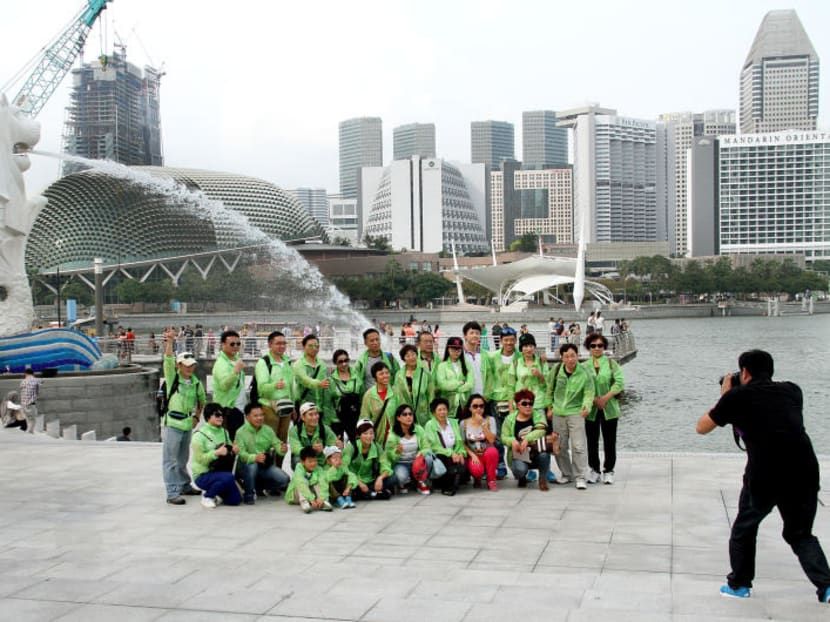
Tourists taking photos at the Merlion Park.
In his commentary, "Why Singaporeans need to understand two global trends that will shape nation's future" (July 12), Mr Bilahari Kausikan highlighted his concerns on China's intention to influence and shape the Singapore identity.
In particular, he referred to statements by Chinese leaders and a recent re-organisation of the Chinese government, taking these to indicate China's position, which is that "overseas Chinese should be persuaded, induced, or in extremis, coerced, into accepting allegiance to China as at least part of their identity".
While Mr Kausikan is a well-connected veteran diplomat, in some instances he might not have been able to fully comprehend the intricacies of the language.
Unlike in the past where "overseas Chinese" or "hua qiao" loosely referred to all ethnic Chinese residing outside China, today "hua qiao" is defined as Chinese citizens residing outside China, while other ethnic Chinese with foreign citizenship are "foreign Chinese".





The Chinese government website indicates that it has obligations and rights on the "hua qiao", but clarifies that the policy on the "hua qiao" and "foreign Chinese" should be distinct, where the relationship with the latter should be based on "friendship, co-operation and exchanges".
Reading the Chinese news report on the speech by Mr Yang Jiechi during an Overseas Chinese Affairs Office (OCAO) internal working meeting in January this year, which was quoted by Mr Kausikan, the focus of the speech was to direct the OCAO's provincial offices to improve their engagement of the "hua qiao".
The phrase translated as "overseas Chinese patriotic friendly forces" could alternatively be translated as "to develop hua qiao's strength in love and affinity for country". It does not appear that the speech is intended for foreign Chinese.
Even if Mr Kausikan concerns are valid, I am quite confident that Singapore has sufficient resilience, and China would be more cautious with its action here in contrast to those in Malaysia that he mentioned in his commentary.
For one, Singapore does not practise ethnic politics.
Several months ago, there was a discussion among some members of the Chinese community here on the continued relevance of the Special Assistance Plans (SAP) schools, a scheme started in 1979 to allow the best Chinese-stream schools to develop effectively bilingual students, to study the Chinese language and culture. Many of these members felt that the SAP schools are no longer distinctive from other mainstream schools these days.
Moreover, younger Singaporeans generally have low affinity and interest in China. A case in point is in the choice of destination for overseas holidays, where China is hardly a popular choice among the younger set.
Therefore, any attempt by China in pushing its messaging here would likely not garner much interest among younger Singaporeans in the foreseeable future.
China is a large and complex country, and easily misunderstood. This is sometimes compounded by the translated language. As China becomes more powerful, there is a need to invest more effort to understand it correctly.
In the meantime, Singapore should continue to strengthen the society's core values and build up resilience against any form of foreign influence.