

Make SafeEntry check-ins contactless with TraceTogether tokens
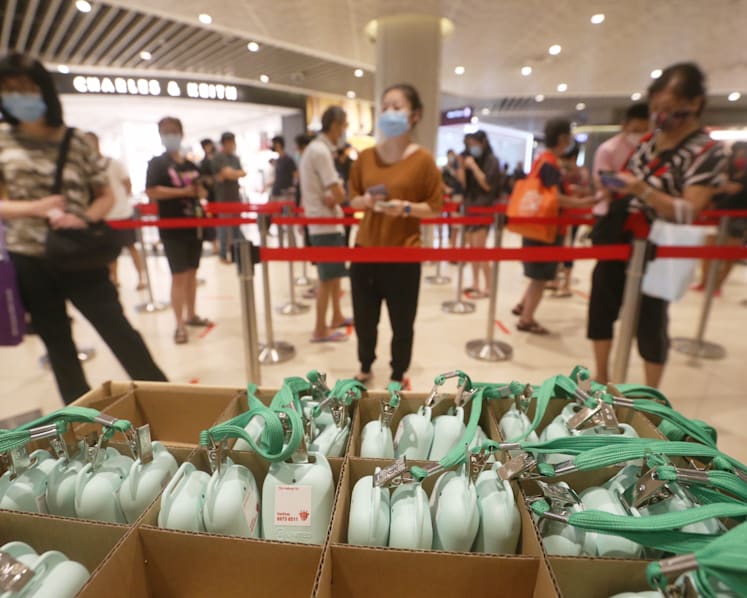
Right now, users of TraceTogether tokens must have the QR (quick response) codes on the back of their devices scanned for SafeEntry check-ins.
I was disappointed to learn that the recently distributed TraceTogether tokens have QR (quick response) codes behind them for SafeEntry check-ins.
This means that anyone who wishes to enter a SafeEntry point will still have to retrieve his or her token for manual scanning.
Doing so limits the potential of the TraceTogether tokens in accelerating the check-in process at SafeEntry points.
Since the TraceTogether token has a range of 10m, public beacons — devices configured for and distributed to establishments and businesses — can be placed at entrance gantries or on floors, walls and ceilings, and used to perform contactless SafeEntry check-ins.





With the tokens and beacons exchanging Bluetooth signals, users can be checked in automatically.
The cost of this would be comparable to the current costs incurred to produce and distribute TraceTogether tokens to the public, since identical tokens may be used as public beacons for a start.
Since SafeEntry data is centralised anyway, the data stored in these public beacons will not compromise data privacy even if they were to be uploaded to a centralised server.
An analogue to this is the DingTalk B1 beacon by Chinese technology firm Alibaba, which also operates on Bluetooth signals and has been employed extensively in China since the early days of the Covid-19 pandemic.
I urge Singapore’s authorities to consider this complete integration of TraceTogether with SafeEntry using public TraceTogether beacons. This will increase convenience for the public, since SafeEntry is here to stay.
Have views on this issue or a news topic you care about? Send your letter to voices [at] mediacorp.com.sg with your full name, address and phone number.




