Mixing babies and business
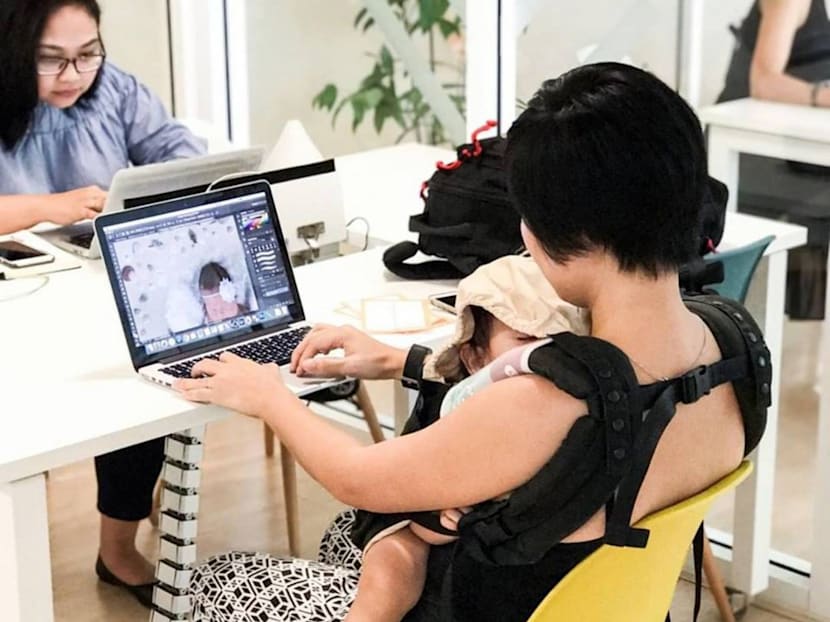
A mother and her baby at Trehaus, a co-working space with a nursery, on Orchard Road, Singapore. Co-working spaces with integrated childcare are rare and typically run as social enterprises or as parent co-operatives. Photo: Trehaus’ facebook page
For many working parents, settling down with your laptop to work while your baby and other small children play a few metres away may seem like a terrible idea. Yet some freelancers, employees and start-up owners are choosing to use a new breed of co-working space — with childcare provided on-site.
These workplace hybrids allow parents to be close enough to breastfeed their children or to read them a story. In terms of childcare, they offer more flexible hours and host fewer children than traditional nurseries.
And they provide a community of like-minded co-workers, a place free from home distractions, while helping to assuage the guilt a new parent can feel when putting their child into daycare.
Mr Luke Ward is a freelance advertising creative director and copywriter with a three-year-old daughter who lives in South Orange, a New Jersey suburb in the United States. He and his wife, Michelle, a self-employed career coach, use Work and Play, a co-working space with a nursery.





There, they pay US$14 (S$19) an hour for childcare — US$4 less than the cost of their previous nanny — plus US$125 a month for 20 hours of office space each week.
The nursery is staffed by childcare professionals, and parents can book fixed hours or drop-in sessions with 24 hours’ notice. Mr Ward’s daughter, Ramona, attends three days a week 9am to 3pm, but he adds extra hours when an assignment comes in. It gives him a place to work away from his home office.
“If Ramona went to daycare and my wife and I both worked out of the house, I think we would probably drive each other a little nuts,” he said.
Mr Mischa Beitz, who runs the Malaysian operations of a Chinese IT company remotely from Singapore, said the physical separation from home is crucial for him to be efficient at work. With two sons aged three and one and his wife, Ms Mengmeng Cui, working full-time, Mr Beitz discovered Trehaus, a co-working space with a nursery, when his elder son Sascha’s nursery relocated.
Impressed by the quality of the childcare and its reasonable price (at three-quarters the cost of traditional daycare), he uses it for childcare for his younger son Ascher five mornings a week, while he works upstairs.
“One of the things that I liked about Trehaus is that you are not pushed away,” said Mr Beitz. “It is up to you how much time you want to spend with your children.”
Now that his son is settled, Mr Beitz is usually left undisturbed, just taking a peek when he makes a cup of coffee.
“You only get to have kids at this age once. I would feel like I was doing my kids and myself a disservice if I didn’t make some sort of effort to spend as much time with them as was reasonable,” he said. Yet co-working spaces with integrated childcare are rare and typically run as social enterprises or as parent co-operatives.
Ms Bethan Francis, a freelance consultant in fundraising for charities, uses a co-working and nursery pop-up called Entreprenursery in West Hampstead in London.
Held one morning a week in the local church, she works in the area upstairs while her 13-month-old son Cooper attends a nursery, staffed by two qualified nannies, downstairs.
Ms Francis had explored the idea of having a nanny come to her flat for a few hours, “but the nanny and the baby and I would all be on top of each other in the same space”, she said. “I couldn’t work with him in the same room. I know he’s there and he knows I’m nearby.”
Ms Francis pays £8 (S$14) for childcare and £5 for the co-working space an hour at Entreprenursery, which compares with £12 an hour for a nanny or £115 for a day in nursery. The obvious downside is the limited hours Entreprenursery offers. Under nursery rules, she also has to stay in the same building as her son.
Mr Sam Aldenton, a new father and co-founder of London-based co-working business Second Home, thinks that the city has not responded to the needs of the demographic who are choosing to work more independently.
Expensive property prices, strict childcare rules for carer to child ratios, and the logistics of offering flexibility make it financially precarious to provide such services. Second Home opens its first space with childcare on site in Hackney in September.
The company is partnering with a London-based childcare provider, who will take charge of the nursery. Meanwhile, Second Home will provide the purpose-built office and nursery space and a guaranteed number of filled places each week.
Mr Aldenton is willing to take the financial risk. “It’s a completely untapped and unmet demand,” he said.
CO-WORKING WITH MY SON
The Third Door in Putney, London, has a dedicated government-approved nursery downstairs and a co-working space upstairs.
I head there for a morning’s work with my three-year-old son Laurence.
We enter the spacious ground-floor nursery and are met by Ms Megan Agwunobi, an enthusiastic level-three qualified childcare professional.
Today there are five staff and 18 children aged between 14 months and four years, some of whom will be there for a full day from 7.30am to 6.30pm.
As a registered nursery, parents are able to leave the building, and Ms Agwunobi tells me most children are booked in for regular sessions, although there will often be drop-in children who are booked 48 hours ahead.
Within a couple of minutes, Laurence is joining in with “head, shoulders, knees and toes” and, 10 minutes later, I am able to leave to work in the soundproofed co-working space upstairs.
I tell the staff to come and find me if Laurence gets upset, though I check on him after an hour and see him happily eating a snack.
After another hour’s work, I go downstairs to join him for lunch and find him chatting to his new four-year-old friend Mika. Of his experience, Laurence said: “It was good but I didn’t want to join in with the Spanish lesson.”
Yes, I think to myself, co-working with childcare does work, though at a cost of £43.50. FINANCIAL TIMES
ABOUT THE AUTHOR:
Emma De Vita is a freelance business journalist with the Financial Times.