

My painful journey from hip hop workouts to (costly) knee surgery
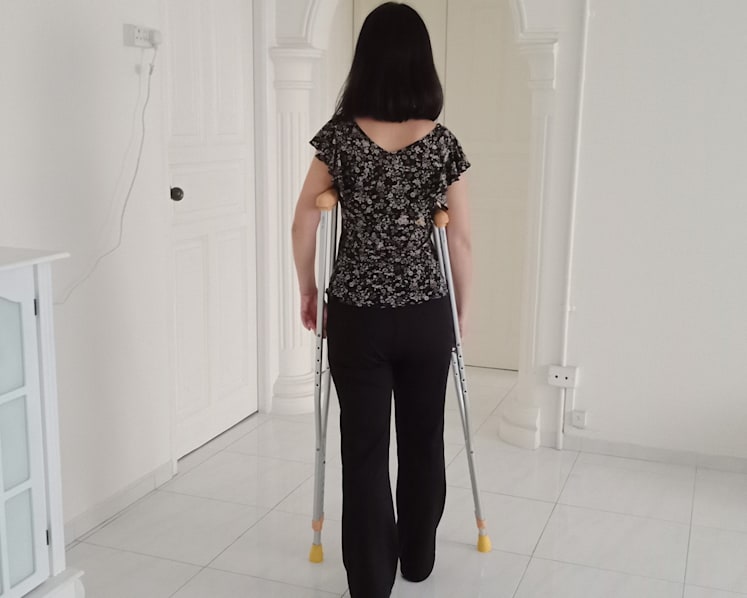
The author had to rely on crutches for a few days after her operation.


Last month, I underwent keyhole surgery on my right knee, after experiencing severe pain as a result of over exercising.
When my friends heard about my operation — my first ever surgery — a common reaction was: “You are not even 50!” In their eyes, knee operations are only for “old people” in their 60s or 70s.
I had thought so too, thinking that in my 40s, I was likely among the youngest knee-surgery patient — until the big day. At the waiting area before I was wheeled into the operation theatre, I noticed that the majority of the patients were in their 20s, 30s or 40s.
What’s wrong with their knees?





Based on anecdotal evidence and from chatting with my fellow patients at the hospital, I have come to two conclusions: First, knee surgery is age-blind — it’s not exclusive to “senior citizens”. Second, too much exercise can be bad for your body.
HOW IT ALL STARTED
I started doing fitness dances, such as zumba and kpopx, more than five years ago. In 2018, I expanded the range of workouts to include kickboxing, piloxing, salsation, masala bhangra, hip hop and bokwa.
I got so addicted to them I was working out six times a week, for an hour each day. It felt exhilarating to be sweating, jumping, swaying, kicking and punching to the danceable beat of songs from all over the world.
It wasn’t long before my right inner ankle, knee and sometimes toes started aching.
I am not sure why. Perhaps I could be using the wrong techniques? Or maybe I did not warm up or cool down enough?
I tried taking painkillers, rubbing ointment and cream, pasting pain-relief plasters, going for massages and wearing a knee guard. Sometimes one or a combination of these remedies provided some relief.
But by August 2019, the pain had become so intense, some days I could hardly walk.
A magnetic resonance imaging report showed I had suffered a meniscal or chondral injury, with tears, bleeding and thinning of the cartilage in my right knee.
I was given two options — lifestyle change or knee surgery. Lifestyle change includes less walking (how is that possible?) and exploring other forms of exercises.
I opted for surgery because of the pain I was in, even though it would cost me about S$23,000 as a private patient in a public hospital.
But as the days passed, I started having doubts. I was afraid of being immobile for who knows how long. Friends suggested that I seek a second opinion or alternative medicine such as traditional Chinese medicine.
Some suggested that I go for physiotherapy to alleviate the pain. But this was quickly ruled out by my doctor / surgeon, who said my condition was too serious to be suitable for physiotherapy.
He assured me that my operation had a high chance of success and I should be able to resume sports soon.
My operation lasted about three hours. With me under general anaesthesia, my surgeon harvested blood, purified it and pumped it into both my knees.
He also patched up the cartilage tear and injected some collagen in my right knee, and did a minor procedure to strengthen my left knee, which had come under some strain due to the pain on my right.
I stayed one night in hospital for observation, and was wheeled to a physiotherapy room the next morning.
There, I recognised a fit-looking woman in her 20s, who had her surgery just before me. She told the therapist that she had injured herself because she was heavily into body combat.
I was able to walk slowly with crutches or walking stick the second morning after the surgery. Within a few days, I could stop using the walking stick.
I guess I was more fortunate than those patients who were dependent on crutches for a few months after their surgeries.
During my hospitalisation leave, I found out that many of my friends who are around my age or younger had or are experiencing knee woes.
Some, like me, injured themselves due to an active lifestyle, while others were suffering relapses of old sports injury from years back.
Those who had opted for knee surgery had mixed views on their experience.
Some recovered well and resumed their active sporting lifestyle, though they did caution that the recovery process could take a long time.
One man — who started experiencing knee pain in his mid-30s due to his “overly active lifestyle” — took 18 months before he could resume his sporting activities.
There were also less successful stories. A friend’s colleague had to undergo three operations on the same knee due to problems such as infected tissues.
Such scary tales had deterred my other friends from going under the knife. Instead, they try to cut back on exercise and change their diet so that they could lose weight and reduce the pressure on their knees.
So, is surgery the best option when you have a major problem with your knees at a relatively young age?
Much would depend on the type of injury, your age and lifestyle.
It’s been a month since my surgery. My story hasn't ended because I'm still recuperating. I am certainly happy that I am able to walk, albeit slower than before as I am still feeling tightness and some pain around the operated area.
The surgeon, physiotherapist and those who had successful surgeries assured me that I could return to high impact exercises within six months.
Meanwhile, I need to do knee, calf, thighs, and hip strengthening exercises religiously to aid my recovery.
Because I’ve cut down my high impact exercises to zero, I also try to eat moderately (which is difficult during these two months of festivities) so that I don’t pile on the kilograms and put more pressure on my knees.
I will probably have a better idea if I’ve indeed made the right decision to go for surgery in either a few weeks’ time.
If nothing else, I hope it was a S$23,000 well spent.
ABOUT THE AUTHOR:
Valerie Ng works in corporate communications. She was previously a journalist and educator.




