

The new face of masculinity in East Asian pop culture
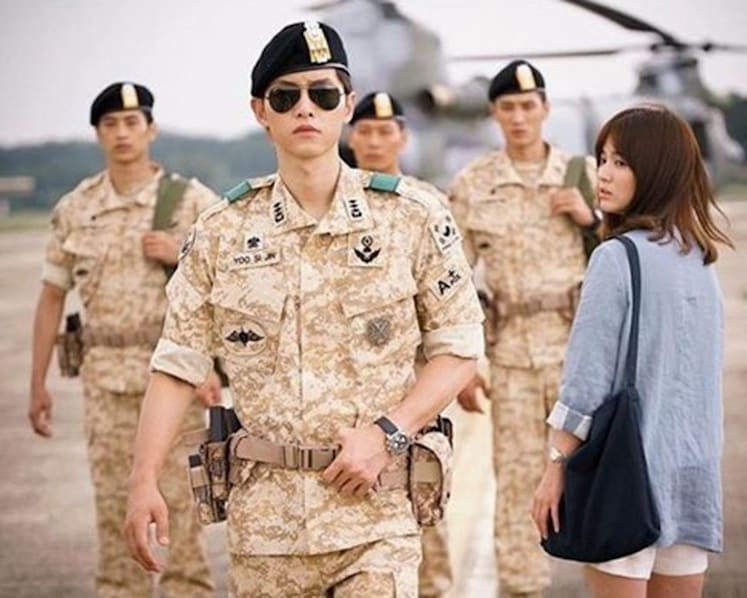
The cult of male beauty associated with Descendants of the Sun is reminiscent of a recent trend that has been termed “Pan-East Asian soft masculinity”. Photo: Production still
Descendants of the Sun, a South Korean TV drama featuring a romance between a soldier and a surgeon in a fictional war-torn nation, has reignited K-drama fever across Asia. In China alone, where the programme is simultaneously broadcast online, it has drawn more than 2.4 billion views on video-streaming website iQIYI since it began airing in late February.
Its fandom is mostly composed of young women who are fixated with the handsome male protagonist, played by Song Joong-ki. It is reported that a jealous husband in China one night drunkenly stormed into a photography studio and demanded that the shop owner take pictures to “make him look like Song”.
The cult of male beauty associated with Descendants of the Sun is reminiscent of a recent trend that has been termed “Pan-East Asian soft masculinity”. These types of images are mainly produced and circulated by the “Korean Wave” and Japanese anime, comics and games culture. It is well-received by youth across most of East Asia, and presents a significant response to the globally hegemonic masculine ideal based on the image of the transnational businessman.
Some claim that the success of South Korean and Japanese pop culture lies in attempts to make it “mugukjeok” (culturally odourless) by downplaying their national specificity. But for many others its popularity can be largely explained by its representations of Pan-East Asian soft masculinity.





Pan-East Asian soft masculinity has its roots in the Confucian tradition of scholar masculinity shared by many East Asian cultures, such as the “wen” (literary attainment) masculinity in China or “seonbi” (scholar-officials) masculinity in Korean history. The talented scholar is physically weak, delicate and handsome, with androgynous beauty. He is desirable to women by dint of his knowledge and literary gifts.
At the same time, the current popularity of these images of masculine beauty also reflects the influence of the metrosexual trend from the West. This indicates that masculinity has become increasingly pluralistic and hybridised in a rapidly globalising East Asia.
One conspicuous example of the transnational flow of male images in East Asia is the spread of the “otaku” (people obsessed with popular culture) phenomenon. With the international spread of anime and manga, the term otaku has entered other cultures and generated new expressions. In Chinese, the vogue word “zhainan” (the Chinese pronunciation of the Japanese kanji for otaku) refers to a socially awkward young man who secludes himself in his home all day, indulging in computer games, anime and geek culture.
Despite the Japanese term’s association with antisocial behaviour, more and more young men in Chinese cities identify themselves as zhainan, and the term has come to indicate a desirable form of masculinity.
There are web essays on how to woo a zhainan, and love stories featuring high school students and their zhainan teachers. The “zhai lifestyle” has even become a trend among urban youth. The popularity of zhainan in China may be explained by the discourse in premodern Chinese literature on the “purity” of men who have obsessions.
Compared with zhainan, the word “meng” bears an even more direct link with Japanese pop culture, being the Chinese pronunciation of the Japanese character “moe”. Moe, which originally meant “budding” or “burning”, now refers to a particular kind of “adorable” or “cute” pre-adolescent girl in anime, comics and games culture. Like otaku, the word has undergone transformations in meaning and usage during its migration to China.
In the Chinese context, meng, which can be used as a noun, adjective or even a verb, has become a trendy word among young people, particularly in cyberspace. It can be used to describe a wide of range of things: From children’s expressions to President Xi Jinping’s new hairstyle. Notably, it is increasingly used to describe loveliness in men. When a man is referred to as meng, there is a (positive) implication of femininity. The popularity of zhainan and meng in China, on the whole, represents a growing cultural convergence among East Asian countries.
The “softness” of Pan-East Asian soft masculinity also lies in its more sensitive and caring attitude towards women. The “Herbivore Man” (soshoku danshi) in Japan and South Korea, and “Warm Man” (nuan nan) in China are all in line with this type of sensitive new guy.
The term Herbivore Man and its counterpart, “Carnivorous Woman”, were first coined by Japanese author Maki Fukasawa, and became known through Megumi Ushikubo’s popular book The Herbivorous Ladylike Men: A Change in Japan. This new type of man is arguably a rebellion against the ideal salaryman masculinity of post-war Japan. They are less ambitious and are harmless to women because they always display an understanding of women and their feelings.
The 2013 Chinese hit film, Finding Mr Right, centres on the idealised Warm Man. The male protagonist, played by Wu Xiubo, used to be a renowned doctor in Beijing, but gives up his career in order to look after his teenage daughter in the United States. In China, he also epitomises the ideal sensitive man who harbours warm emotions for women.
“Tough” masculine images are coterminous with “soft” ones in East Asian popular culture. One example of the former is heroic men in China’s anti-Japanese TV dramas, a popular subgenre of TV programmes in China. This government-sponsored and market-oriented consumerist nationalism represents a happy marriage between the state’s agenda and popular social desires in Chinese television.
In these dramas, patriotic Chinese masculinity is portrayed against its other — the “Japanese devils”. The characterisation of Japanese officers and soldiers reflects stereotypes that are deeply rooted in the collective memory and imagination of generations of Chinese, gained from popular media if not from actual experience. For instance, the cold-blooded Japanese commander predictably commits hara-kiri when ultimately faced with defeat. The Japanese officer regularly slaps his subordinates in fits of anger, with “baka” (Japanese for fool or idiot) always on his lips. He also regularly mistreats women, while his submissive wife bows deeply to welcome him home every evening.
It is against these images of Japanese men that an idealised Chinese manhood is portrayed and eulogised. EAST ASIA FORUM
ABOUT THE AUTHOR:
Geng Song is associate professor at the University of Hong Kong’s School of Chinese.




