

North Korean charm sure beats the alternative
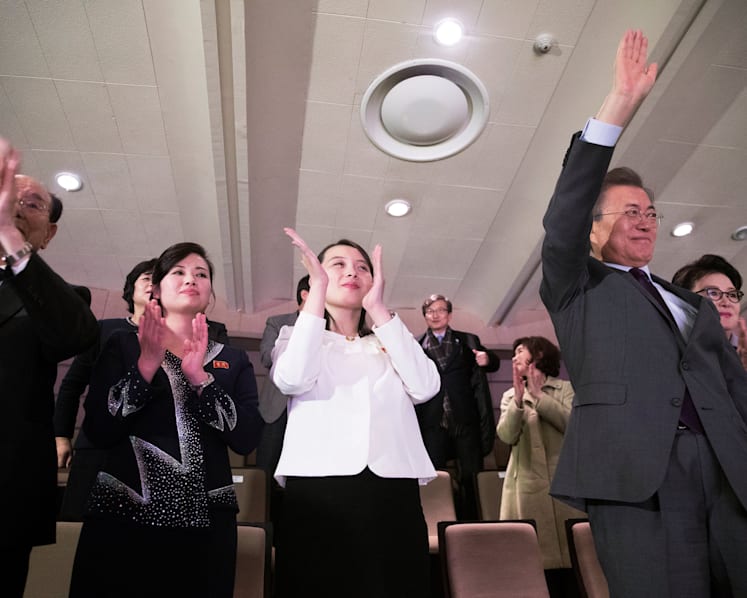
South Korean President Moon Jae-in and Kim Yo Jong, the sister of North Korea's leader Kim Jong Un, applaud after watching North Korea's Samjiyon Orchestra's performance in Seoul on Feb 11. The author says that even if helping North Korea open up little by little doesn’t eventually topple the Kims, it is still better than today’s explosive atmosphere of mutual fear. Photo: Yonhap via Reuters
The South Korean use of the Pyeongchang Olympics to improve relations with the North has left the United States media torn between a natural curiosity about the first North Koreans they have seen up close and a compunction against “normalising” the Kim regime.
US audiences are treated, on the one hand, to takes marvelling at the exotic cheering squad and the no-frills personal style of Kim Yo Jong, and on the other hand, to strong expressions of disgust at the “fawning” represented by those takes.
Some cheered the starry-eyed optimism of Angela Ruggiero, the former US hockey player and member of the International Olympic Committee, who has suggested the joint Korean hockey team for the Nobel Peace Prize; others found the idea offensive.
Both the curiosity and the tendency to hew to the US government’s foreign policy line are instinctive and sincere, and they clash in any country that enjoys media freedom. But commentators, politicians and the broader public must avoid the false dichotomy. Such contacts are perhaps the only way to lure North Korea onto a path that leads to the regime’s defanging, if not yet its fall.





Here’s an anecdote to explain why what looks to some like craven hypocrisy can be smart diplomacy.
In 1967, a Korean intelligence service snatched renowned composer Isang Yun from West Berlin, where he was living at the time. In his home country, he was tortured, forced to confess to espionage and sentenced to life imprisonment.
Only the intervention of colleagues -- such as Igor Stravinsky, Karlheinz Stockhausen and Gyorgy Ligeti, all admirers of Yun’s work -- lead to his release in 1969. So which Korea did this?
The answer will surprise many of those who are used to seeing South Korea as a democracy. It wasn’t so long ago that the country, run by a regime that could sometimes match the Kims’ brutality, did things like the Yun kidnapping.
Through it all, it was a staunch US ally. Was hypocrisy required to keep the alliance going? Definitely. Did the alliance help South Korea to democratise eventually? The answer is also yes.
South Korean President Moon Jae-in’s “normalisation” steps mean he’s not ignoring that lesson. He and North Korean dictator Kim Jong Un agreed that the two Koreas’ teams would walk as one at the opening ceremony and that a joint women’s hockey team would be fielded.
US Vice President Mike Pence managed to ignore Mr Kim’s sister, Kim Yo Jong, while seated next to her in the stands; but Mr Moon shook her hand. He was duly invited to Pyongyang to meet with Mr Kim, something he has wanted to do for years and which is now possibly only thanks to the Olympic truce. But the fact that he couldn’t accept immediately reflects the raging debate -- whether to engage or shun -- being played out in Washington and in US media circles.
There’s a good reason why the curiosity side of the debate should prevail. US foreign policy experts worry that the Kim regime is getting recognition and legitimacy without giving up anything, especially its nuclear weapons, which it proudly displayed at a big military parade before the games.
Instead, it should be hopeful that the Kim’s regime feels good about the recognition and gets hungry for more of it: That would be a step down a slippery slope.
Most totalitarian and authoritarian regimes in history have fallen due to the dictators’ own mistakes. Daniel Treisman, a UCLA political scientist, has catalogued the most frequent ones: Hubris (think Nicolae Ceausescu in Romania, calmly making a speech as a riot that will topple him begins), failing to manipulate vote results enough to hold on to power (think the 1988 referendum that led to the end of Augusto Pinochet’s rule in Chile), trusting a traitor to be a successor (think Francisco Franco in Spain grooming future King Juan Carlos for power), counterproductive violence (think Viktor Yanukovych in Ukraine in 2014).
The Kims have studiously avoided all of these mistakes with a family-line succession and extreme repression that works well enough for dissent to be way too risky.
There is still a mistake on the Treisman list, though, that Mr Kim can make. It’s the one that brought down Mikhail Gorchachev: Starting a liberalisation trend that creates an appetite for regime change.
Mr Kim Jong Un can step into this trap because, apart from Mr Gobachev’s scary example, there are also the Chinese and Vietnamese stories of economic liberalisation that allowed the Communist parties to stay on top.
Mr Kim has already taken some stumbling steps down the liberalisation path. They have been well-documented in a series of columns titled “North Korea: Witness to Transformation” on the website of the Peterson Institute for International Economics.
The series has been discontinued, but some of the recent entries give an idea of what’s been going on lately just as the rhetoric between North Korea and the US got all fiery and furious.
Mr Kim’s new year’s address, while betraying no sign of self-doubt, hinted at a creeping “marketisation” of North Korea’s all-powerful state sector. There’s a thriving shadow economy in the country that should propel the halting official effort to introduce economic incentives forward, as it did in the Soviet Union and its European and Asian satellites.
The US and its allies can do little to stimulate these processes inside North Korea. But it can look naively welcoming to North Korea’s efforts to project soft power, get the regime to send more people to the outside world, intensify contacts in whatever form they’re possible.
Some of the North Koreans who participate in the exchanges will just do their job for the regime; others will start having vague doubts. I saw it happen in the Soviet Union, which was, admittedly, a much softer regime than the North Korean one -- but which also sought to isolate its citizens from corrosive Western influences.
Welcoming the cheerleaders with smiles and applauding Kim Yo Jong’s fashion sense should get her brother thinking about the benefits of international charm offensives, which in fact do regimes like his more harm than good because they break down the isolation on a basic human level.
Even if helping North Korea open up little by little doesn’t eventually topple the Kims, a China or Vietnam scenario is still better than today’s explosive atmosphere of mutual fear.
The South Korean leadership appears to realise this -- unlike, it seems, the Trump administration, which sulks because it’s being denied a leadership moment but is forced to go along because no other strategy is feasible. BLOOMBERG
ABOUT THE AUTHOR:
Leonid Bershidsky is a Bloomberg View columnist. He was the founding editor of the Russian business daily Vedomosti and founded the opinion website Slon.ru.




