North Korea’s pachinko missiles
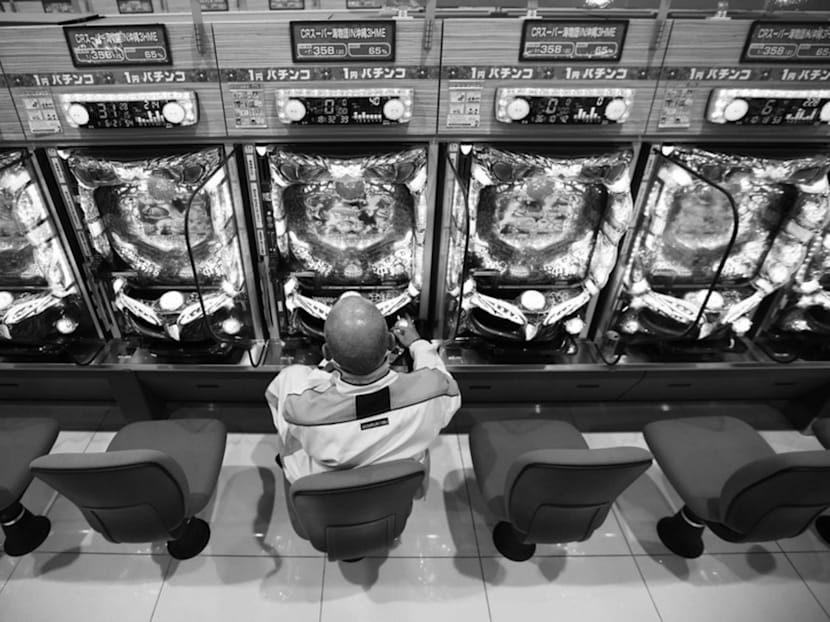
Profits from Japan’s pachinko halls, some of which are owned by Koreans with ties to the North, are believed to have funded Pyongyang’s missile and nuclear programme. Photo: Reuters
Three scenes are often the subject of photographs taken by foreign tourists visiting Japan: One is a forest of utility poles; another is cars riding a gondola in mechanical parking areas. The third is pachinko.
Pachinko is a kind of pinball game with betting, and the people lined up facing the vertically arranged machines look like they are working in a factory. According to one report (in Japanese), there are 11.5 million pachinko enthusiasts, and the market is valued at ¥24.5 trillion (S$299.3 billion), almost double the automaker Toyota’s sales last year.
For foreigners, pachinko is a gaudy scene — the players, including professionals who make a living from it, seem glued to their spots — and thus it is an understandably irresistible photo opportunity. But, for Japan, there is a darker side to the fun and games.
Many of the owners of Japan’s 11,000 pachinko halls are from the Korean peninsula, and some with relations to North Korea have sent substantial sums of money back home for many years. Such “contributors” to the well-being of the North Korean economy are recognised by the regime in Pyongyang according to the extent of their support, and are given awards and sometimes publicly recognised as patriots. And on national days, such as the birthday of North Korea’s founder Kim Il-sung, these expats are almost forced to contribute. Indeed, they can be assigned to raise sums big enough to cover the cost of food distributed to North Koreans on such occasions.





Many of these donations are made not out of love for the Kim dynasty, but to buy the safety of family members back home. The threat is very real. Koreans living in Japan know how ruthless the North can be towards its own citizens; after all, North Korea has even abducted Japanese citizens, many of whom have never returned.
Cartons of cash were even reported to have been loaded onto the Mangyongbong-92, a passenger ship connecting Wonsan in North Korea with Niigata on the Sea of Japan. The Mangyongbong-92 has also served as a means of smuggling goods and people — high-tech equipment such as computer parts and missile components, along with North Korean spies.
PACHINKO PROFITS
Indeed, it is increasingly believed that the transfers of “pachinko profits” are being used to fund the North’s development of missiles and nuclear weapons. After North Korea’s underground nuclear test on Oct 9, 2006, one of the sanctions imposed on the country prohibited all North Korean ships, including the Mangyongbong-92, from entering port in Japan. But the measure was too little, too late. A wide-ranging system of transfers now ensures that these funds find their way to the North. When some routes are closed off, new ones open up.
Meanwhile, because of the funding and high-tech components produced by pachinko money from Japan, North Korea’s weapons programmes have become increasingly sophisticated.
The North first fired a Nodong medium-range ballistic missile into the middle of the Sea of Japan in May 1993. That missile, believed to have a range of 1,300km, could hit almost all the Japanese islands. Five years later, in August 1998, the North fired a Taepodong-1 medium-range ballistic missile, with a range of 1,500km, over Japan and into the Pacific, claiming that it was testing the missile’s ability to launch the Kwangmyongsong-1 satellite into orbit.
Then, in July 2006, North Korea launched seven ballistic missiles, including the Taepodong-2 intercontinental ballistic missile. The range of the Taepodong-2 is believed to be approximately 6,000km, and an improved version’s range may be more than 10,000km, indicating a steady improvement in performance. North Korea also launched short-range ballistic missiles in April and July 2009.
Even after the death of North Korean leader Kim Jong-il in December 2011, his successor as First Secretary and ruler of the dynasty, Mr Kim Jong-un, continued his father’s programme of missile development. Indeed, he appears to have accelerated it. Several missiles launched on Mr Kim Jong-un’s watch use mobile transporter erector launchers. And in January this year, the North announced it had detonated a hydrogen bomb, though many international experts doubt this.
North Korea, it should be noted, provided prior notice to China of its missile tests, but not of the supposed hydrogen-bomb test, despite China’s ongoing efforts to protect Mr Kim Jong-un’s regime from even harsher international sanctions.
But the North has become so brazen that South Korean President Park Geun-hye, who, despite her conservative credentials has been deepening ties with China, decided that enough was enough. She ordered the closure of the Kaesong Industrial Region, a cross-border investment zone that was bringing modern production to the North and served as a point of contact with the regime.
Ms Park has gone even further, ramping up South Korean sanctions against the North. And now the US and China have joined her in tightening the sanctions noose, particularly with a new prohibition on the export of fuel, including jet fuel.
Although doubts abound about the success of North Korea’s bomb tests, the steadily improving performance of the regime’s missiles is undeniable. The 33-year-old “Young Marshal” is playing with fire. So it is time for Japan, and others, to deny him the funds with which he buys the matches.
ABOUT THE AUTHOR:
Yuriko Koike, Japan’s former Defence Minister and National Security Adviser, was chairwoman of Japan’s Liberal Democratic Party’s General Council and currently is a member of the National Diet.