Politician’s ouster hurts Myanmar’s democratic reform
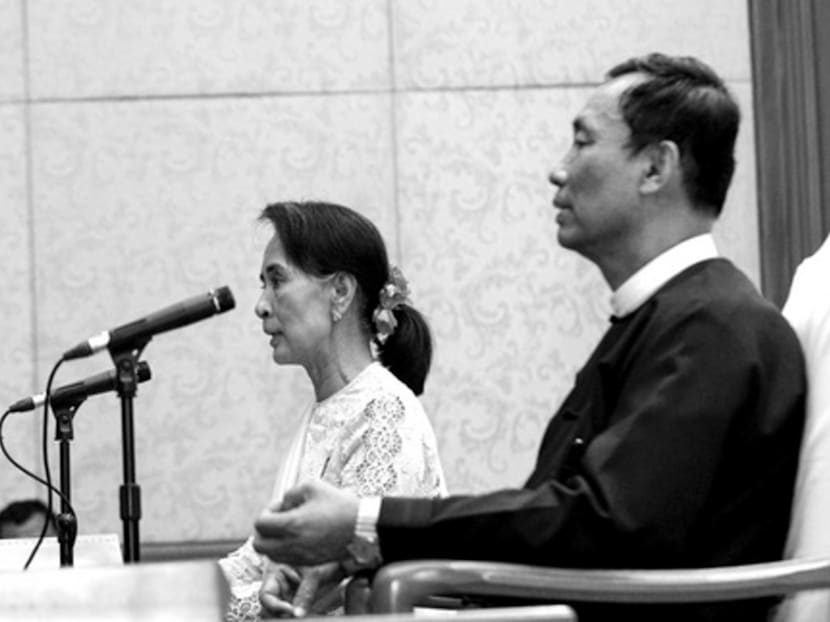
Opposition leader Aung San Suu Kyi talking to the media with Mr Shwe Mann beside her during a news conference in Naypyidaw last year. One cannot help but wonder whether Mr Shwe Mann is a ‘closet liberal’ or an opportunist who bet on the wrong horse by fraternising with Ms Suu Kyi.
Photo: Reuters
The sudden removal of one of Myanmar’s most powerful men sent shockwaves through the diplomatic community in the old capital of Yangon, where foreign embassies are still located.
It seemed more like a midnight coup than an ordinary leadership reshuffle — security forces in the new capital Naypyidaw entered the headquarters of the de facto ruling party, the Union Solidarity and Development Party (USDP), late on Aug 12. The following day, it was announced that Mr Shwe Mann, speaker of the Lower House of Myanmar’s bicameral parliament, a former general and anticipated by some foreign observers to be the country’s next President, had been ousted.
Despite the drama, his removal reconfirmed the widely held belief that the nation’s military is not about to relinquish real power. The power shift in Naypyidaw is also unlikely to change the big powers’ attitudes towards the military in Myanmar.
Parliamentary elections are scheduled for Nov 8. Early next year, an electoral college consisting of elected parliamentarians along with army officers will select the head of state of the country. After decades under solid military rule, Myanmar is supposedly edging towards a more democratic order.





For many Western pundits, Mr Shwe Mann was the favourite for the post, regarded as a “bridge” between the junta, which had ruled the country until elections were held in November 2010, and the quasi-civilian government that took over in March 2011 as well as democratic forces headed by opposition leader and Nobel Peace Prize laureate Aung San Suu Kyi.
Before becoming parliamentary speaker, Mr Shwe Mann was considered the third-most-powerful man in the then ruling junta. As a nominally civilian parliamentarian, he was often seen with Ms Suu Kyi and began speaking in favour of reforms aimed at limiting the power of the military.
Myanmar’s constitution was drafted under military supervision and adopted in 2008 after a referendum dismissed by most observers as fraudulent. Under the constitution, the military holds 25 per cent of all seats in the parliament and regional assemblies. Since major changes in the constitution’s clauses require 75 per cent approval, the army enjoys what amounts to veto power over any major changes in the nation’s power structure.
COSMETIC REFORMS TO IMPROVE TIES WITH WEST
Precisely what had made Mr Shwe Mann popular among foreign diplomats, academics and think-tanks became, in effect, the cause of his fall.
A number of political reforms and seemingly liberal initiatives were introduced after the new government took over in 2011, such as the release of political prisoners, more press freedom and the right of political parties to operate openly.
Such steps were not taken because the military had little intention of giving up power. The strategy was to remain in power and, at the same time, improve Myanmar’s image and strained relations with the West, which had imposed sanctions on the junta for its abysmal human-rights record.
During that time, Myanmar had become heavily dependent on China. Internal military documents dated as far back as 2004 suggested that the country was losing its independence to its powerful northern neighbour.
The solution was simple: Make some reforms — and the West would reciprocate by welcoming Myanmar back to the international community.
The United States, in particular, viewed the spread of Chinese influence in Myanmar with increasing concern. The reforms provided an opportunity for Washington to normalise relations with Naypyidaw.
At the end of November 2011, then Secretary of State Hillary Clinton travelled to the nation — the first top-level US visit in half a century. A year later, President Barack Obama made a trip to Myanmar. In May 2013, Mr Thein Sein became the first Myanmar President to visit America since 1966. Relations were on track as Myanmar distanced itself from China. The US was no doubt pleased.
Before long, it became increasingly clear that Myanmar was not undergoing an organic democratic transition from military dictatorship to elected civilian rule.
Newspapers and magazines were not closed, but critical journalists and editors were charged with libel, defamation and even trespassing. Student activists and people protesting against land seizures were thrown into jail. Some parliamentarians sought to change the constitution, but the military intervened to prevent that from happening.
Just before his second visit to Myanmar in November last year, Mr Obama said Myanmar’s transition from military rule had not been as fast as hoped and that the government was “backsliding” on some reforms. Observers began to question whether Myanmar was really “backsliding”, or if the initiatives towards more openness had been limited from the start.
POLITICAL STAR’S DOWNFALL
Mr Shwe Mann, evidently, stepped out of line by trying to go further. Long-time Myanmar observers see striking similarities between his ouster and a 2004 purge that saw the fall from grace of then Prime Minister and once powerful former intelligence chief Khin Nyunt. He was also a maverick.
Like Mr Shwe Mann, he had amassed enormous political and economic power for himself and his family. Mr Shwe Mann’s two sons, Mr Aung Thet Mann and Mr Toe Naing Mann, are prominent businessmen involved in numerous deals that certainly will come under scrutiny.
And one cannot help but wonder whether Mr Shwe Mann is really a “closet liberal” or an opportunist who, in the end, bet on the wrong horse by fraternising with Ms Suu Kyi.
In the late 1980s, he saw combat against Karen rebels along Myanmar’s eastern border, earning the honorific title thura, or brave hero. A cable from the US Embassy in Yangon dated March 15, 2007, made public by WikiLeaks, stated that he had utilised civilian porters, including women and children, on a massive scale during operations against Karen insurgents. The cable’s headline read Shwe Mann: Burma’s Dictator in Waiting, and outlined his military career.
He was also allegedly involved in the crushing of the 2007 so-called Saffron Revolution, a democracy movement led by Buddhist monks. In November 2008, Mr Shwe Mann led a secret military delegation to North Korea, where he signed a memorandum of understanding on military cooperation. He visited an air base, a missile factory and other defence industries near Pyongyang.
During his time in the army, Mr Shwe Mann was a loyal officer, showing no sign of dissent. Ironically, he led the purge against Mr Khin Nyunt and his henchmen in 2004. Now, Mr Shwe Mann’s followers in the USDP and elsewhere may face the same fate as the former intelligence chief’s.
Apart from being parliamentary speaker, Mr Shwe Mann also led the USDP, a post now held by Mr Htay Oo, a former major-general close to Mr Thein Sein who, in turn, has the military’s backing. The party’s general secretary Maung Maung Thein and other Shwe Mann loyalists have also been removed. A “rejuvenated” USDP is poised to contest the November election.
These internal purges are unlikely to have much impact on Myanmar’s foreign relations. The US may grumble, but no one there wants to push Myanmar back into China’s embrace and Beijing is pragmatic enough to adjust to the new realities so as not to jeopardise its fragile ties with Naypyidaw.
Of special importance are gas and oil pipelines that China has built from the Bay of Bengal through Myanmar to the southern Chinese province of Yunnan. In July, Naypyidaw ratified the agreement to set up the China-led Asia Infrastructure and Investment Bank, a relationship that Beijing will not upset by interfering with an internal power struggle in Myanmar.
If anyone had doubts, it is clear that the military still calls the shots in Myanmar. YALEGLOBAL
ABOUT THE AUTHOR:
Bertil Lintner is a former correspondent with the Far Eastern Economic Review and author of several books on Burma/Myanmar. He is currently a writer with Asia Pacific Media Services.