Prudent for Singapore not to adopt new US hypertension guidelines for now
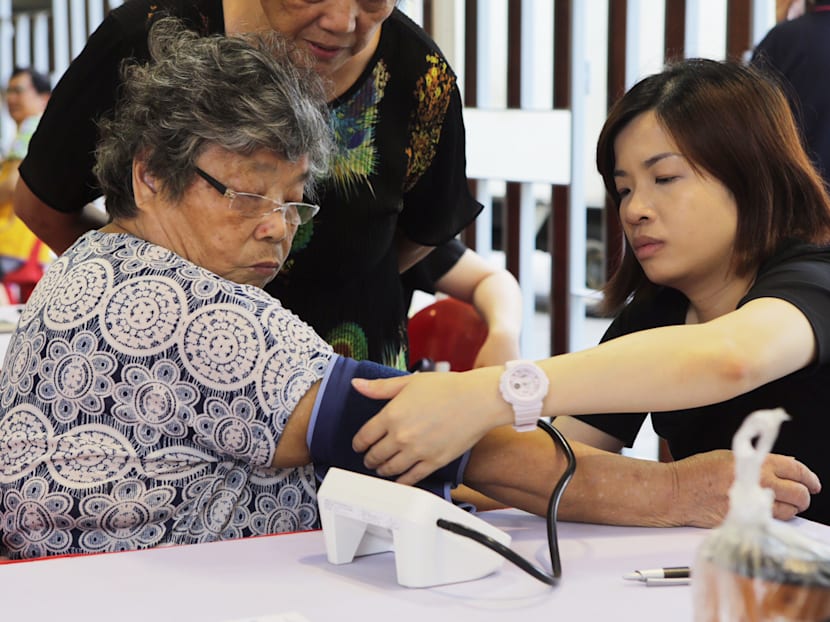
A resident gets her blood pressure checked at Hong Kah Community Centre in August 2017. Greater clarity is needed about the value of shifting blood pressure thresholds downwards as the diagnostic criteria for hypertension, says the author. TODAY file photo
The American Heart Association (AHA) released its new hypertension guidelines on Nov 13, lowering the definition of high blood pressure from 140/90 mm Hg to 130/80mm Hg.
The new guidelines not only made global headlines, but also sparked debates in the healthcare community as to whether other countries should also follow suit and adopt the stricter criteria.
Here in Singapore, the Ministry of Health (MOH) responded by maintaining its definition of hypertension as a blood pressure (BP) reading greater than 140/90mm Hg.
MOH elaborated that the current 140/90mm Hg reading still reflects the general consensus globally supported by guidelines from respected societies, including the British Hypertension Society, the International Society of Hypertension and the European Society of Cardiology.





In this instance, MOH is right in not rushing to make changes, as the US’ new definition of hypertension was developed in the context of its population and the new guidelines do not change the approach to managing hypertension in a major way.
While MOH may continue to review the evidence backing the new guidelines and the ways in which they might apply to the Singapore population, it is essential to have more local evidence first before considering whether or not to adopt the new guidelines wholesale.
The rationale for the change in AHA guidelines was primarily based on a systematic analysis of several clinical trials to lower BP, including the large SPRINT study in 2015.
The findings from these trials demonstrated that having BP targets of 120 systolic instead of 140 helped in preventing heart attacks, strokes and death. Lifestyle modification was an integral component of BP lowering strategy in all these trials. There has long been uniform consensus that lifestyle modification, including a diet rich in fruit and vegetables and low in sodium and saturated fats; weight management and increased physical activity; as well as a moderate alcohol intake and quitting smoking, is essential for all individuals with high BP to help them guard against adverse cardiovascular events.
However, greater clarity is needed about the value of shifting BP thresholds downwards as the diagnostic criteria for hypertension.
To begin with, the scientific evidence to support the lowering of the hypertension threshold to 130/80mm Hg is not clear-cut. For example, putting an individual on anti-hypertensive medication the moment his systolic BP is 130mm Hg did not improve his health in any significant way, even if that individual had pre-existing heart disease.
Some argue that lowering the BP threshold would tend to increase everyone’s awareness of, and alertness to, the condition, and therefore encourage individuals to adhere better to lifestyle modification advice and follow-up health checks. However, a healthy lifestyle is a mandatory recommendation for all individuals in any case, so the negative societal implications of labelling individuals with diseases or conditions need to be re-evaluated in a broader socio-cultural context.
Furthermore, more side effects are expected with the lower BP targets recommended by the AHA now. In trials of intensive BP control such as SPRINT, those taking part in these trials experienced greater dizziness and more falls, biochemical abnormalities in the blood and acute kidney failure in the strict BP target group (less then systolic 120) compared to the group under the conventional BP target (less than systolic 140).
Thus, when lowering the BP threshold with medications, more education of patients on the prevention of side effects is required.
It is also important to take into account how blood pressure measurements in the real world clinical practice are generally not standardised as they are in a clinical trial setting.
The quiet and restful environment created before measuring BP in a clinical trial tends to lower systolic BP by up to 10mm Hg.
However, similar settings are challenging to replicate in busy clinics, and therefore routine BP readings in doctor’s office may be about 10mm Hg higher than corresponding standardised measurements in a trial. Thus, aiming for the same BP target as in the trial runs the risk of even more aggressive BP reduction, and consequently more side effects.
The new AHA guidelines do make some adjustment for this in the BP treatment goal recommendation. However, the diagnostic threshold of 130 does not seem to account for expected BP variability in clinical practice.
There is thus a need to do a real-world effectiveness study of implementing the new AHA guidelines, to provide a better picture regarding the feasibility, general applicability, and profile of side effects across a spectrum of primary care environments.
While there is merit in promoting the adoption of the AHA’s new guidelines, as well as the health systems in which intensive BP-lowering trials were conducted, more information on the effectiveness and safety implications of these fresh approaches is needed before populations and health systems outside the US embrace them.
According to the National Health Survey Singapore (NHSS)’s 2010 poll of a total of 4,337 Singapore residents, one in four adults here (aged 25 years or older), and one in two elderly (aged 60 and older) suffers from hypertension.
About 30 per cent of Singaporeans surveyed by NHSS did not go for their recommended BP screening in the most recent year, and 50 per cent of all individuals with hypertension had uncontrolled BP using the conventional target definition of 140/90 or higher.
The situation is much worse in low- and middle-income countries in Asia, where 50 per cent do not get BP screened, and more than 70 percent of all individuals with hypertension have uncontrolled BP (140/90 or higher).
Thus, efforts are needed to enhance the effectiveness and outreach of hypertension care services, and improve BP screening and control rates.
Ongoing studies, such as the SingHypertension trial in polyclinics funded by the Singapore National Medical Research Council, of approaches to lowering BP based on cardiovascular risk stratification will offer further insights into optimal treatment strategies for Singaporean adults with hypertension.
Finally, it is important to underscore that guidelines such as the AHA’s are just one of the options for guidance regarding diagnosis and management of hypertension.
In the end, the onus is on individuals to take action and get their BP monitored and under control by adhering to a treatment plan with lifestyle changes to improve their health, and prescribed medication to give them the best chances of warding off heart attacks and other cardiovascular crises.
ABOUT THE AUTHOR:
Dr Tazeen H Jafar is Professor of Health Services and Systems Research at Duke-NUS Medical School.