Reliefs aside, need for growth transformation remains
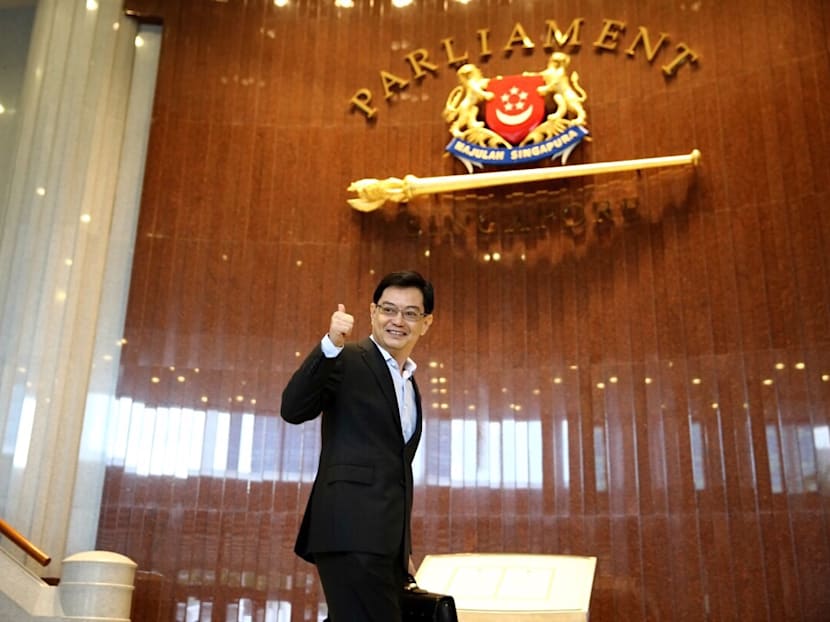
Arrival of Minister for Finance Heng Swee Keat at Parliament House for Budget Day 2017. Photo: Nuria Ling/TODAY
Businesses who were hoping for bold recommendations and extensive reliefs in Budget 2017 to help them alleviate business costs and ride out the current weak economic outlook may be a little disappointed. Many of the measures were targeted at local businesses and specifically at small and medium sized enterprises (SMEs), rather than large corporations or multinationals.
In Budget 2017, the government continues to adopt a prudent fiscal policy, while providing support to certain sectors facing cyclical headwinds in their transition. Longer-term measures to encourage enterprises to develop sustainable growth, where collaboration is the key feature, were introduced by the Finance Minister, Mr Heng Swee Keat in his second Budget.
SHORT-TERM RELIEF FOR BUSINESSES
Some immediate ‘painkillers’ were provided this Budget to help tide over clear and present challenges. Recognising the continued weaknesses in the Marine and Process sectors, the government has announced the deferral of foreign worker levy increases for these sectors by one more year. This will no doubt provide enterprises in these sectors financial reprieve.





The government has also announced two additional near-term measures. Firstly, the cap on the corporate tax rebate for the Year of Assessment (YA) 2017 will be raised from S$20,000 to S$25,000, even though the rebate stays at 50 per cent of the tax payable. Secondly, the corporate tax rebate will be extended to the YA 2018, at a reduced rate of 20 per cent of tax payable, and capped at S$10,000.
With the extension of the Additional Special Employment Credit till end-2019, enterprises hiring older workers who are not covered by the new re-employment age of 67 years old and earn under S$4,000 per month will receive wage offsets of up to 3%. Together with the Special Employment Credit, these will support employers that hire older workers with relevant experience to enable the business to hopefully tide over the near term.
COLLABORATING FOR SUSTAINABLE, LONG-TERM GROWTH
More importantly, Budget 2017 injects life into the recommendations by the Committee on the Future Economy while building on the themes of past Budgets – strengthening the capabilities of our enterprises, especially targeting the small and medium sized enterprises (SMEs), as well as building a caring and inclusive society.
A new, targeted initiative is the SMEs Go Digital Programme, which aims to help SMEs build digital capabilities under multi-prong guidance. Administered by the Info-communications Media Development Authority, SPRING and other sector lead agencies, SMEs can expect to receive advice under three components, ranging from advice on technologies to be used at each stage of growth, in-person help at SME Centres and a new SME Technology Hub to be set up, as well as funding support for the piloting of emerging infocomm technology solutions by SMEs.
Recognising that SMEs, by virtue of its scale, face difficulties in kick-starting innovation or testing their ideas for commercialisation, it is a positive move for the government to launch several schemes to provide SMEs access to government institutes. The Agency for Science, Technology and Research (A*Star) Operation and Technology Road-mapping scheme, where A*Star works with firms to identify how technology can help them to innovate and compete, will be expanded to support 400 companies over the next four years.
To help companies to gain better access to intellectual property (IP), A*Star currently co-develops IP with SMEs under the Headstart Programme to enjoy royalty-free and exclusive licenses for 18 months in the first instance. In response to feedback, this will be extended to 36 months.
In addition, a new Tech Access Initiative will be launched by A*Star to provide companies with access to advanced machine tools for prototyping and testing.
Financing has always been a constraint for SMEs and by extension, a barrier to growth. To strengthen the financing ecosystem for SMEs, the government will be setting up a new $600 million International Partnership Fund that will co-invest with Singapore-based firms to help them scale-up and internationalise.
This adds to the existing Internationalisation Finance Scheme, which was introduced to provide financing assistance to Singapore companies tapping on infrastructure development in emerging economies. Recognising that gaps still exist in financial market for such project finance, the scheme will now be enhanced to catalyse private cross-border project financing to smaller Singapore-based infrastructure developers with the government co-sharing the default risk of lower quantum non-recourse loans.
Clearly, there is a mix of near and long-term measures in this year’s Budget to enable our local enterprises to stay viable, grow and transform – depending on their capacities, agility and ambitions. The country’s fiscal discipline has allowed Singapore to remain competitive over the past years. This remains important but more crucial is the will of government agencies, businesses and individuals to collaborate closely and take charge of our collective future to make things happen.
In doing so, the main thrust of the Budget is that the job of strengthening the economy is not just the government’s responsibility but the role of individuals and corporates.
ABOUT THE AUTHOR: Chai Wai Fook is Tax Partner and Emerging & Private Enterprise Leader at Ernst & Young Solutions LLP.
The views in this article are those of the author and do not necessarily reflect the views of the global EY organisation or its member firms