The Rohingya crisis: Vital to prevent a jihadist snowball
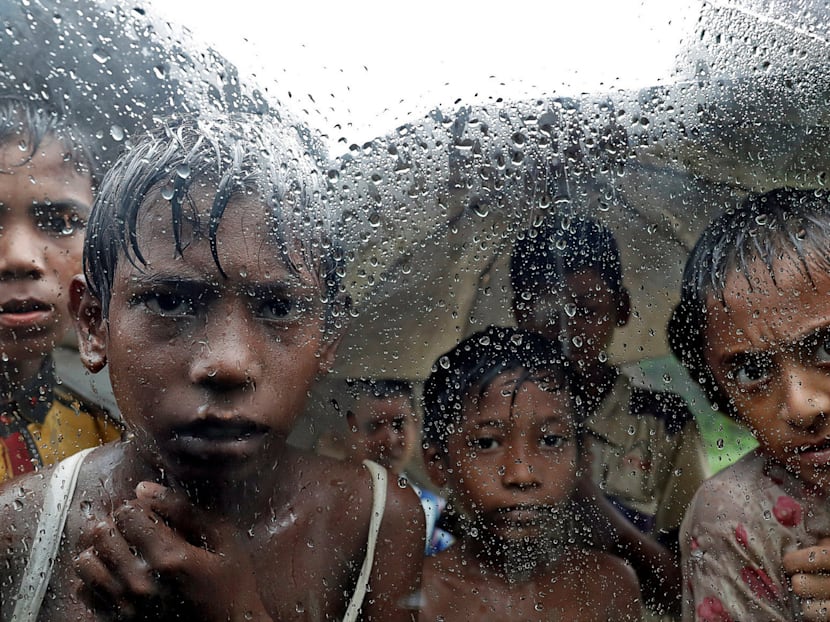
Rohingya children seen in Cox's Bazar, Bangladesh. Photo: AP
The alleged genocidal killing of Rohingya in Myanmar’s Rakhine state by the military has drawn global condemnation. Inevitably, the crisis has also fired up jihadist groups who have been clamouring for an assault against the Myanmar government in response to the alleged atrocities against the Muslim minorities.
Recently, Al Qaeda in the Arabian Peninsula (AQAP) weighed in on the crisis with its leader, Khaled Batarafi, calling for attacks against the Myanmar government. This marks a new phase in the terrorist group’s plans in the region.
Despite a long history of violence between Rohingya groups and the Myanmar government, Al Qaeda had not taken up the cause of the Rohingya since its formation in the late 20th century.
But its call to action now is significant, given that AQAP is the most powerful branch of Al Qaeda in the world, having ruled over large swathes of territory in Yemen in recent years.





Its strength is buttressed by a robust leadership that has now gained considerable military and administrative experience. The group’s international exploits — ranging from the Charlie Hebdo attack in 2015 and the sharing of bomb-making expertise with the Somali group Al Shabaab — have strengthened its image.
Coupled with its affinity to latch itself onto populist demands of Muslim populations (such as opposition to Zaydi Shia Houthi rebels in Yemen), there is a good chance that the group could mobilise supporters to launch attacks or share its expertise with jihadist elements in the Rohingya populations.
Al Qaeda is not the only group trying to capitalise on the issue, of course.
According to Malaysian police, the Islamic State (IS) is making use of the crisis in Rakhine state to recruit new members. With Marawi in the Philippines ravaged by pro-IS militants and Indonesia, Afghanistan and parts of other countries slowly being targeted by such terrorist groups, there is a risk that these parts of Asia will become new theatres of conflict.
That Myanmar is a country that straddles both South and South-east Asia means that jihadist groups could be even more interconnected in these regions than before. This is a danger that Myanmar and its neighbours in the region have to guard against.
AQAP’s calls to action in Malaysia, India and Bangladesh, among others, highlight the growing need of international cooperation to stymie any flow of fighters towards Rakhine state.
The Rohingya issue needs to be understood as a complex problem with a long history that cuts across not just religious, but also geographic lines.
With Myanmar still struggling to overcome the yoke of its nearly 50 years of military rule, Ms Aung San Suu Kyi’s reticence on the Rohingya issue is a calculated one. She is clearly cautious about pushing the military (also called the Tatmadaw) too hard in this early stage of her government.
In such a scenario, global pressure directly on Myanmar’s military may work better, particularly given how it is still dependent on international support for supplies, modernisation and training.
One example is the United Kingdom’s suspension of military training provided to the Tatmadaw until the persecution of Rohingya stops.
The United Nations too can offer the Myanmar military an entry into its peacekeeping forces as a means to gain valuable experience and exposure to different armies. This is generally a good carrot for developing nations, which are compensated financially by the UN for their efforts and which can gain valuable exposure to modern weapons and superior forces.
The United States, similarly, has been known to have dangled military aid and support to Myanmar in return for democratic reforms.
What it can do now is to withhold admission of Myanmar forces to its much coveted International Military Education and Training programme until the human right violations cease.
The programme provides funds for international personnel to attend US military professional training, and is in much demand by the Tatmadaw.
This was a point acknowledged by Mr Aung Lynn, Myanmar’s envoy to the United States. Mr Aung Lynn also expressed Myanmar’s desire to take part in more military training workshops such as the Lower Mekong Initiative and Disaster Response Exercise and Exchange held in December 2016, which Myanmar hosted.
This is an increasingly important field to engage in due to the nation’s susceptibility to disasters and consequent domestic risks, as outlined in a 2017 UN report. Unfortunately, the US has thus far refused to use a carrot and stick approach on Myanmar.
On the contrary, it has stepped up cooperation in an effort to exploit Myanmar’s weakening ties with China.
This illustrates the complexity of implementing such solutions. Another option is to target companies linked to the military, especially those in mining and power generation, that have allegedly profited from resource-rich land grabbed from the Rohingya.
There is clearly a need for stronger international coordination on putting pressure on Myanmar and its military. And time is of the essence.
Ultimately, we cannot be sanguine about the risk of international terrorism taking root in Rakhine state. One only need to look at what happened in Afghanistan in the late 20th century.
The price to pay for not acting now may be another protracted phase of jihadist influx to the region, leading to greater instability in South and South-east Asia.
ABOUT THE AUTHOR:
Mohammed Sinan Siyech is a Research Analyst at the International Centre for Political Violence and Terrorism Research at S. Rajaratnam School of International Studies.