Secondhand smoke — how to take baby steps towards greater personal responsibility
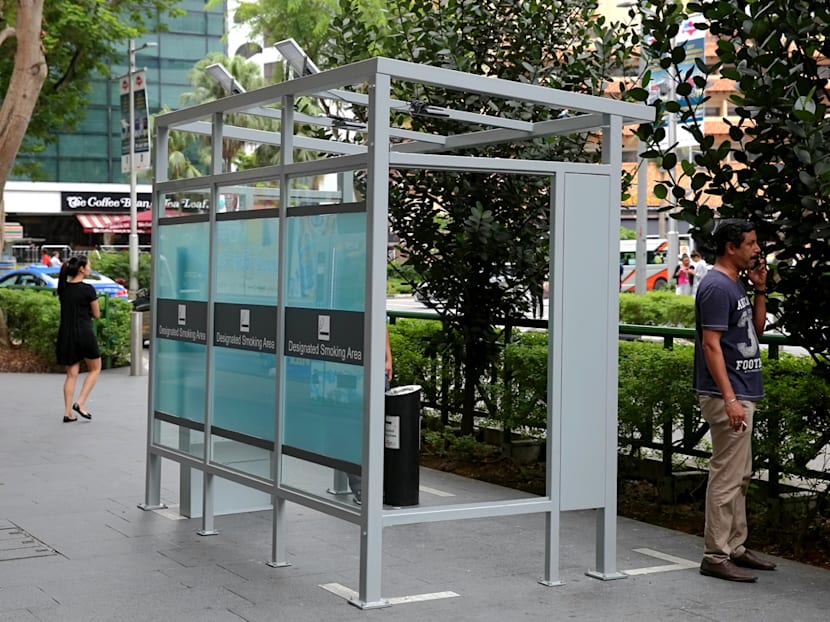
Drawing a yellow box or designating open air smoking areas do not help to curb secondhand smoke, says the author
The issue of secondhand smoke drifting into homes has been much talked about of late, with some online petitions calling for a law to ban smoking in homes, going even further than the ban of smoking at balconies and windows that Member of Parliament Louis Ng has called for.
But is legislation the answer? Singapore’s history has seen laws banning chewing gum, spitting, littering and other anti-social habits.
These laws have had, in my view, limited success. And the fact that you need laws to manage human behaviour says a lot about us as a people.
The difficulty is that some people simply do not care. When there is a complete lack of empathy and common sense, having an additional law would not help.





The Smoking (Prohibition in Certain Places) Act lists common corridors, staircase landings and void decks as non-smoking areas.
Smoking is lawful in private areas such as your home or at dedicated smoking areas.
In addition, the Building Maintenance (Strata Management) Regulations 2005 provides prescribed by-laws that cover noise, the behaviour of owners and residents, maintenance of your unit but nothing per se on smoking.
However, Section 32 and 33 of the Building Maintenance and Strata Management Act allows the Management Corporation (MC) to make additional by-laws to deal with secondhand smoke and if there is a breach of the by-law, the MC may apply to court for an order to stop someone from disobeying the by-law.
Having a new law does not necessarily mean the problem will go away. You may have to enforce it and that comes with a different set of issues.
In her parliamentary response to Mr Ng, Senior Minister of State in the Ministry of Sustainability and the Environment Dr Amy Khor was spot on when she said that the proposed ban may not be the “silver bullet” for the problem because of privacy concerns and enforcement challenges.
When you smoke, does it matter to you if others are affected by the smoke that emanates from you? Or do you not even care?
I personally find it annoying to breathe in secondhand smoke before I enter an office building or eating place because there will always be smokers around the premises smoking away.
Smoking is not banned in Singapore and that looks highly unlikely at the moment. Arising from this, how we deal with secondhand smoke is a sensitive but important issue which should not be looked at in absolute terms.
This cannot be left to the smokers and non smokers to sort it out among themselves.
In my work as a lawyer, I have come to see how difficult it is for some neighbours to approach each other, to have a conversation and work out how they can co-exist peacefully, whether by knocking on each other’s door or at mediation.
Some simply do not turn up for mediation. I have also been involved in mediation between neighbours with community leaders and unfortunately they often may not have the necessary people skills.
Let me emphasise that this should never be about my rights against yours. Rather, this must be about how we can work out something that smokers and non-smokers alike can accept.
What is needed is a holistic solution by the authorities that can satisfy both sides.
And no, drawing a yellow box or designating open air smoking areas do not count.
I would like to think that if we can promote the idea of smoking responsibly, perhaps a compromise can be reached and every one can live happily after.
Last year, the proposal of air-conditioned outdoor smoking cabins that filter cigarette smoke into clear air was introduced by Southern Globe Corporation to address the issue of secondhand smoke in Singapore.
Despite write-ups by mainstream media, the idea of smokers in a confined space to smoke together did not take off.
I do not know why but I think it is a brilliant initiative which the authorities should look at and promote.
Surely, having such smoking cabins would make more sense in curbing secondhand smoke compared to designated open air smoking areas.
And I do not think costs should be an issue as the authorities collected in excess of S$987 million in tobacco levy for the first nine months of 2020.
The other smoking alternative is to allow smokers to smoke only in purpose-built smoking bars and pubs built with the necessary exhaust and filter systems.
Yes, this does not quite address the issue of smoking at one's home and there will still be some who will be inconsiderate enough to want to smoke at their balconies or windows with little care for their neighbours.
But we have to take baby steps and perhaps, by having smoking cabins in housing estates and condominiums, we can start the conversation on smoking responsibly.
Instead of limiting smokers’ rights, by offering the smokers options, perhaps this may instill some sense of responsible smoking amongst the smokers and at the same time, win the respect and support of the smoke free lobbyists.
More importantly, this may allow opportunities for both sides to move forward on their agendas and to perhaps help each other live together without having to take extreme measures.
ABOUT THE AUTHOR:
Nicholas Aw is a partner at Clifford Law.