

Shutting up President Duterte
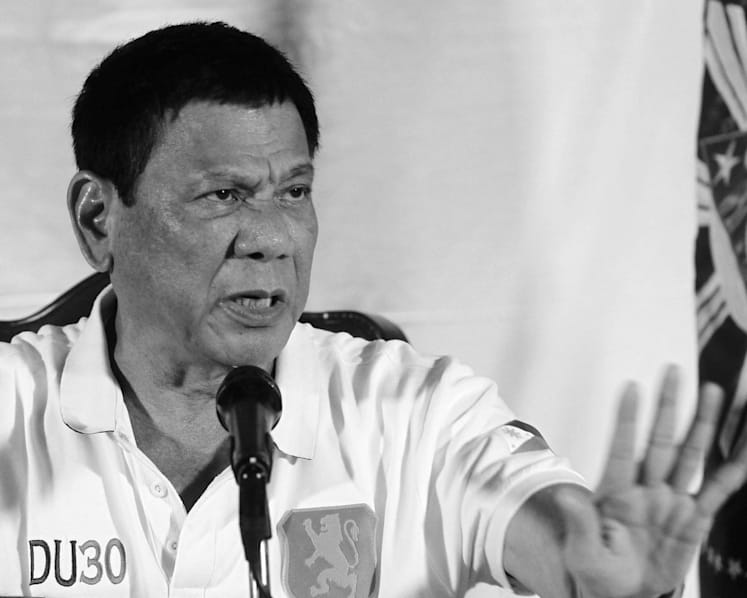
Philippine President Rodrigo Duterte. Photo: Reuters
I apologise that I could not personally thank all those who texted and emailed me yesterday—on the feast-day of St. Francis of Assisi.
One gets to be 77 only once, and I appreciate it very much. As animal lovers brought their pets to be blessed in church in honour of that great and well-loved saint, I prayed that we may learn to love the lowliest animals as well as he did, but also care for the least of our brethren much more than we are inclined to do. This is a constant challenge, but it has grown beyond all measures lately.
Francis (1181-1226) spoke with birds and the wolf that preyed on the livestock of the Italian town of Gubbio; we have to speak to a different kind, President Rodrigo Duterte, and convince him to stop the routine killing of drug suspects, and put up with the Obamas and Ban Ki-moons of this world who want him to follow the rule of law. I cannot say if the poor man of Assisi had an easier time.





A RESTATEMENT OF PURPOSE
But it has not been easy for anyone to function as a constructive political critic, much less as a God-fearing, law-abiding and concerned patriot these last three months. After 53 years in public life, mostly as a journalist, I can only promise to be true to my duties, wherever that would take me.
I will never purposely offend the President, but I will state my honest position on every issue. If my good intentions and sincere desire to be helpful amount to nothing, then there is nothing more I can do.
I thought I would insert this brief restatement of purpose as a critic after an important anniversary. At a time like this, many may be tempted to look at a serious critic as a danger to society.
Supreme Court Associate Justice Marvic Leonen made the mistake of invoking the Constitution and repeating the slogan of the First Quarter Storm (when heavy anti-government demonstrations during the first quarter of 1970 led to the implementation of martial law in the country) at the University of Philippines—Kung hindi tayo kikilos, sino ang kikilos? Kung hindi ngayon, kailan pa? (If we do not act, who will? If not now, when?) — and quickly found himself in a hostile beehive in the social media.
I sympathise with Mr Leonen, who is not entirely innocent of the offence with which he charges Mr Duterte, also popularly nicknamed DU30 on social media.
But this is the price one must be prepared to pay. And this is how efficiently the pro-DU30 camp disposes of its perceived “enemies”. It will use its every advantage in the law, propaganda, technology and money.
A three-part article by journalist Maria Ressa on Rappler, a Filipino social news network she founded, on weaponising the Internet, shows how effectively the camp has used the internet to manipulate the political narrative to DU30’s advantage, from the time he declared his candidacy last year.
From midnight of Nov 25, 2015, when DU30 declared his candidacy until 2am the next day, 30,000 tweets on DU30 were posted, sometimes more than 700 tweets per minute, says the article. “Paid trolls, fallacious reasoning, leaps in logic, poisoning the well — these are only some of the propaganda techniques that have helped shift public opinion on key issues,” Ms Ressa writes.
Fake social media posts are used to spread “fear, uncertainty and doubt” with respect to DU30’s war on drugs. Netizens who express critical opinion on DU30 are not only verbally abused but also threatened with physical harm by trolls.
This situation has spilled over to mainstream media, and to the rest of society, where DU30’s standing as a demigod is now promoted by a new corps of fanatics, which includes some commentators who did not have a kind word about him before he became President.
This has so impacted the thinking and conversation in the public arena that what is right is shouted down by the mob as wrong, and what is wrong is trumpeted to the political heavens as right. The perversion of moral values has become routine.
There is no debate about the evil of drugs, and the need to expunge it from our midst.
But going after this evil does not justify the unspeakably greater evil of eliminating drug suspects without due process.
One observer compares it to the hygienic campaign during Mao Zedong’s Great Leap Forward (1958-1962), which sought to exterminate sparrows, rats, mosquitoes and flies.
None of Mao’s targets had any human rights. Among them, the rat had the most sordid reputation; it had long terrified men, women and children.
In George Orwell’s novel 1984, it is used to terrorise the central character Winston Smith; in Albert Camus’ The Plague, it makes up the invading army that overruns the Algerian town of Oran.
THE SPARROW AND THE DRUG ADDICTS
But it was the Eurasian tree sparrow that finally exposed the folly of Mao’s campaign.
The sparrow is not an insect but a bird, but Mao saw that it ate grain and, therefore, robbed the people of the fruits of their labour. So people were mobilised to go after the bird by beating drums and banging pots and pans to scare them from landing, according to Wikipedia, and to force them to continue flying until they fell from the sky in exhaustion.
Nests were torn, nestlings were killed, eggs were broken. Non-material rewards and official recognition were given to schools, work units and government agencies according to the number of sparrows brought down.
By 1960, the Chinese government realised that the sparrows also ate insects, but with the sparrows gone, the insects, notably locusts, proliferated. Rice yields decreased, the forests were degraded and ecological imbalance became unavoidable.
The Great Chinese Famine ensued, during which about 20 million people died of starvation.
There is no basis for comparing the drug suspects to the sparrows.
Their disappearance from the scene could only reduce our rice consumption and, perhaps, improve the ecological balance. But exterminating them without due process, while DU30 attacks those who attack the killings in the most toxic and vulgar language, can only inflict far from serious consequences on the moral character of the Filipinos.
THE SOCIETY OF DEBASED
From being one of the most God-fearing, polite and courteous people in the world, Filipinos could become one of the most vulgar and cruel people on earth. And if the negative reaction of the global market continues, and the drying up of the economy follows, they could become among the most miserable people in the world.
DU30 can still do something about it, and it is not too late.
Aside from the summary drug killings, which have provoked worldwide condemnation, DU30’s quarrel with the world has been caused only by his foul mouth, nothing else.
No great sovereignty — or national interest — issues are involved. He seems so deeply in love with his own vulgarity that he seems unable to deliver a point without punctuating it with an expletive.
Nobody else — not even in the dockyards — seems to talk like that. Even Teddy Locsin Jr, his ambassador-designate to the United Nations known for his Nazi-themed tweets, is having a hard time trying to compete with his “F***k you” tweets.
So why does he do it?
This probably needs a medical explanation. His trusted Cabinet officials should look into it. In an article on Dangerous Leader Disorder, Dr John D Mayer examines the cases of Adolf Hitler, Josef Stalin and Saddam Hussein, and comes up with three things they had in common: Indifference toward people’s suffering and devaluation of others, intolerance of criticism, and a grandiose sense of national entitlement.
The Cabinet has to ask themselves if these three qualities are present in the President? If they are, then they must reach out for a medical cure or a constitutional solution.
The solution does not lie in a coup d’etat, which both the President’s communications secretary Martin Andanar, and Cabinet secretary Leoncio Evasco Jr have been talking about, but in the President or majority of the Cabinet informing the leaders of Congress that he is unable to discharge the powers and duties of his office.
If, on the other hand, he does not suffer from any such disability, the Cabinet must agree to treat his speech problem by compelling him to never comment on any issue without a written text, or by allowing a 30-second delay in all his live interviews, so that anytime he utters a profanity or an obscenity, Mr Andanar or a technical person could cut off the offensive portion during that 30-second delay, as is done by the most responsible broadcasting networks.
If he persists in talking without these safeguards and precautions, the Cabinet must find the courage to tell him as gently as possible, but to his face by all means, “Please shut up, Mr President.” THE MANILA TIMES
ABOUT THE AUTHOR:
Francisco Tatad is a Filipino journalist and politician. He was Minister of Public Information from 1969 to 1980 and a Senator from 1992 to 2001.




