Thanks doc for the crackers and helping me overcome Covid-19
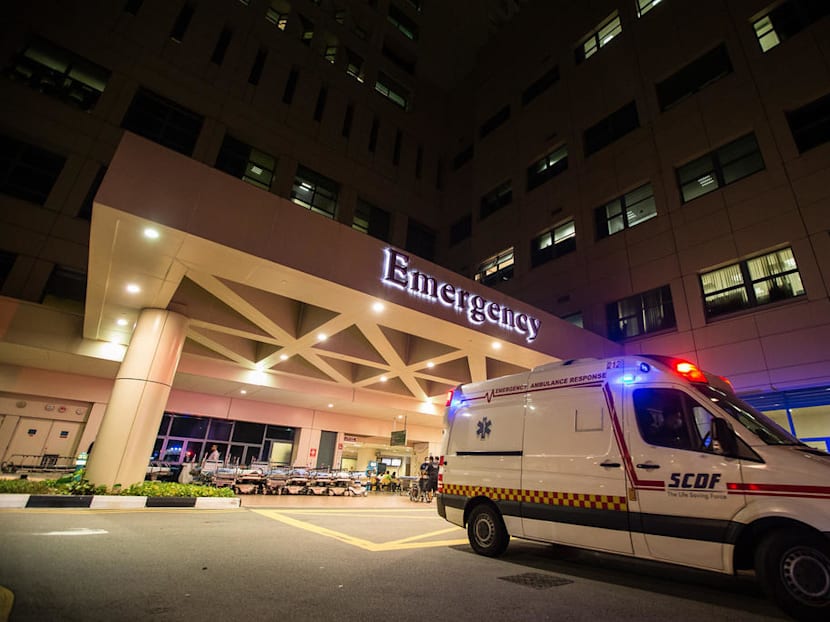
The author says that in the earliest days of her hospitalisation at Tan Tock Seng Hospital, she "was visited by dark thoughts, felt bleak and despaired often enough to entertain questions of my survivability".
I never had the chance to see my doctor’s face. It was always covered by a mask, his eyes hidden behind thick plastic goggles.
Completing the look were a pair of blue surgical gloves and a protective yellow plastic coat that he would remove after leaving my hospital room when his morning visits to Covid-19 patients like myself ended.
He was definitely a young doctor. His posture and gait suggested competence and skill, and along with his gentle and happy voice, they immediately comforted me.
I was admitted to Tan Tock Seng Hospital (TTSH) early last month after being infected by someone in my condominium and this doctor was assigned to my ward one and half weeks into my hospitalisation.





All the hospital personnel — from the other doctors and nurses to medical technicians and cleaners — donned the same outfits.
Together they were a yellow army, with a steady and perpetual presence.
Each member did his or her jobs with quiet dedication, whether it was swabbing my nose, administering the blood pressure monitor and oximeter, or picking up the garbage at way past midnight. Every single day and night.
Right by my bed was a window that gave me a ringside view of the nurses’ workstation. They were a red button call away. A small sensor pasted on my belly and connected to an outside computer gave them ready access to any changes in my body temperature.
They were always ready to attend to every patient’s need at any hour, be it the daily dose of Panadol or a request for milk tea and biscuits.
It was on one such morning two weeks after being hospitalised that I told the doctor how hungry I was, and that my tastebuds were aching for truffle cheese pizza.
My appetite had returned, my symptoms had subsided, and I was slowly regaining strength. But we needed to wait for the two consecutive negative swab results before I could be discharged.
The following day, he came with two packets of Meiji crackers and a sliver of cheese tucked in a plastic food container.
“Just don’t eat the silica gel, even if you’re that hungry,” he quipped. We both laughed.
I have been committed to Meiji crackers as my daily afternoon snack ever since.
Beating Covid-19 was surely more than just a biomedical battle, especially for a 67-year-old, even though I have no underlying health conditions other than asthma.
In the earliest days of my confinement, I was visited by dark thoughts, felt bleak and despaired often enough to entertain questions of my survivability.
I read updates of the spread in other countries. I devoured news stories of other patients who went through similar predicaments, some of them worse than mine.
One was delirious with 39°C fever and hallucinated.
I had fluctuating fever, occasional asthma attacks, enormous fatigue and lack of strength but none too debilitating. The short walks to the bathroom would tire me, all 10 steps of them, and I suffered loss of appetite for the first two weeks.
I read, I clung to my hopes and I bravely fought my demons.
Then the battle shifted to a mental one, one of patience, fighting off confinement-induced boredom and tolerating my roommates’ idiosyncrasies.
One snored till I thought my eardrums would burst; another engaged in cellphone marathons until the batteries died and still another devoured cartoons nonstop on the hospital television monitor.
Six roommates later, I had developed a tolerance for sharing small spaces with total strangers whose only commonality with me was a devious virus that continues to confound us all.
I joked with my husband and siblings that this was the Covid version of speed-dating. My humour was back, and with that, I knew I was going to live.
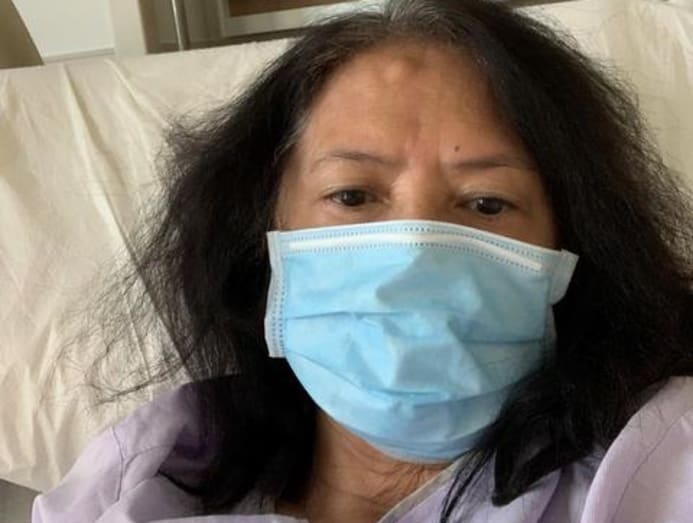
The author during her stay at TTSH. Photo courtesy of Teresita Cruz del Rosario.
Twenty-five days and 11 nose swabs later, the doctor announced the good news that two consecutive negative swab tests allowed me to return home.
He reached out with his blue surgical gloves to squeeze mine, especially happy, proud and honoured, he said, that I was his second successful patient from the academia of which he had the privilege to take care.
I asked for his name — Dr Eugene Bingwen Fan — and his email address, determined to write to him of my deep gratitude.
When I did, he replied to state that it was his team who worked together to treat us one patient at a time.
With characteristic humility and humour, he stated that his only major role was to provide me with cheese and crackers as a respite from hospital food.
Someday, not in the too distant future, I would love to return to the fifth floor of TTSH where I passed the most memorable three and a half weeks of my life. It was truly a defining moment and made me realise my mortality was so real and immediate.
I hope to see Dr Fan again and the doctors before him who called and visited every day as well as the nurses and medical technicians, the sweepers and cleaners — without their yellow plastic coats, masks, goggles, and gloves.
I want to shake their hands without fear or trepidation. Remember each one of them by name. Speak of my gratitude and admiration.
And just all around rejoice that in this formidable battle still raging, we can celebrate our victory at having become a better species who fight tooth and nail to care for each other.
Thank you, Dr Fan, for the crackers.
ABOUT THE AUTHOR:
Dr Teresita Cruz del Rosario is an independent scholar affiliated with the Asia Research Institute’s Inter-Asia Engagements Cluster at the National University of Singapore and former Visiting Associate Professor at the Lee Kuan Yew School of Public Policy.