Trump’s dangerous Taiwan gambit
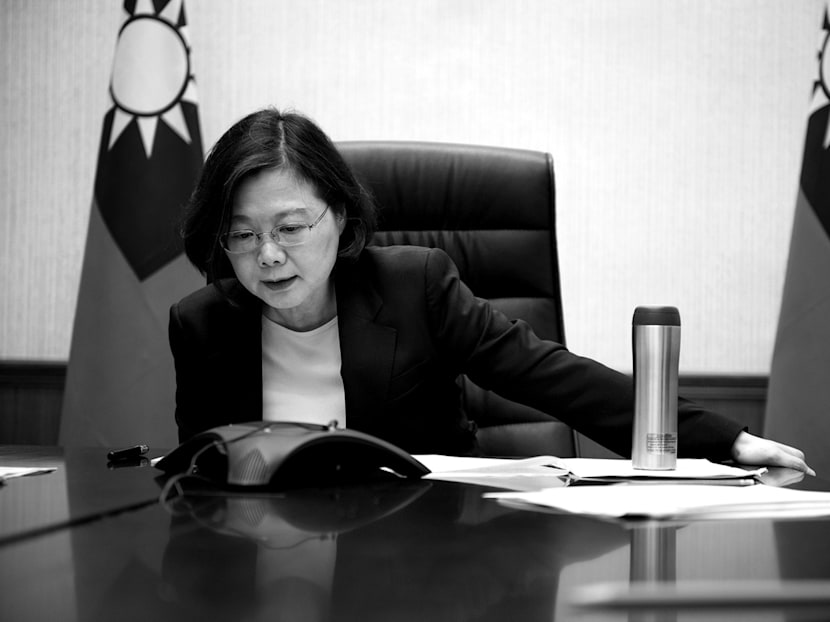
Taiwanese President Tsai Ing-wen speaking with US President-elect Donald Trump in Taipei on Saturday. There have been no direct conversations between the leaders of the US and Taiwan since the former established diplomatic relations with China in 1979 and severed diplomatic links with Taiwan. Photo: Taiwan Presidential Office via AP
Mr Donald Trump’s telephone conversation with the President of Taiwan, Ms Tsai Ing-wen, was a massive break with established policy. When the United States re-established diplomatic relations with the People’s Republic of China in 1979, it also severed diplomatic links with Taiwan. Since then, there have been no direct conversations between the leaders of the US and Taiwan.
The stakes involved in the triangular relationship between Taipei, Beijing and Washington could not be higher. The Chinese government has repeatedly stressed that it is prepared to go to war, rather than accept Taiwanese independence.
The US, while it does not promote the independence of Taiwan, has also promised to resist any attempt to incorporate Taiwan into China by force. I have personally witnessed a conversation between Chinese officials and high-ranking Americans, in which the US side has said openly that a Chinese attack on Taiwan would lead to war between the US and China.
The current situation is already tense, since Ms Tsai, who was elected President in January this year, is an advocate of the eventual formal independence of Taiwan — although she has also promised not to press to change the current status quo.





It is not yet clear whether Mr Trump stumbled into this situation, without being aware of its true implications; or whether the President-elect is signalling a deliberate change of policy.
Either development would be alarming — but for different reasons. If Mr Trump is making major foreign-policy decisions, without knowing the background or taking advice — that is clearly a risky course.
On the other hand, if Mr Trump has deliberately decided to adopt a more confrontational policy towards China, the world is in for a bumpy and dangerous ride. That is all the more the case, given that Mr Trump’s open protectionism — and threats of high tariffs on Chinese goods — represent a direct threat to the prosperity of China.
The government in Beijing will now be wondering whether a Trump administration is preparing to commit the US to economic and strategic confrontation with China.
For the moment, the Chinese government seems prepared to take the line that this is simply a blunder by an inexperienced President-elect.
The Chinese foreign minister, Mr Wang Yi, has called the phone call a “petty trick” by Taiwan — implying that Mr Trump was duped by President Tsai. Mr Trump, for his part, has issued a defensive tweet, pointing out (in block capitals) that the Taiwanese leader “CALLED ME”.
However, if the Tsai-Trump call does turn out to represent a major change in US policy, Beijing’s reaction is likely to be fierce.
China has already adopted a more nationalistic and assertive foreign policy under President Xi Jinping.
The evidence for this has come in its willingness to confront Japan in the East China Sea and to build and fortify artificial islands, to bolster its maritime and territorial claims in the South China Sea.
By contrast, tensions over Taiwan have been relatively subdued, until recently. But the demand for the “reunification” of China and Taiwan remains the most sensitive possible issue for Chinese nationalists.
Almost 20 years ago, the US and China confronted each other during the Taiwan Strait crises of 1995 and 1996.
Significantly, the trigger for that crisis was also a Chinese perception of a change in US policy — after the US allowed then-President Lee Teng-hui of Taiwan to give a speech in the US.
Alarmed by this, and by the growth of pro-independence sentiments in Taiwan, China staged missile tests in the waters around its “rebel province”. In response, the US sent aircraft-carriers to the waters around Taiwan — in what was the biggest display of US military force in the region since the Vietnam War.
China backed off and the crisis died down. But in the intervening years, the military balance in the Pacific has changed. China has invested hugely in its navy and has also developed a new generation of “carrier-killer” missiles, that could target US aircraft carriers if they once again sailed through the Taiwan Strait.
As a result, some Chinese strategic thinkers — particularly those of a nationalist bent — believe that the US would no longer risk the show of force that it mounted in the waters around Taiwan, 20 years ago.
The possibilities of strategic miscalculation in both Beijing and Washington are high.
It is possible that the Trump-Tsai call will eventually be dismissed as an early misstep by an inexperienced President-elect — and that it will have no lasting significance.
But it is also possible that the stage is being set for a fresh confrontation between the US and China over Taiwan. FINANCIAL TIMES
ABOUT THE AUTHOR:
Gideon Rachman is the Financial Times’ chief foreign affairs commentator.