Understanding the terror threat to the 2018 World Cup in Russia
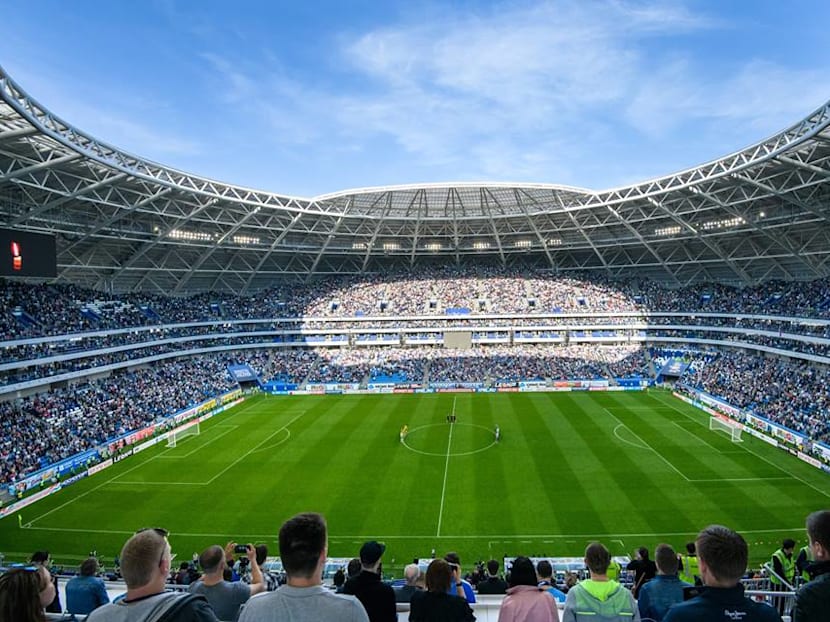
Moscow is committed to ensure that security prevails during the upcoming World Cup, but this could be complicated in the context of the existing terrorist threat posed by returnee fighters linked to IS and Al Qaeda’s affiliates in the Middle East, among others.
On Thursday (June 14), the world’s biggest international sporting event, the FIFA World Cup, will kick off in Russia.
As close to three million local and foreign football spectators are expected to visit 12 different venues spread across 11 major cities to witness a month-long festival of football, ensuring adequate security is a top priority for Russia.
A massive propaganda campaign run by the Islamic State (IS) and an upsurge in terrorist attacks and foiled plots targetting Russia in the months leading up to the World Cup have fuelled reasonable concerns about the security of the tournament.
Similar scepticism was expressed by the international community ahead of the 2014 Sochi Winter Olympic Games, but Russia has successfully prevented the occurrence of attacks.





Moscow is committed to ensure that security prevails during the upcoming World Cup, but this could be complicated in the context of the existing terrorist threat posed by returnee fighters linked to IS and Al Qaeda’s affiliates in the Middle East, domestic jihadist elements in the North Caucasus and others inspired and radicalised by online terrorist propaganda.
Russia in Syria: IS Backfires
The Kremlin’s decision to militarily intervene in the Syrian conflict in September 2015 has made Russia a top target for jihadist groups fighting in the Middle East – IS being the most prominent among them.
In October 2017, IS commenced a massive online propaganda campaign against the 2018 World Cup.
In October 2017, the pro-IS Wafa’ Media Foundation released digitally altered images of football superstars like Neymar, Lionel Messi and Cristiano Ronaldo being executed in its propaganda materials.
IS’ supporters and sympathisers worldwide have subsequently joined this propaganda campaign. Since then, IS-linked online media networks have circulated dozens of posters threatening the event.
Likewise, a pro-IS Indonesian group called ‘Generation 5.54’ released two separate posters in April 2018 which threatened to attack the World Cup in Russia.
One of the posters, portrays the tournament as ‘IS vs Russia’, with a short message in English, “life or death”.
‘Generation 5.54’ was founded in early 2018 and was inspired by IS magazine Al Fatihin.
Researchers believe that while the members of Generation 5.54 are not IS operatives, they represent IS sympathisers and supporters who are waging a ‘media jihad’.
Although it is unlikely that this group will present a physical threat to the World Cup, it appears to seek popularity and legitimacy among its Indonesian-speaking audience by circulating such propaganda.
Since 2011, close to 4000 Russians have reportedly left Russia to join jihadist groups fighting in the Middle East and 400 of them had returned to home.
Although the majority of the returning fighters will be captured or placed under close surveillance by Russian security agencies, some undetected militants may pose a security risk to the tournament.
Terrorist attacks on sporting events are relatively uncommon compared to attacks on other targets, such as public transportation, markets and governmental buildings.
However, IS has targeted a series of football matches and events in different parts of the world.
One such incident included the triple suicide bombings outside the Stade de France in Paris in November 2015, which resulted in 130 deaths during a match between France and Germany.
Other attacks on sporting targets include the Munich Olympic Games in September 1972, Atlanta Olympic Games in July 1996, Sri Lankan national cricket team in Pakistan in May 2009, Boston Marathon in April 2013, Istanbul football stadium in December 2016, and the team bus of Borussia Dortmund football team in April 2017.
The launch of the extensive propaganda campaign by IS and pro-IS outfits against the World Cup is critical as it could trigger attacks targeting the event from the IS-linked Wilayat Qawqaz, Al Qaeda’s local affiliate in the North Caucasus, and self-radicalised members of local and foreign diaspora communities in Russia.
Domestic Militancy in the North Caucasus
The risk of terrorism in Russia primarily derives from domestic militancy in the North Caucasus.
North Caucasus is a turbulent zone in Russia that witnessed ethno-separatist conflicts and active terrorist activities from 1991 to 2009.
In the past few years, militancy in the region has declined. This is largely due to a massive security crackdown launched by Russian security services in the run-up to the Sochi Winter Olympics.
Despite the relative decline in violence, militant groups have been conducting attacks against both well-protected assets and undefended civilians.
Presently, the two major groups operating in the region are Wilayat Qawqaz and the Caucasus Emirate (CE).
Both groups wage armed jihad to establish an independent Islamic state in North Caucasus.
In recent years, Wilayat Qawqaz has overtaken CE as the largest domestic terrorist group in Russia.
This came after local insurgent groups under a hierarchy of CE collectively defected to IS, leading to the establishment of Wilayat Qawqaz in June 2015.
Even though Wilayat Qawqaz has not issued any statement regarding the World Cup, related online propaganda by IS and its affiliates could encourage its members to target the event.
Since February 2016, IS and Wilayat Qawqaz have conducted more than 14 attacks against Russia.
Although these attacks mainly targeted the North Caucasus, the threat has been expanding to major urban centres.
IS carried out an attack on a traffic police station in Moscow province in August 2016 and a supermarket bombing in Saint Petersburg in December 2017.
Russian interests abroad have also been targeted by IS and its affiliates. In October 2015, IS’ Wilayah Sinai claimed responsibility for the crash of the Russian Metrojet plane over Egypt, by stating that it was a retaliatory attack for Russian air strikes in Syria.
Past incidents point to the possibility of suicide bombings, knife and gun attacks by lone-actor militants against civilians during the tournament.
This was apparent by a suicide car bomb attack in Dagestan in 2016; knife attacks in Kaspiysk and Surgut cities in 2017; and a knife attack and shooting at an Orthodox church in Dagestan in 2018.
It is worth noting that Wilayat Qawqaz does not hold territorial control over the North Caucasus and is presently not strong enough to engage in large-scale insurgent activities due to security measures imposed by Russia.
CE is even less likely to mount attacks against the World Cup. This is primarily due to reduced membership in light of the recent deaths of top commanders, defections to IS and the move away from suicide bombings as a tactic.
Presently, the CE is at its most inactive stage and has been struggling to survive and remain relevant in Russia.
Al Qaeda and the Radicalisation of Foreign Diaspora
Recently, Russia has been facing a threat from the radicalisation of foreign diaspora communities, particularly Central Asians.
Russian security agencies have occasionally thwarted terrorist plots by self-radicalised Central Asian individuals.
On April 25, 2017, a suicide attacker supported and directed by a Central Asian cell led by Akram Azimov and his younger brother Abror Azimov exploded a bomb at a subway system in Saint Petersburg.
The Azimov brothers are ethnic Uzbeks from southern Kyrgyzstan who have Russian citizenship.
A few days later, a previously unknown militant group which called itself Kateeba al-Imam Shamil (The Imam Shamil Battalion) claimed responsibility for the attack that killed at least 17 people and injured 50 others.
The militant group claimed that its ‘heroic soldier’ had carried out the attack ‘on the orders’ of Al Qaeda’s leader Ayman al Zawahiri in ‘revenge for Russia’s interference’ in Syria.
The Saint Petersburg metro bombing represented the first time that a militant group has conducted an attack in Russia based on Al Qaeda’s direct order.
Previously, it had been more common for Chechen and Dagestani militants from the restive North Caucasus to take responsibility for such attacks.
It is also pertinent that foreign-born individuals from Central Asia were the perpetrators of this bombing.
The ability of foreign terrorists to attack Saint Petersburg, known to be one of the safest cities in the country, indicates that the terrorist threat is expanding across key urban centres.
The attack could indicate Al Qaeda’s growing interest in attacking Russia as retaliation for Russia’s military involvement in Syria.
It is worth noting that the attack came after Abu Muhammad al Julani, the leader of Hay'at Tahrir Al-Sham (HTS), a former Al Qaeda affiliate in Syria, called for reprisal attacks in Russia as a response to what he said was the ‘indiscriminate killing of Sunni Muslims’.
The heightened interest of Al Qaeda in Russia suggests that the group could target the World Cup in order to gain recognition and compete with IS’ Wilayat Qawqaz.
Assessing the Threat to the World Cup
The most significant threat to the upcoming World Cup in Russia comes from IS’ Wilayat Qawqaz and attacks by IS-inspired individuals.
The possibility of self-radicalised locals and foreign individuals, which include members of the Central Asian diaspora, attempting to attack the World Cup event cannot be ruled out.
Radicalised individuals could attempt to replicate attacks conducted by lone-wolf actors inspired by IS in parts of Europe and the United States since 2015.
Recent propaganda materials released by IS have called lone-actor terrorists for vehicle-ramming and knife attacks at the tournament.
Given the massive security clampdown, militant groups and individuals are unlikely to be able to plot major coordinated and sophisticated attacks during the World Cup in Russia that resemble the series of suicide bombings perpetrated by IS near the national stadium in Paris in 2015.
However, there could be unsophisticated but high-impact attacks that involve suicide bombings outside highly secured areas.
Past attacks demonstrate that public transportation systems, government and security personnel and military installations are attractive targets, where suicide bombings and knife-attacks are preferred.
Since sporting venues, airports, and hotels would be highly secure during the World Cup, terrorists could choose the public transportation system in close proximity to the World Cup venues as a possible target.
Any attack on public transportation during, or prior to an international sporting event, would grant unprecedented visibility to the group due to the higher media coverage.
The twin suicide bombings on the mass transportation system in Volgograd just a few months before the 2014 Winter Olympics also indicate that a similar tactic could be used for the 2018 World Cup.
Countering the Threat
Russia’s security and intelligence agencies have been prioritising counter-terrorist operations ahead of the World Cup.
Hosting the Sochi Winter Olympics and the 2017 FIFA Confederations Cup has helped the country to enhance its security planning during major sporting events.
Authorities have heightened security measures and enforced preventive security operations nationwide.
Russian police disrupted 68 terrorist-related incidents in 2017, out of which there were 25 planned attacks.
They have also been closely monitoring foreign diaspora and immigrant communities, especially in the host cities.
Furthermore, security designers are planning to effectively utilise digital innovations such as automatic facial recognition and surveillance systems to identify known or suspected terrorists.
Taking into consideration reports about the possible use of drones by IS to conduct attacks during the World Cup, the Russian military will establish no-fly zones over 41 locations and will deploy 60 mobile drone jamming units to disrupt potential drone attacks.
Russian authorities have reassured the public that it is prepared to keep the tournament safe from terrorism.
In March, Russian President Vladimir Putin stated that there has been a decline in the number of terrorist related crimes over the past six years. The number of such crimes fell from 316 to 85 and 25 in 2012, 2014 and 2017 respectively.
A successful World Cup event without terrorist attacks will permit Russia to showcase its counterterrorism achievements and enhance its international image.
In addition, this will help Russia to win wavering domestic support for its involvement in the Syrian civil war.
ABOUT THE AUTHOR:
Nodirbek Soliev is a Senior Analyst at the International Centre for Political Violence and Terrorism Research at the S Rajaratnam School of International Studies , Nanyang Technological University.