

US’ pivot to Asia pays off
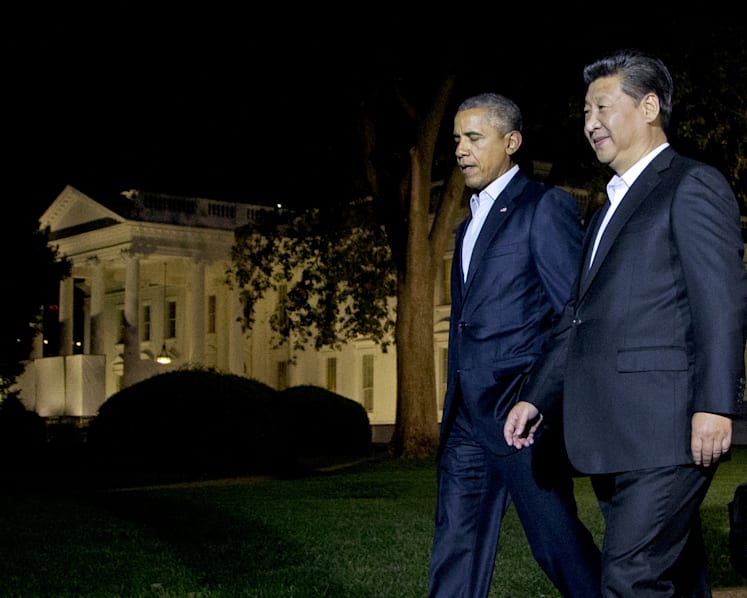
In this Sept 24, 2015, file photo, US President Barack Obama and Chinese President Xi Jinping, right, walk on the North Lawn of the White House in Washington, heading for a private dinner at the Blair House, across the street from the White House. Photo: AP


Between April and October 2015, a procession of important leaders from North-east and South Asia visited the United States.
It began with Japanese Prime Minister Shinzo Abe in April 2015, followed by Indian Prime Minister Narendra Modi and Chinese President Xi Jinping in September, and South Korean President Park Geun-hye in October.
The visits show the US’s pivot to Asia has worked, and these countries, for their own national interests and reasons, are keen to engage America and strengthen relations. For its strategic competitors, the US reiterates its message of Pacific commitment and willingness to work with rising powers on difficult issues.
These visits, taken together, are important in two ways.





First, they show the US’s power and influence in the Pacific, reflecting a stature that is a far cry from President Barack Obama’s first term in office. The US then had to persuade its allies of the need to pivot back to Asia. Even for those who felt the US had never left to begin with, the pivot was needed to address perceptions that the US had neglected the region.
With Mr Abe’s visit to the US this year, the decades-old US-Japan Alliance was reinforced after three years of uncertain relations during the administration of the Democratic Party of Japan (DPJ) from 2009 to 2012. The DPJ’s ambivalent stance on the US naval base issues and collective self-defence made relations with the US challenging. Mr Abe, who is from the Liberal Democratic Party, removed these tensions.
Mr Abe’s strong leadership style and control of a two-thirds majority in the Japanese Diet pushed the collective self-defence bills through parliament, enabling stronger cooperation with US forces and reinforcing the Alliance as the cornerstone of peace in the region.
Like Mr Abe, Ms Park’s visit reaffirmed South Korea’s alliance with the US. Her Pentagon visit is symbolic of the two countries’ close military relations with both firmly in favour of the denuclearisation of the Korean Peninsula.
However, security issues like the Terminal High Altitude Area Defence (THAAD) missile system that can intercept North Korean ballistic missiles headed towards Seoul and the US were not discussed during the visit. The system, which the US and South Korea are keen to deploy, is strongly opposed by Beijing. Going forward, Ms Park will need to showcase her adroit diplomatic skills in navigating between Washington and Beijing.
While President Xi’s visit was viewed as “great power diplomacy” as China is both a strategic competitor and partner to the US, it did achieve some consensus in tackling cyberspace security – a sticking point in relations between the two countries.
Not all issues were resolved though. For instance, the South China Sea dispute will continue to be a point of contention. In fact, the US is considering sailing within 12 nautical miles of the islands that Beijing is reclaiming to signify its rejection of Beijing’s territorial claim over the sea around islands.
INFLUENCE IN REGIONAL ECONOMICS
In other words, the visits indicate unequivocally that the US is the major Pacific power with two important alliances with Japan and South Korea to keep the peace within the region while it works out its relationship with China, a rising power.
All major solutions that affect regional security in Asia cannot be achieved without US partnership. Two of Northeast Asia’s major powers (Japan and Korea) are close US allies while another major power India is friendly to the US so regional security matters cannot be decided without inputs from the US alliance network.
Second, the visits signal the importance of the US’ influence in regional economic affairs. Mr Abe used his visit to drum up support for the Trans Pacific Partnership (TPP) in the US Congress while Ms Park’s visit yielded a joint statement on US support for Korean membership. The recently-concluded TPP involves 12 countries - including the world’s largest and third largest economies, the US and Japan - all of whom reached an agreement on numerous contentious issues.
Japan’s anticipated yields in exporting manufactured products to the US because of TPP access prompted Ms Park to indicate intentions to join the trade pact and to call South Korea and US ‘natural partners’ for the TPP. After being told to wait for the second wave of membership ascension in April 2015, South Korea is keen to catch up by ratifying the TPP so as to maintain its manufactured products’ competitiveness with Japan.
While in the US, the Asian leaders also rubbed shoulders with big businesses. For instance, Mr Xi met key corporate chiefs from Boeing, Microsoft and Starbucks when he visited Seattle recently. This signals the growing ties between US economic interests and East Asia.
Increasingly, the largest orders for American manufacturing companies are coming from Northeast Asia, such as the US$38 billion Boeing deal signed by Mr Xi during his visit to the US.
India was not left out of the business party. Like Mr Abe and Mr Xi, India’s Mr Modi also engaged with key business leaders in the US. However, instead of addressing Washington elites like Mr Abe did, or dining with Seattle bosses like Mr Xi did, Mr Modi communicated with Silicon Valley leaders and ethnic Indians who made it to the top rungs of US tech companies. His bear hug with Facebook founder Mark Zuckerberg was a media highlight.
In the Asian leaders’ visits, the US cities of Washington DC, Seattle and Silicon Valley were hotbeds of economic deals and diplomatic activities. Ultimately, the visiting Asian leaders have their own national interests. For Japan, South Korea and to a certain extent, India, their interest is in keeping the US presence strong in the region to manage a rising China.
As for China, the main takeaway of Mr Xi’s visit was to de-escalate tensions in Sino-US relations in the continuing power play between two of the world’s major economies as they learn how to live with each other.
ABOUT THE AUTHOR:
Dr Tai Wei Lim is senior lecturer at UniSIM and adjunct research fellow at the National University of Singapore’s East Asian Institute.




