What India’s state poll results mean for Modi and BJP
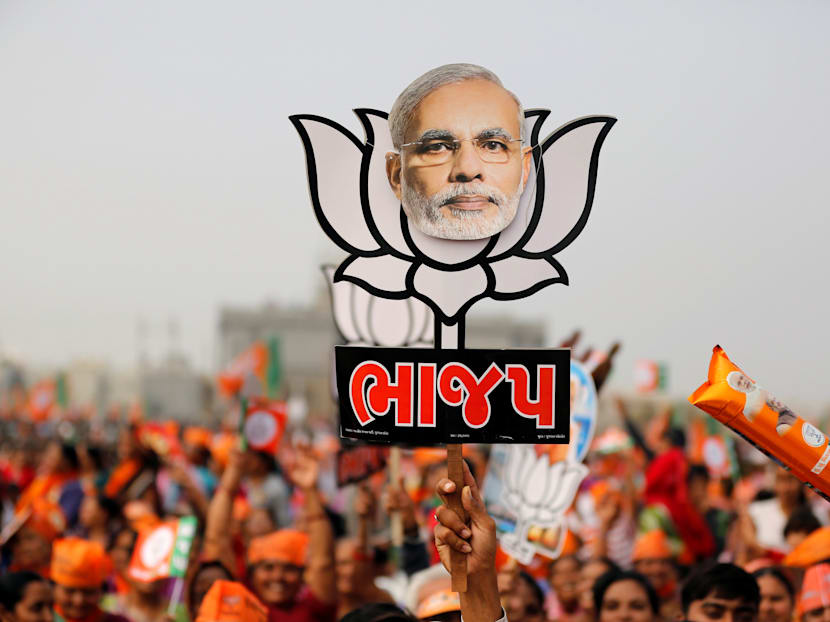
A supporter holds up a cut-out of a lotus, the election symbol of India's ruling Bharatiya Janata party (BJP), with an image of Prime Minister Narendra Modi during a campaign meeting on the outskirts of Ahmedabad. India’s divided opposition has seized on a new way to counter BJP: bringing national and regional rivals together to take on the ruling party.


The ruling Bharatiya Janata Party (BJP) last week lost elections in five Indian states, three of which were Hindi heartland states.
The opposition Congress party was the big gainer, dislodging the incumbent BJP in the three Hindi belt states of Chhattisgarh, Madhya Pradesh and Rajasthan.
In the two other states -- Telangana in southern India and Mizoram in the northeast – regional parties came out on top.
Though the scale and margin of the Congress victory differed in the three Hindi heartland states, the results represented a coming of age for Rahul Gandhi, who this month completed a year as the party president and has often been dismissed as a lightweight.





The results will ring alarm bells for the BJP as it heads into general elections in early 2019.
In the 2014 general elections, the BJP had won 62 of the 65 parliamentary seats from Chhattisgarh, Madhya Pradesh and Rajasthan.
This represented 22 per cent of the 282 seats that the BJP had won in 2014.
If the Assembly poll results were to be replicated in 2019, the BJP’s seat tally would go down to 31 seats in these three states.
While state election results are not necessarily always in the general elections, the proximity of the polls to the 2019 elections is crucial as is the erosion of BJP votes across the board.
Indeed, the past cycle of elections in these three state suggests that the party that does well in the state polls carries forward the momentum to the general elections.
Though the results in Chhattisgarh, Madhya Pradesh and Rajasthan augur well for the Congress in 2019, the party is organisationally weak in most of the other Hindi heartland states, including the populous states of Uttar Pradesh and Bihar, where it is unlikely to win even a handful of seats.
Outside the heartland, the Congress performed poorly in Telangana and Mizoram going to show that the Congress and Rahul Gandhi have a long way to go. However, the Congress’s strong showing will make it a far more credible fulcrum in 2019 for the opposition parties.
For the BJP, the erosion of support in Chhattisgarh, Madhya Pradesh and Rajasthan cut across the rural-urban divide, caste and class.
This was due to agrarian distress and unemployment turning out to be burning issues in the recent elections. The BJP was particularly hit hard in rural constituencies as well as those reserved for lower castes and tribals.
This will be a cause of concern for the BJP in 2019.
While Prime Minister Narendra Modi still remains very popular, his ability to swing elections is under scrutiny.
Though he addressed 30-odd rallies in the three Hindi heartland states, the BJP’s success in those constituencies was mixed.
Mr Modi, who benefited from being the challenger in 2014, has to now face the problems that come with incumbency. The tenor of the BJP’s 2019 campaign will be decided by what lessons Mr Modi and his inner circle draw from the current results.
The BJP’s poll campaign in the three Hindi heartland states saw a distinct rise in the pitch for Hindu nationalism with Uttar Pradesh’s controversial and divisive chief minister, Yogi Adityanath, campaigning prominently for the BJP and an escalation in personal attacks. Arguably, both did not have a positive impact on the party’s electoral fortunes.
Whether the BJP will continue ratcheting up its rhetoric on Hindu nationalism or highlight development and governance, as it did in 2014, remains to be seen.
The party though might find itself in a corner given its poor record on alleviating rural distress and in creating jobs. It is likely that the Modi government will announce big-ticket populist measures before the 2019 elections to sway voters.
The results of the Assembly elections, particularly in the three Hindi belt states, has thrown open the field for 2019.
The BJP will try and compensate for its probable losses in the Hindi heartland with additional seats from eastern India and the North-east, but that might not prove to be enough.
It will also be looking to reach out to regional parties as possible allies, both before and after the 2019 elections.
For the Congress, the Assembly poll results have firmed up its role as the pivot for opposition politics. But the Congress too needs to stitch together state-level alliances with regional parties if it is to significantly increase its seat tally from 2014.
Given its formidable election machinery, considerable war chest and Mr Modi’s continuing popularity, the BJP still remains the frontrunner to form the government in 2019.
Like in 2014, the BJP is likely to turn the general election into a referendum on Mr Modi. The recent Assembly elections have, however, given the opposition significant momentum and made the BJP’s task that much more difficult.
Should Singapore be worried about the prospect of a coalition government or the Modi government being voted out in 2019? The answer is no.
A change in government or a coalition government is unlikely to result in any major change in foreign policy, particularly with regard to Singapore or the region.
Foreign policy, too, rarely figures prominently in Indian elections with the exception of the immediate neighbourhood, Pakistan in particular.
So the best course of action for people in this region is to sit back and enjoy the next round of elections in India, which will the biggest and noisiest exercise in democracy in the world.
ABOUT THE AUTHOR:
Dr Ronojoy Sen is a senior research fellow at the Institute of South Asian Studies and the National University of Singapore’s South Asian Studies Programme.