

Why I’ll always want to look like a superhero
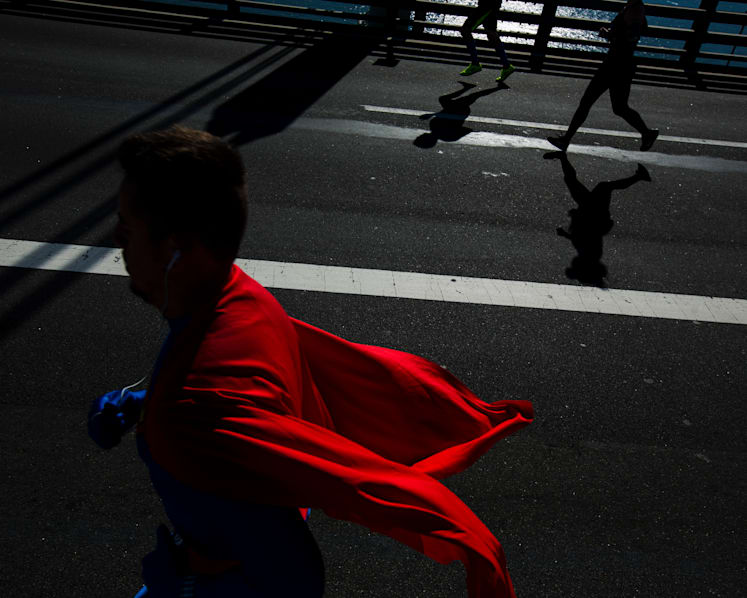
We all need to put on the costume, says the author, as the need to dress up is a childish impulse that foreshadows a permanent adult reality.


When did I first think seriously about clothes? As best as I can recall, I was 10, and the outfit that got my attention was a dark red bodysuit.
It was worn by Daredevil, The Man Without Fear. I can remember the very issue — number 181, April 1982 — that made Daredevil my favourite comic book, unseating my old standby, The Uncanny X-Men.
A big part of the appeal was that costume. Frank Miller drew the blood-coloured hero as an extension of the shadows he was always leaping out of or disappearing into. A badass costume, if there ever was one, and one that spoke directly to my apocalyptic pre-adolescent mood.
Daredevil has been on my mind since the death of Stan Lee this month. Lee was the man behind Marvel Comics, which published Daredevil and just about every other comic I ever loved.





His brilliance as a writer and ideas man, combined with the visual genius of his early collaborators Jack Kirby and Steve Ditko, transformed a niche boys’ entertainment of the early 20th century into a pillar of popular culture in the 21st.
When I started reading Marvel Comics they cost US 60 cents apiece. Disney bought Marvel Entertainment almost a decade ago for US$4 billion. It underpaid.
The latest Marvel movie, Infinity War, made more than US$2 billion at the box office. Marvel films tend to be technically competent and diverting enough, if you go in for explosions, or Scarlett Johansson.
For me, though, the magic is largely lost. This is not surprising.
Money can have that effect. But it is worth reflecting on what has changed. Part of it, I offer, has to do with those costumes — which are, after all, comics’ defining visual motif.
Why are the costumes so important? Because in their classic form, superhero comic books were that rare art form devoted to a single subject: the identity struggle of the adolescent male.
Superman, Batman, Spider-Man, the Hulk — the story always mirrors the tension between an imagined adult self, overflowing with power and beauty, and the awkward, unattractive, self-pitying boy beneath the costume.
Part of Lee’s achievement was creating superheroes who could reach beyond this pimply core audience. But the point remains.
The messy male at comics’ historical root is repugnant to parents and snobs alike.
Rejection of intellectual and moral sophistication, of filial deference and work-a-day responsibility are where the genre started. It amounts to a desperate scream: if only you fools could see what I really am!
But the grown-ups have it wrong. There is a lesson in comics’ crude dramatic scheme.
My comic obsession did not lead me to smash my enemies or dress in bright-coloured long underwear. But it impressed a deep truth.
Clothes do not make the man. They conceal the boy, the secret identity, the imposter we all harbour.
Part of the reason to get dressed in one way rather than another is to support the imaginative effort required to make yourself the person you want to be.
We all need to put on the costume. The need to dress up is a childish impulse that foreshadows a permanent adult reality.
The primary colours, bold patterns, capes and wild masks of the comics happily survive in the movies about Spider-Man and Thor, heroes closely identified with their outfits.
Many other Marvel characters, however, have had their costumes replaced with something resembling a military uniform, or the body armour of a SWAT team.
The favoured colour of film superheroes today? Matte black.
Consider Wolverine, most popular of the X-Men in 1980 and still so today. Originally he wore a bright yellow costume, with blue details, slashing black stripes and a mask with two sharp peaks.
In the latest movie, he has lost not only his superhero name — the film was called Logan, the character’s human name — but his costume.
He is just a man, played by a grizzled-looking Hugh Jackman in jeans and a leather jacket, who happens to be indestructible and to sprout metal claws.
Hero and man are blurred drearily together. Whatever merits the movie might have, the mythic oomph of the cheap comic has gone missing along with the costume.
The slow removal of the outlandish costume from the screen probably reflects an effort to make the films more palatable for adult audiences.
Note, though, it is happening at a time when men increasingly dismiss the importance of dressing generally (except at moments of real crisis, such as job interviews or their own wedding).
The khakis, blue shirt and fleece vest the average man pulls on before venturing into the adult world is not a costume fit for a hero. It is closer to a prison uniform.
My mother despaired as I dumped my allowance into comic books week after week. I consider it money well spent.
The world Lee made remains real to me, and when I get dressed I am, in some small way, trying to be a superhero. FINANCIAL TIMES
ABOUT THE AUTHOR:
Robert Armstrong is the FT’s US finance editor.




