

3 ways to make land transport safer, more convenient for seniors, persons with disabilities
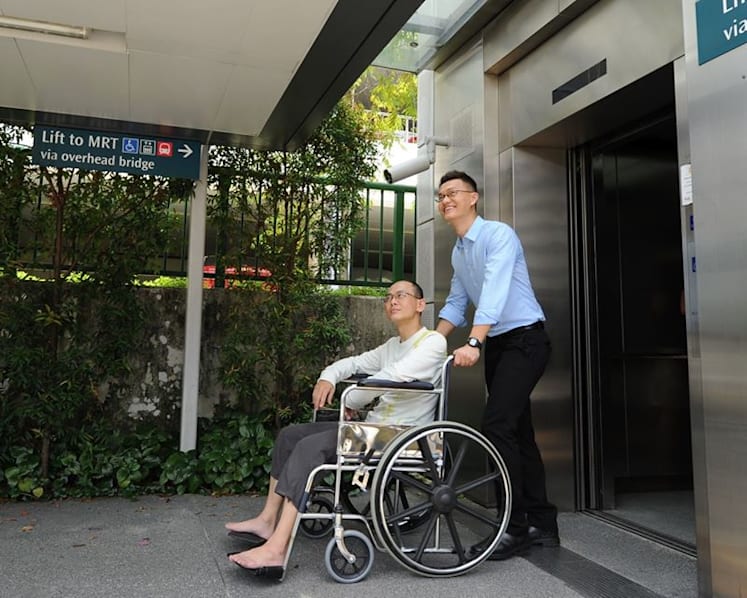
The Government has said that given the high costs of building lifts at overhead pedestrian bridges, it has to be prudent and prioritise its efforts on where to build these lifts.
The recent tender by the Land Transport Authority (LTA) in September to build lifts at 27 more pedestrian overhead bridges progressively from 2022 is laudable. It provides barrier-free access for persons with disabilities (PWDs) as well as convenience for the elderly and people pushing strollers.
Transport Minister Khaw Boon Wan has said in Parliament that it costs up to S$4 million for a pair of lifts to be installed at each bridge and a further S$40,000 a year to maintain them. He added that the Government therefore has to be prudent and prioritise its efforts on where to build these lifts, with LTA focusing on locations that most benefit seniors and commuters with mobility challenges, such as public-transport nodes and healthcare institutions.
Given these constraints, I would like to suggest that instead of retrofitting pedestrian overhead bridges with lifts, a ramp extension that connects to a nearby landing, building or even to the ground could be considered.
This not only improves connectivity with more load consideration but greatly lowers the possibility of mechanical failures.





On other road-safety matters, I would like to suggest further improvements to existing infrastructure.
First, the standard features in current zebra crossings have zigzag line markings, flashing yellow beacons and pedestrian crossing signs. These are purely visual indicators and may not be sufficient. Furthermore, some zebra crossings with two vehicle lanes can create blind spots. Even with the right-of-way for pedestrians, not all drivers drive safely.
To address that, tactile indicators such as road regulating stripes should be installed a distance away before zebra crossings.
Second, more signalised pedestrian crossings should be retrofitted with a central refuge and Green Man+ function. The Green Man+ function gives the elderly and PWDs extra crossing time of between three and 13 seconds with a tap of their respective concession cards on a reader box.
Even so, a full crossing may be difficult for some elderly people with knee problems or using mobility aids as well as PWDs on non-motorised wheelchairs. Thus, an additional central refuge will allow these pedestrians to have a breather and cross smoothly at their own pace.
Third, install handrails at pedestrian crossings. This will give seniors who are not using mobility aids extra support, instead of leaning on the traffic-light pole while waiting for the green man to light.
By 2030, one in four Singaporeans will be aged 65 and above, and our life expectancy today stands at 84.79 years. There is an urgent need to future-proof Singapore's land infrastructure to cater to the elderly and PWDs.
Have views on this issue or a news topic you care about? Send your letter to voices [at] mediacorp.com.sg with your full name, address and phone number.




