da:ns fest 2015: Stamp of approval for Eko Supriyanto’s Cry Jailolo
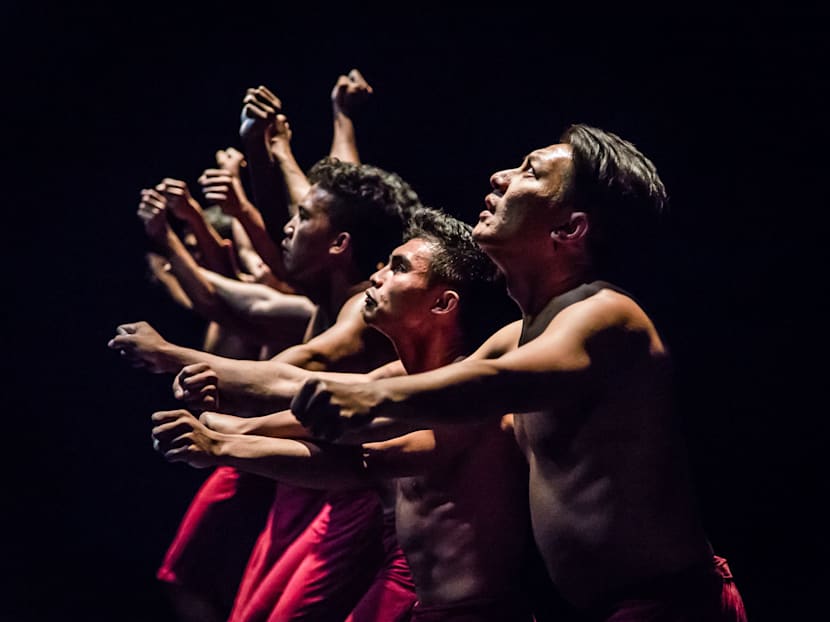


SINGAPORE — In Cry Jailolo, the first thing greets you is the faint rhythm of stamping in the dark. It is also the last thing you will hear.
It’s the catchy motif that forms the backbone of Indonesian choreographer Eko Supriyanto’s absorbing traditional-meets-contemporary piece based on the lesser-known cultures of Eastern Indonesia, in particular that of the town of Jailolo in the Maluku Islands (also known as the historical spice islands of Moluccas).
Tapping into traditional dances, as well as taking inspiration from marine life (the fluid movements of fish schools as well as the sorry state of coral reefs in the area), Supriyanto explores the idea of group dynamics and individual expression.
The seven young male performers — who, with one exception, are all members of Jailolo’s different tribes — continuously form patterns onstage. They arrange or rearrange themselves in a row or diagonally, or cluster together, all done to the steady pounding of their left heels (which has to be the most unusual anchor of a dance piece I’ve seen in a while).





The almost-uniform sight of upright bodies — and later, the equally uniform sight of performers half-crouched — gives Cry Jailolo an almost martial feel, which is occasionally disrupted when performers break free from the pack for a brief solo before blending into the group once more. All these as electronic beats (including hints of EDM) mesh or clash with the organic stamping.
It’s all pretty hypnotic — a simultaneous action of 14 arms fanning above heads, with all hands painted white, for instance, offers a shimmering effect — and halfway through, you feel like you’ve entered the world of Space Invaders-meets-Mambo Jambo-meets-Matisse’s La Danse (by way of Gauguin’s tropics). It’s also a rave moment slowed down, an exercise in endurance, and a moment of boys at play. It’s not so much bringing the so-called traditional into the now but reminding us that difference is overrated and at our basest bodily forms, you can glimpse similarities: When the performers enact what seems to be the gesture of holding spears and shields, minus props or costumes and in the context of artificial beats, you see it’s not much different from fist-pumping at a club.
The delight in seeing this completely new-yet-oddly familiar choreographic language that Supriyanto has organically created (after working with the Jailolo youths for two years) was similar to the first time this reviewer saw contemporary works in the region by the likes of Supriyanto’s compatriot Jecko Siompo, Thailand’s Pichet Klunchun or Cambodia’s Amrita Arts (in collaboration with Belgium’s Arco Renz). That Singapore’s festivals, such as da:ns fest, continue to encourage works from artists that challenge and reinvent ways we approach the region’s rich dance cultures — beyond free cultural presentations — is something quite precious and to be lauded.
Cry Jailolo succeeds as a work in itself, but it also offers other lessons on community empowerment, artists’ self-sufficiency and even cultural tourism.
During the post-show discussion, Supriyanto revealed how the work was done without any government funding. Instead, it was supported by the regent of West Halmahera (of which Jailolo is the capital), who let him create with no questions asked.
Supriyanto’s pitch? Cry Jailolo was to be a “silent tourism project” that tours. And indeed, it has been traveling to various arts festivals, the non-stop stamping slowly leaving its mark all around the world.
There’s one more show of Cry Jailolo tonight (Oct 15), 8pm, at the Esplanade Theatre Studio. Tickets at S$30 from SISTIC. For more info on the festival, visit http://www.dansfestival.com/2015/