

Finding hope and answers at life’s end
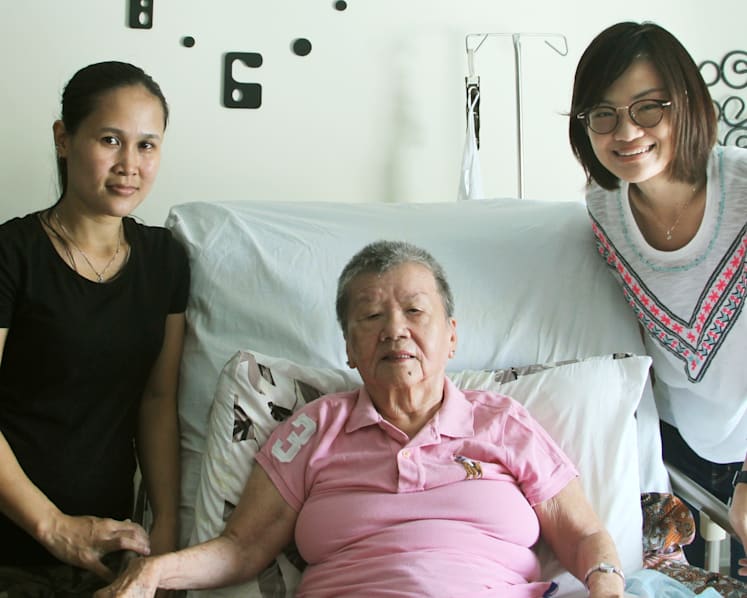
The author, a medical social worker seen here (right most) at a patient's home, says some of her patients have taught her the power of hope.
Hopelessness is highly correlated with the genesis of suicidal thoughts, but as a medical social worker of nine years, I believe that every person carries hope — in various forms, in all situations.
Hope often seems lost when death approaches, as we tend to perceive death as the end — the end of hope.
Although my patients’ physical bodies are failing, I believe there is always potential for growth, for hope, in other aspects of their being.
This can be in the form of their awareness and acceptance of emotions towards oneself, relationships with loved ones and their sense of spirituality (in other words, their pursuit of meaning and purpose in this concluding phase of their life journey).





Take Mr Chia, my first home hospice care patient. He was in his 70s, a tattooed chain-smoker who had lived a full and colourful life with many stories, some of which he enjoyed sharing and others which he preferred to keep to himself. His children were married and lived apart from him.
His relationship with his children was distant as he had extramarital affairs in his younger years and had also lived overseas in recent years with his girlfriend and their two teenage children.
Mr Chia returned to Singapore when he was diagnosed with terminal cancer and he was very grateful to his wife for letting him stay with her.
His wife was subsequently diagnosed with an illness that affected her mobility. He was deeply grieved and took up a caregiving role for his wife briefly.
As his wife’s condition deteriorated, their children decided to move her to live in one of their homes.
Mr Chia lived on his own thereafter and lost contact with his wife, as his children did not want him to visit her. He started to express suicidal thoughts, talking about losing hope of being able to reciprocate his wife’s care for him.
Soon, his sense of guilt towards his wife and children, as well as his girlfriend (and teenage children) grew.
My colleagues and I made more regular visits and worked with his children to monitor him. I also found a neighbour of his who agreed to visit him daily to check on him.
The turning point came when Mr Chia found peace through his religious faith. Whenever I visited him, he would reminisce about religious retreats he had attended. He placed his hopes on his pursuit of spiritual growth and often showed me his prayer books and prayer beads.
His children, being more aware of his very poor prognosis, began to visit him more and also brought their mother to visit him. These gestures were very important for him, as his deepest hope of being forgiven and accepted by his children was fulfilled.
He subsequently agreed to be admitted to a hospice and passed away a few weeks after that.
I also remember another patient, Mr Wong, who was in his 60s.
Cared for by his wife, he yearned to meet their adopted daughter May (not her real name), their only child whom he had not seen for five years. She had run away from home after giving birth to a girl, who was then cared for by her parents.
A disappointed Mrs Wong did not want to speak to May thereafter. But to Mr Wong, the happiest period of his time was raising and caring for May when she was young, and he wanted to remember her for the joy she had brought to him.
They had kept in touch from time to time, mostly when she needed money. As her husband’s health deteriorated, Mrs Wong finally agreed to arrange for May to see him by promising her a sum of money.
Mr Wong was greatly comforted by May’s visit, and told me that he was now at peace with himself. He passed away not long after, with Mrs Wong by his side.
Both Mr Wong as well as Mr Chia and his family have taught me the power of forgiveness — of self and of others — as well as the value of spirituality in very difficult times.
They have also taught me the power of hope. Mr Chia’s hope for forgiveness and acceptance from his family gave him peace and strength in his last days. The same went for Mr Wong’s hope of seeing May again.
Of course, I also see patients and families who lose hope when they grieve over their losses. For patients, it may be their health and independence (physical, financial and social), for families, it could be the sense that they have lost their connection with their sick loved one.
What I try to do is to listen, build connection and see the potential in their stories, to expand and develop a sense of hopefulness.
For patients who appear to have no or little hope, I find it helpful to introduce some form of reflection in our conversations. “What do you hope to have hope(s) in?” I would often ask.
No hope is too small or remote to be acknowledged, valued and respected.
In some instances, patients and families hold hopes that seem detached from reality. Then it is about engaging them with respect, trying to understand where they are coming from and helping them to adjust their aspirations.
After all, hopes are dynamic. We construct hopes, revisit and refashion them according to changing circumstances.
By staying connected to my patients and their families, I get to witness this dynamic process.
It is a privilege that I cherish. Just like it as a privilege for me to witness how Mr Wong and Mr Chia firmly held on to their hopes, which eventually came true.
ABOUT THE AUTHOR:
Venus Ther is deputy head of psychosocial services at HCA Hospice Care.




