Hong Kong’s extradition bill will only drive businesses to Singapore and elsewhere
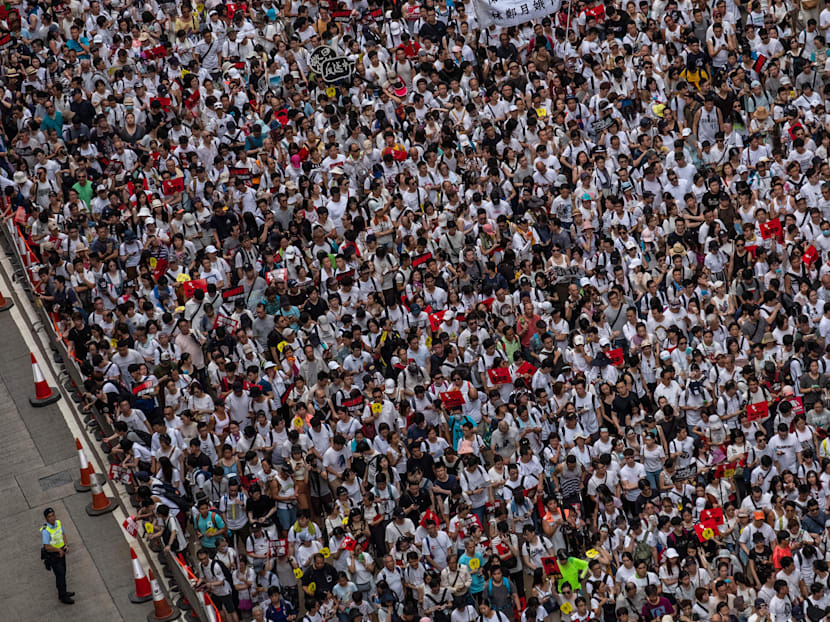
Protesters march on June 9 against the extradition bill, which the author says has already damaged Hong Kong's reputation as a global money centre.
I am just coming up to 50 years in Hong Kong. I saw through 1997, and there’s a pretty good probability that I will see through 2047. That makes me a very connected observer of my city.
Last Sunday, a million people surged onto the pavements like the floods of a June rainstorm. In 1997, there was an air of hope and confidence in the special administrative region, thanks to the Basic Law.
It allowed Hong Kong to have many years of relatively independent development, interspersed with some increasingly frequent cack-handed interventions. Hong Kong’s troublesome insistence on defending its 155-year-old way of doing things has clearly irritated Beijing.
China has a very long memory and revenge is a dish best eaten cold. The seeds of the extradition treaty were planted 16 years ago in the failed enactment of Basic Law Article 23, the National Security Bill 2003.





That time, a mass march succeeded; the people’s voice was heard and the proposal was shelved. Beijing then understood that Hong Kong was a rebel province. It is payback time. The fugitive offender ordinance is unfinished business.
The extradition treaty was a god-sent opportunity to enact a law that will, as the Chinese idiom goes, “kill the chickens to scare the monkeys”.
There were a lot of chickens marching last weekend and the response by Chief Executive Carrie Lam Cheng Yuet-ngor to continue with enacting the ordinance regardless, has swept away the last vestiges of the authorities’ credibility.
That actually is not as bad as the news that has come out in private conversations with lawyers, bankers and businesspeople.
They have indicated that it is getting increasingly tough to do international business here.
Singapore is mentioned as a frequent competitor. A Singaporean friend said about their government: “They really have got their stuff together”. Although he didn’t actually say “stuff”.
The extradition bill has already damaged our reputation as a global money centre.
The Nordic Chamber of Commerce said that the fugitive offender ordinance “represents a major change to Hong Kong’s external legal and judicial arrangements” that sits uneasily with a “stable and transparent centre for commerce and trade”.
Businesspeople don’t stick their heads above the parapet — they quietly vote with their feet. People are moving their money out.
The Hong Kong dollar is bumping up against its weak limit against the United States dollar.
“Of course,” they say, “Hong Kong is absolutely fine — but why take the risk, I’ve got my money in US dollars just in case.”
Surprisingly, not everybody outside our borders realises that we are a global city with the rule of law, low taxes and a century of top-level business skills.
Or that Hong Kong is the one city that never sleeps, where you can get business done in record time. As my wife says, “Hong Kong is New York – but in colour.”
For the first time, I am seeing the most committed and loyal supporters of Hong Kong privately turn to Plan B.
Formerly diehard Hong Kong residents are looking at business resident visas in places like Malaysia, Singapore, Taiwan and Thailand – or just using their foreign passports.
“Good riddance!” you might say, but you cannot be a global financial centre without the globe. China is the sovereign power and if the authorities keep to their domestic hard line, we must expect Beijing to tighten its grip. Hong Kong’s autonomy is a bad example to the rest of the nation.
Yet, enacting such an open-ended law by fiat will only drive business to places like Singapore.
Hong Kong must have some process of assimilation with the mainland, but politics should not have to damage our wealth.
Forcing the bill through will be a blow to our much-envied stability and transparency but power means little if your citizens distrust and resent you.
Forcing it through will also lead to a counterreaction. There is talk of more marches; shopkeepers have closed stores to allow staff to protest. Economies run from the bottom up.
Soothing political words from the ruling classes who have lost credibility with the Hong Kong people will not support the economy or provide evidence of a better business environment in the future.
Yet it cannot be beyond the wit of those same authorities to be a little more creative about how to bring Hong Kong into the fold while safeguarding our economic future.
I am sure that when I finally see July 1, 2047, it will be an anticlimax. We will have fully adapted to our new sovereign.
The Basic Law will be a distant memory and Hong Kong will merely be the 14th largest city in China. It may be smaller if political restrictions hinder our reputation as the go-to place for international business in Asia.
Our unique characteristic, the one thing that only we can give away, is the drive and energy that Hong Kong people have to get things done.
That, I hope, will never disappear. SOUTH CHINA MORNING POST
ABOUT THE AUTHOR:
Richard Harris is chief executive of Port Shelter Investment and is a veteran investment manager, banker, writer and broadcaster, and financial expert witness.