

India loses its faith in trade
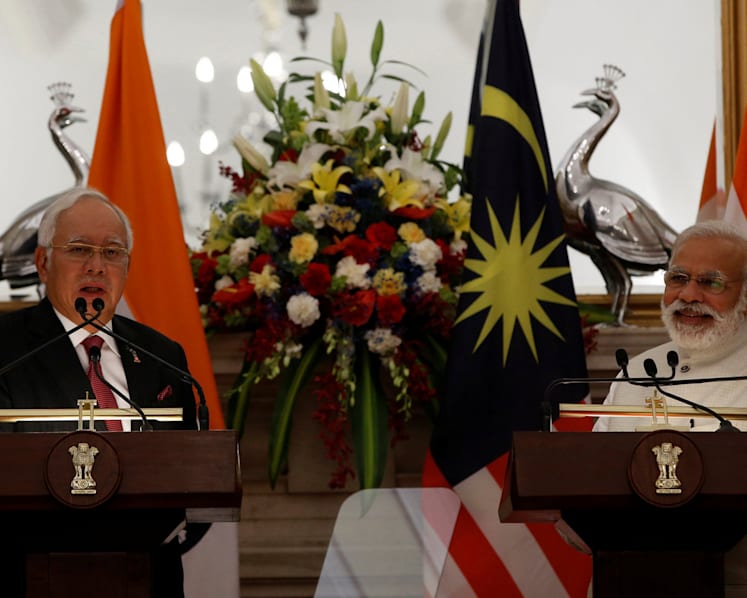
Negotiations over the RCEP trade pact were not mentioned when Malaysian Prime Minister Najib Razak stood beside Mr Narendra Modi during his visit to New Delhi last week. PHOTO: REUTERS
Until fairly recently, it looked like two massive new agreements would compete to define the future of world trade. The Trans-Pacific Partnership (TPP), backed by the United States, would try to move the global trade architecture towards new norms, with harmonised regulations at its centre.
Meanwhile, the Regional Comprehensive Economic Partnership (RCEP), backed by China, would drastically reduce remaining tariffs across a swathe of Asia and push the existing model of trade and manufacturing as far as it could go.
The TPP is now history, thanks to Mr Donald Trump. But the RCEP cannot exactly declare victory yet. The 16 nations involved — China, Japan, Korea, Australia, New Zealand and much of South-east Asia — have discovered a familiar hurdle in their path: India.
India has a long history of grumbling about trade agreements. In the past, it almost single-handedly held up consensus at various World Trade Organisation meetings. But it seemed much of that had changed in the past decade or so.





Under its previous prime minister, Mr Manmohan Singh, an understanding had begun to develop in New Delhi that trade agreements are not just about the mechanics of who gains and loses; they are about international relations, and how to tie countries and economies closer together. Under Mr Singh, India negotiated dozens of free-trade agreements — including one with the Association of Southeast Asian Nations (Asean), which he hoped would lead to a “pan-Asian” agreement.
But he never won over his bureaucrats or even many within his own party. And his successors seem far less enthusiastic about the possibilities of free trade. Partly that is because of India’s experience with the Asean deal, which began in 2010. It infuriated domestic industry and farmers’ organisations.
One chamber of commerce claimed that, since 2010, India’s exports to Asean had stagnated, while imports had grown by a third. Farmers in the south, meanwhile, have argued that they cannot compete with spices and vegetable oil from South-east Asia.
The government failed to stand up to these voices; it announced a “review” of existing trade deals early on in Mr Narendra Modi’s tenure, and there was the strong suggestion that new ones would be frowned upon — effectively ending Mr Singh’s policy of economic integration.
This same scepticism seems to be guiding the government’s behaviour at the RCEP negotiations. If Asean decimated Indian plantation farming and caused Indian companies to struggle, the argument goes, just imagine what free trade with China could do. India has been worried about Chinese overcapacity and its tendency to dump goods for a while.
Thus, when Malaysian Prime Minister Najib Razak flew to New Delhi last week, he was prepared to push hard on behalf of the RCEP. But it did not quite work. Mr Modi, standing next to Mr Najib, never even mentioned the negotiations. Other Indian officials made all the right noises, but it was clear that the only sort of agreement they were willing to countenance was a very weak one indeed.
India is hoping to drive a wedge between China and Asean — for instance, by offering the latter deeper tariff cuts than China would receive — although it seems Indian diplomats found few takers for their cunning plan.
Unless New Delhi feels it has more levers to keep Chinese imports out, it appears that it will simply not agree to any draft, and keep negotiations dragging on as long as possible. There are growing murmurs that India should just be dumped from the process altogether, and that the other countries should move on to a deal that they already largely agree on.
Mr Modi, when he took office in 2014, said that Mr Singh’s “Look East” policy would be replaced with an “Act East” policy of more engagement with South-east Asia and the Pacific Rim.
As is often the case with the Indian government, when you look behind the slogans, there is not much there. In fact, Mr Modi’s government has been moving backwards on trade. This is a pity — as Mr Singh was right. His much-maligned deal with South-east Asia may not have boosted exports. But tapping into foreign supplies of vegetable oils, for example, has helped ensure that consumers enjoyed low and stable prices for an essential part of their diet.
Moreover, India’s engagement with the thriving commercial networks of South-east Asia and southern China is the only way it can possibly develop an export-focused, job-generating manufacturing sector. Of course, it needs to operate in parallel with domestic reform — freeing up labour and land markets, and further reforming taxes. The government needs to open up Indian industries up to competition, give them the tools to compete and then be confident that they will.
But, judging by its response to the RCEP, it does not intend to do that at all. Is Mr Modi’s India really so much less confident than Mr Singh’s? BLOOMBERG
ABOUT THE AUTHOR:
Mihir Sharma is a Bloomberg View columnist. He was a columnist for the Indian Express and the Business Standard, and the author of Restart: The Last Chance for the Indian Economy.




