Making new year's resolutions? Prioritise your mental health
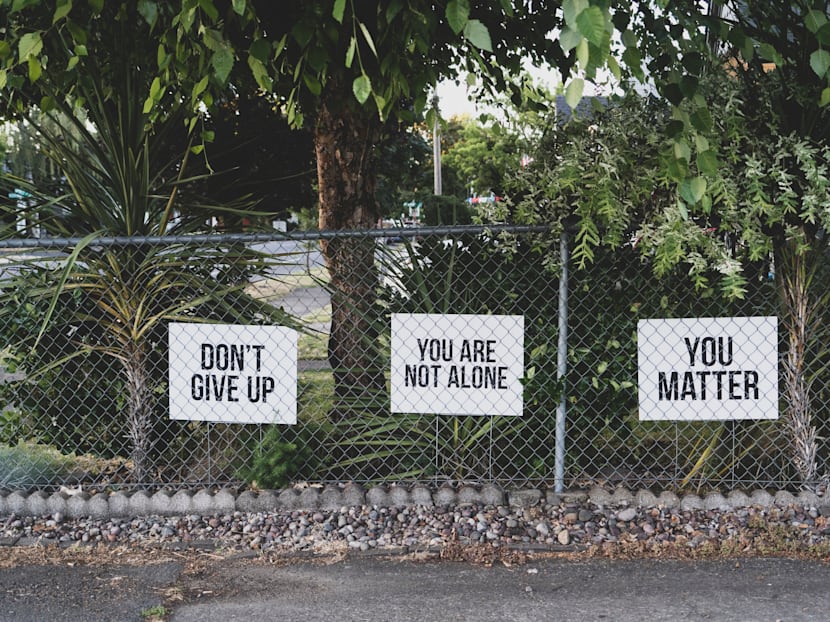
Singaporeans should prioritise looking after our mental health through setting achievable and measurable goals, writes the author.
In Singapore, one in seven people suffers from mental health problems — mood, anxiety or alcohol use disorder — in their lifetime and less than a quarter of these people seek professional help.
Like building a retirement nest, Singaporeans should prioritise looking after their mental health through setting achievable and measurable goals. Building up our resilience pays dividends when we hit rocky times.
Building up our resilience pays dividends when we hit rocky times.
As a society, we tend to value productivity at work over rest and personal relationships.





In our pursuit of excellence, we may set unrelenting standards for ourselves and others, such that there is no room for setbacks, and being "okay" is not good enough. This can keep us impatient, irritable and discontented.
Many of us no longer know how to be kind to ourselves, and we often hear more self-criticism than self-compassion.
This becomes a vicious cycle when we also expect perfection in others and are intolerant to imperfections and mistakes, which are actually part of our shared humanity.
The internet and its social networks have also robbed us of time spent with people we love and doing things we value.
It is common to see groups of people dining together, where each person — young and old alike — is more engrossed in their own handheld devices than the people in front of them.
Nothing beats real connections, and having trusted friends.
Looking ahead to the new year, here are mental health resolutions you can consider making — and keeping.
BE CONTENTED AND EXPRESS GRATITUDE
Consider keeping a journal where you can pen down three good things every day. These could be simple things that you appreciate in life. Be generous with your expression of gratitude.
If there are people in your life who you appreciate, why not express your gratitude through a simple message or any kind gesture such as running an errand for them or buying them a meal?
SLOW DOWN
Set aside a down-time of an hour daily where you can do anything you want. If it is hard to set aside an hour daily, then perhaps try an hour a week. Fit it into your schedule.
The trick to building down-times into your schedule is to plan ahead, or be flexible in catching a time which frees up at the last minute.
There are many things you can do during this quiet time: Mindfulness breathing, meditation, praying, and reading uplifting or scriptural verses.
Or it can even just be a time to be kind to yourself with self-affirmation phrases such as: “I am okay the way I am”, “I have done the best I can”, or “Making mistakes is part of learning”.
MAKE TIME TO GIVE
Individuals who volunteer are likely to benefit from a sense of meaning and fulfilment. So, another resolution could be to commit to a cause that you can volunteer in. You can start from your inner circle of friends, your local community or faith-based group. Any time given away is good enough!
PLAN AHEAD FOR HOLIDAYS
Many of us love our holidays. Now would be a good time to look at the year ahead, and start planning for your holidays with family and/or friends.
Holidays could be short breaks over long weekends, or longer stretches within your time limits and budget. You may also want to consider “detox holidays” — where you can meditate, practise a preferred exercise, or indulge in healthy organic food.
BUILD A 'REAL LIFE' SUPPORT SYSTEM
As social support is a crucial resource in building resilience to counter stress, why not set resolutions to preserve old relationships, and also be open to making new friendships each year?
I have a goal to make a new friend each year. This has not only enriched me, but has also reaped many joys over the years.
For example, since starting a new hobby — gardening and growing organic herbs, I have come to know of like-minded friends who have taught me how to grow my plants and vegetables better, and sharing my knowledge on what I learn has brought me joy when my friends are happy to hear my experiences.
DEVELOP ROUTINES FOR SLEEP AND REST
For adults, resolve to sleep about seven to eight hours daily. For families, do your best to set aside a regular bedtime that allows children to have the recommended hours of sleep per night, ranging from 11 to 13 hours for pre-schoolers and 8.5 to 9.5 hours for teenagers.
If you have young children, you can set aside time to read to your kids at least half an hour before bedtime. This can be part of your daily routine to bond with your children, and build a structure so your children can develop good sleeping habits.
At bedtime, parents can reflect with their children on three good things that they appreciated during the day.
Families can also consider having a device-free time for the family each day. For example, one can set aside an hour to dine and talk about the day together, without the use of devices, for a fixed number of days per week.
In addition, parents can intentionally carve out time for recreation and to be in the outdoors daily. Playing outdoors has many health benefits, such as helping to maintain children’s eyesight. In addition, exposure to sunlight helps to improve sleep.
Children can choose their preferred supervised outdoor activity — for example, a sport, and this could evolve into a fun activity for the whole family.
MAINTAIN GOOD PHYSICAL AND PYSCHOLOGICAL HEALTH
When our body is healthy, our mind is healthy — and vice-versa. It is thus important to go for annual health screenings.
The Health Promotion Board recommends at least 150 minutes of exercise a week and if we cannot meet this goal, any exercise is better than nothing. So, do consider setting realistic and achievable exercise goals, work towards keeping a regular schedule, or find a friend exercise regularly with. Accountability will keep you from straying from your goals.
As we set resolutions for ourselves, let us also look out for others who may need help — family, friends, or colleagues — and offer support. Do get the necessary professional help early when all natural coping resources are exhausted.
Although some people may have genetic vulnerabilities to mental health issues, and some experience life stressors that are powerful enough to challenge anybody’s mental well-being, we can all make resolutions to develop good mental health habits, build up resilience and be a support to one another as we move into the year ahead.
Happy 2020.
ABOUT THE AUTHOR:
Khoo Sue Anne is a principal clinical psychologist with the Department of Psychological Medicine at Khoo Teck Puat Hospital.