The OPEN 2015: Dance artist Cristian Duarte gets up close and historical


SINGAPORE — The Beatles’ Sgt Pepper’s Lonely Hearts Club Band album cover is one of my favourite album covers: Pop artists Peter Blake and Jann Haworth’s collage of around 70 famous (and infamous) people, improbably gathered for some kind of awkward group photo. To be honest, I can still only identify less than half of these folks. But that doesn’t take away from the fact that it’s really an arresting image, both cheeky and cocky.
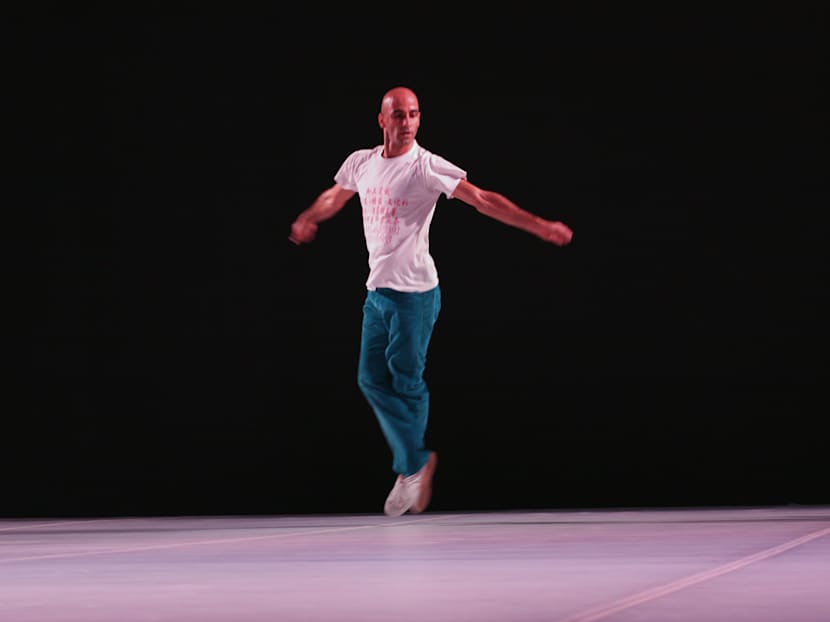
It’s a bit like my experience of Cristian Duarte’s The Hot One Hundred Choreographers at The OPEN, really. The Brazilian choreographer’s one-hour solo show last Thursday was essentially a movement catalogue of a hundred choreographers who have been influential in his career. A kind of embodied “group shot” if you will.
Inspired by British artist Peter Davies painting The Hot One Hundred, which was literally a list of a hundred artists and artworks, Duarte physically enacts some trademark movements from people ranging from ballet legend Marius Petipa and musical theatre great Bob Fosse to Martha Graham and Yvonne Rainer to Bruce Lee and Michael Jackson.
(In a way, I’m reminded of Choy Ka Fai’s previous Notion: Dance Fiction project, which looked at dance as pure muscle memory, where electrical jolts can turn anyone into Nijinsky. And I’m sure the whole idea of cataloguing and mapping in Duarte’s work can be linked to Choy’s own mapping project of Asian contemporary dance in his coming work SoftMachine at da:ns Festival. And while we’re at it, the idea of referencing influences and looking at multiple bodies of work also has, to my mind, connections with the Retrospective project of Xavier Le Roy — who’s in Duarte’s list, by the way.)





Duarte describes The Hot One Hundred Choreographers as a “game”. And, just as I’m sure to lose a Who’s On The Sgt Pepper’s Cover contest, I’ve probably failed miserably in Duarte’s game, too, which mashes up all the movements to the point where you can’t really recognise these. Although some were clear as day, I thought.
Until I checked out Duarte’s list post-show (http://www.lote24hs.net/hot100/) and realised I didn’t get most of my guesses at all. (Was that an Alvin Ailey? Sidi Larbi Cherkaoui? Contact Gonzo? Wrong, wrong, wrong, wrong. Wait, I see a macho Hofesh Shechter sequence! Sorry, try again. Oh, Duarte was standing there for a millisecond doing nothing — was that the Jerome Bel?)
Unless you’re a dance nerd, the whole Where’s Wally? approach can be a repetitive and frustrating experience. But stepping back from the mental exercise you can certainly admire Duarte’s single-mindedness in creating one whole work where the shifts and differences are clearly seen as he flows from fluid and elegant to the rough and angular, the stiff, the pop, the classic, the dramatic, the conceptual. You may not know every single reference but there is a particular history of dance filtered in Duarte’s ever-morphing body. Also, it’s hard not to be impressed by his ability to shift mental and physical states and mindsets continuously for an hour across 100 choreographers, a flurry of activity that the soundscape’s own mash-up across time and styles echoes and underscores.
The piece is undoubtedly partly a (cheeky and cocky) homage by Duarte. In the end, he gets a mic and loops himself singing Dirty Dancing’s Time Of My Life (before some stunt with a pile of blue glitter gently being dispersed by a mini-fan).
But surely there’s a bit of mockery here, too. A critique of the very idea of lists and catalogues, and of reducing artistic practices to trademark gestures, the way one would reduce to Pollock to the drips and splashes or e e cummings to the lower case letters.
***
Personal histories and codified movements are also made use of in Duarte’s other show, where he moves to one side and lets others do the dancing.
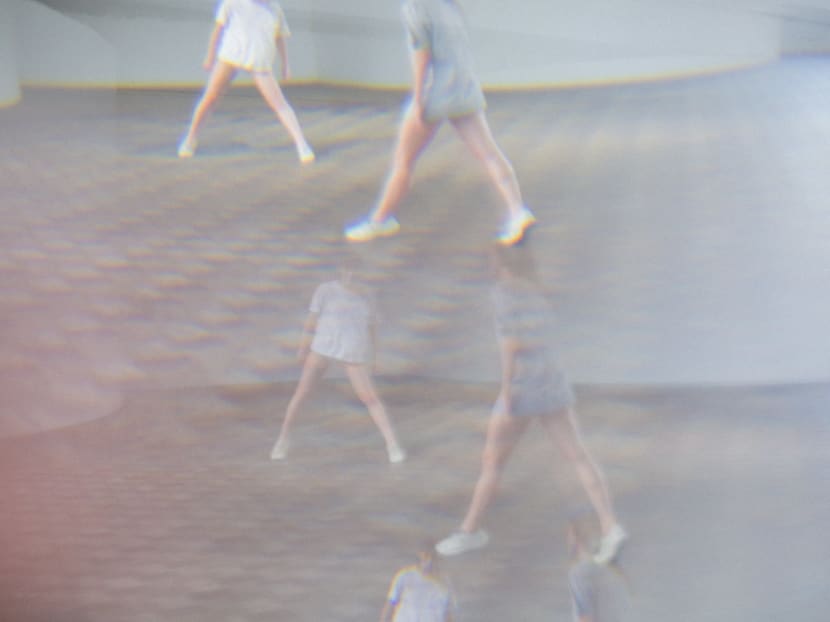
Compared to Duarte’s more cerebral solo, Friday’s BIOMASHUP is a contemplative experience as six dancers weave in and around audiences inside TheatreWorks’ white space venue for nearly an hour and a half, accompanied by the otherworldly sounds of the theremin as performed by Tom Monteiro.
If The Hot One Hundred Choreographers mixed and matched, BIOMASHUP, well, mashed up improvisations by the dancers and the musician. And they both complement and parallel one another: Standing still, Monteiro waves his arms around like a maestro while his dancer-collaborators focus on footwork by way of ballet and Cunningham. But at the same time, just as Monteiro doesn’t touch the theremin to create his music, the dancers come up close to audiences without touching them even as the proximity triggers sensations one wouldn’t normally have in a more conventional audience-performer stage set-up.
The “duet” between sound and movement is more emotive than rhythmic (the theremin is, after all, not a percussive instrument). And as Monteiro evokes a range of droning sounds from a ship horn to a planes passing overhead to eerier sounds, the performers — dressed in white tees, white sneakers and white briefs — are like ghosts flitting about.
What begins as slow, measured movements pick up pace. From plies to pirouettes. Legs kick out higher. Frowns appear on their faces and they become more aggressive, staring you down. Someone munches on an apple, someone else splashes water on the walls. They surround a few audience members. Eventually, you notice the subtle use of hands, slightly raised or arms crooked. Then, for some reason, they’re covering their hands with hand sanitiser and you eventually see these covered in blue glitter ala gloves (a nod to the glitter moment in The Hot One Hundred Choreographers).
And this sequence of events unfold all around you. The audiences are as close to a performers’ bodies as one could possibly get. If The Hot One Hundred Choreographers was like reading a book on dance history by way of Duarte’s body, this was a super close reading of bodies in transformation: The straining of leg muscles, the musky scent of the performers as they walk past you, and the sweat — droplets fall on the floor (or on you), their tees are soaked and cling to their bodies.
Unlike the first show, you don’t need to play a game of who’s who — it’s the dancer in front of you.