BOJ Governor Ueda's comments at news conference
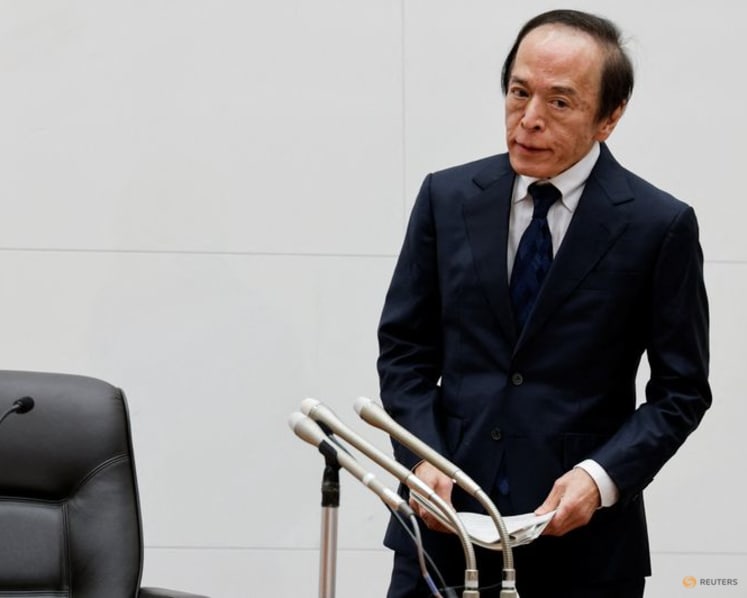
Bank of Japan Governor Kazuo Ueda enters a venue to attend a press conference after a BOJ policy meeting in Tokyo, Japan, January 23, 2026. REUTERS/Kim Kyung-Hoon
Jan 23 : The Bank of Japan raised its growth estimate and maintained its hawkish inflation forecasts on Friday even as it kept interest rates steady, signalling its confidence a moderate recovery would justify raising still-low borrowing costs further.
At a two-day meeting that ended on Friday, the BOJ maintained its key policy rate at 0.75 per cent in a widely expected decision after having just hiked the rate from 0.5 per cent in December.
Following are excerpts from BOJ Governor Kazuo Ueda's comments at his post-meeting news conference, which was conducted in Japanese, as translated by Reuters:
IMPACT OF PAST RATE HIKES





"Not much time has passed since we last raised rates in December, but companies' fund demand continues to rise moderately. Banks' lending attitude remains active... Financial conditions remain accommodative in Japan. It might take some time to gauge the impact of our past rate hikes. We hope to scrutinise developments carefully."
RATE-HIKE PATH AND PACE
"We will continue to raise interest rates if our economic and price forecasts materialise. As for our rate-hike path and pace, that will depend on economic, price and financial developments at the time. We will carefully look at available data at each policy meeting, and update our view on economic and price developments, risks and the likelihood of achieving our forecasts."
RECENT RISES IN LONG-TERM INTEREST RATES
"Long-term interest rates are rising at quite a fast pace... As we've been saying, we are ready to take nimble action to cope with exceptional moves that are different from usual. We will communicate closely with the government, and stand ready to play each of our roles."
WEAK YEN
"I won't comment on yen levels. Currency rates move on various factors, including interest-rate differentials. As the yen weakens, import prices would rise, which could then work to push up inflation for the time being. Companies are becoming more active in raising prices and wages, so they could pass on rising import costs more aggressively. That's something we need to keep an eye out on."
IF BOARD DISCUSSED WHETHER TO TWEAK BOND TAPER PLAN
"There was discussion on that topic. But the conclusion was that the BOJ would communicate closely with the government, and that each would play their role as needed."
PRICE HIKES
"In the past, most firms raising prices were doing so to pass on rising raw material costs. Now, a lot of firms are saying they are hiking prices to pass on labour costs. We hope to scrutinise wage moves affect inflation. It's true April is an important period as many firms change prices at that month. But if you ask me whether it's the most important factor in gauging the rate-hike timing, I would say not necessarily. It's among factors we will look carefully."
FACTORS BEHIND NEXT RATE-HIKE TIMING
"Unlike last time, we won't focus on any particular aspect. As prices and wages rise gradually, we're at a phase where we need to scrutinise whether this will continue and if so, at what pace, looking at various data in making our rate decision. We also need to look at how our previous rate hike affects the economy."
TIME TO GAUGE IMPACT OF PAST RATE HIKES ON ECONOMY
"The key would be how higher rates affect capital expenditure, investment and consumption, and how that affects inflation. But that will take a very long time to judge. We don't want to wait that long and want to grasp clues earlier. One way to do this is to look at financial conditions. Another is to conduct surveys on companies frequently, as they are the ones that make spending decisions."
WHAT DETERMINES PACE OF RATE HIKE?
"We'd like to scrutinise how our rate hikes last year affect the economy. We'd like to gather information as much as possible. The outcome would determine the pace of rate hikes. Since it's hard to grasp the exact level of neutral interest rate, that's the only way we can decide."
INFLATION
"I'm not of the view we are behind the curve in dealing with inflation. We will conduct monetary policy appropriately to ensure we don't fall behind the curve."
WHETHER THE BOJ HAS ALREADY PRODUCED ESTIMATE ON NEUTRAL RATE BASED ON LATEST DATA
"We haven't had updated data, so that's something our staff will probably do in the future. But our forecasts suggest that even if we use new data, our neutral rate estimate won't change much. We'll look into releasing our findings such as through a staff paper."
WHETHER HE AGREED WITH FINANCE MINISTER KATAYAMA THAT THE BOND MARKET SELLOFF HAS RUN ITS COURSE FOR NOW
"Volatility remains high, so I would like to scrutinise developments carefully."