







Stocks edge up, yields fall as US data, tariff risk gauged
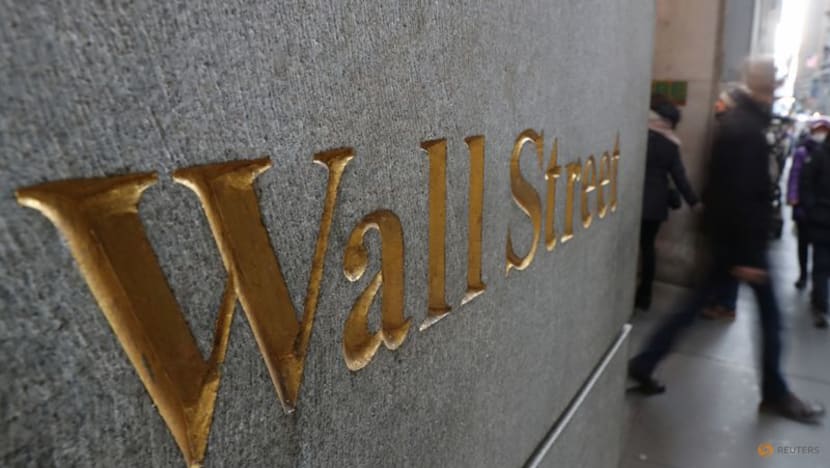
FILE PHOTO: A street sign, Wall Street, is seen outside New York Stock Exchange (NYSE) in New York City, New York, U.S., January 3, 2019. REUTERS/Shannon Stapleton/File Photo
NEW YORK :A benchmark of global stocks hit a record on Friday while U.S. Treasury yields dipped as some soft U.S. data and the latest tariff announcements raised hopes that the Federal Reserve may have some cushion to be more aggressive in cutting interest rates.
The Commerce Department said retail sales dropped 0.9 per cent last month, the biggest decrease since March 2023, after an upwardly revised 0.7 per cent increase in December, and well short of the 0.1 per cent decline estimate of economists polled by Reuters, suggesting rising prices and tariff uncertainty may be leading consumers to tighten spending.
Other data from the Federal Reserve showed factory output dipped 0.1 per cent last month, short of the estimate calling for a 0.1 per cent increase, after a downwardly revised 0.5 per cent rebound in December, as a sharp drop in motor vehicle output weighed.
On Thursday, U.S. President Donald Trump directed his economic team to devise plans for reciprocal tariffs on every country that taxes American imports, raising the risk of a global trade war, but stopped short of imposing another round of duties.
On Friday, Trump warned again that BRICS nations could face tariffs from the United States if they set up their own currency.
Investors were watching for updates from the Munich Security Conference, where U.S. Vice President JD Vance accused European leaders on Friday of censoring free speech and failing to control immigration, drawing a sharp rebuke from Germany's defense minister and overshadowing discussions on the war in Ukraine.
A meeting between Vance and Ukrainian President Volodymyr Zelenskiy ended without news of a deal for critical minerals that is central to Ukraine's push to win Trump's support.
"It's all about Trump right now. All the other stuff is just noise. What everyone is focused on is, 'What is Trump going to do next, and where are his tariff wars going?'" said Dennis Dick, a trader at Triple D Trading in Ontario, Canada.
On Wall Street, the S&P 500 ended roughly unchanged, as tech led sector gains while consumer staples was the worst performer.
The Dow Jones Industrial Average fell 165.35 points, or 0.37 per cent, to 44,546.08, the S&P 500 fell 0.44 points, or 0.01 per cent, to 6,114.63 and the Nasdaq Composite rose 81.13 points, or 0.41 per cent, to 20,026.77.
For the week, the S&P 500 gained 1.47 per cent, the Nasdaq rose 2.58 per cent, and the Dow climbed 0.55 per cent. The Nasdaq marked its biggest weekly percentage gain since early December.
Expectations for a cut of at least 25 basis points by the Federal Reserve in June have crept back up to 51.3 per cent, after markets were pricing in a 40.3 per cent change in the prior session, according to CME's FedWatch Tool.
Dallas Fed President Lorie Logan reiterated her view on Friday that even if inflation data comes in cooler in coming months, the U.S. central bank should not necessarily reduce short-term borrowing costs in response.
MSCI's gauge of stocks across the globe added 1.73 points, or 0.20 per cent, to 884.10 after inching up to a fresh intraday record for a second straight session at 885.66. The index was on track for its fourth weekly gain in five.
The pan-European STOXX 600 index closed down 0.24 per cent but was able to secure its eighth consecutive week of gains, its longest streak in a year. European stocks have outperformed their U.S. counterparts since the start of the year, although questions remain whether that can last.
The dollar index, which measures the greenback against a basket of currencies, fell 0.3 per cent to 106.77 after falling to a two-month low of 106.56, with the euro up 0.28 per cent at $1.0493.
Against the Japanese yen, the dollar weakened 0.35 per cent to 152.26 while Sterling strengthened 0.14 per cent to $1.2583 against the greenback.
The yield on benchmark U.S. 10-year notes fell 4.7 basis points to 4.478 per cent but was still on track for a weekly gain after falling in two consecutive weeks.
Oil prices fell, erasing earlier gains, as prospects for a peace deal between Russia and Ukraine were countered by a delay in U.S. reciprocal tariffs.
U.S. crude fell to settle down 0.77 per cent to $70.74 a barrel and Brent settled at $74.74 per barrel, down 0.37 per cent on the day.
text_section_type="notes">https://www.reuters.com/markets/ For Reuters Live Markets blog on European and UK stock markets, please click on:





