







Tech, banks lead Wall Street bounce, gold wanes on Iran, strong jobs data
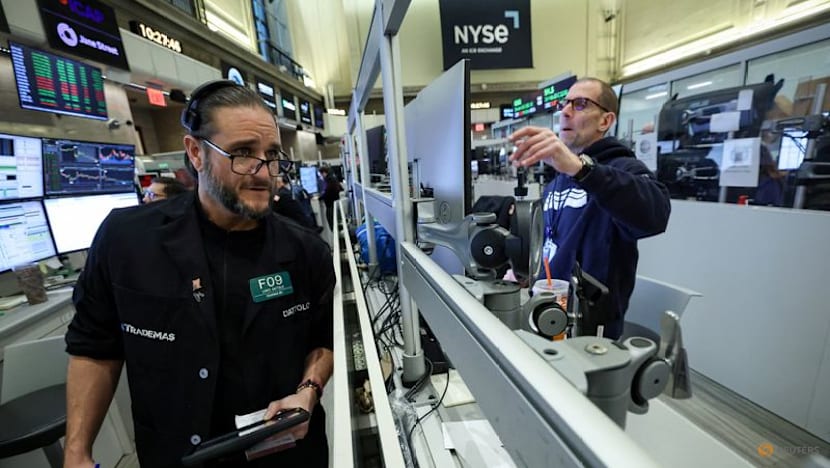

Jan 15 : Winning results from chipmaker TSMC and major banks bounced Wall Street higher after two days of losses on Tuesday, while gold fell from recent highs as U.S. jobless data boosted the dollar and President Donald Trump moderated his message about a deadly crackdown on protests in Iran.
Taiwan's TSMC, the world's biggest producer of advanced AI chips, posted a forecast-smashing 35 per cent jump in fourth-quarter profit, sending its U.S.-listed shares up 5 per cent.
Financial firms joined the earnings party. Investors rewarded BlackRock for beating analyst forecasts with a 6 per cent rise in the global asset management leader's share price.
Goldman Sachs gained 5 per cent and fellow investment bank Morgan Stanley rose 6 per cent after both reported rising quarterly profits, helped by busy dealmaking.





Investors had worried tech valuations "were getting a little too far ahead of themselves," said Alan Lancz, president of Alan B. Lancz & Associates Inc., an investment advisory firm, based in Toledo, Ohio. "That's been kind of squashed this morning with the news from Taiwan Semiconductor."
According to preliminary data, the S&P 500 gained 0.26 per cent, to end at 6,944.57 points, while the Nasdaq Composite gained 0.25 per cent, to close at 23,530.02. The Dow Jones Industrial Average rose 0.60 per cent, to 49,446.23.
"We are at the very beginning of the earnings season and so far so good," said Peter Cardillo, chief market economist at Spartan Capital Securities in New York.
The tech tide had lifted Dutch chip equipment maker ASML, a major TSMC customer, which in turn pushed European shares back towards record levels.
IMMEDIATE RISK SOFTENS
Oil prices settled 4 per cent lower, breaking a five-day streak of gains sparked by Trump's threat of intervention in Iran, a member of the Organization of the Petroleum Exporting Countries.
"While the situation remains fragile, the immediate risk premium has softened but is unlikely to go away given the continued risk of a disruption," Saxo Bank analyst Ole Hansen said.
Brent futures settled down $2.76 or 4.15 per cent, at $63.76 a barrel. U.S. West Texas Intermediate crude fell $2.83, or 4.56 per cent, to $59.19.
Gold, which thrives as a safe haven in geopolitical and economic uncertainty, as well as in low-interest-rate environments, declined.
Its price fell 0.15 per cent to $4,613.37 an ounce, a day after hitting a record $4,642.72.
In an interview with Reuters on Wednesday, Trump addressed his administration's pursuit of Federal Reserve Chair Jerome Powell, which has been another source of investor consternation.
Trump said he had no plans to fire Powell, who is facing a Justice Department criminal investigation.
"Right now, we're (in) a little bit of a holding pattern with him, and we're going to determine what to do. But I can't get into it. It’s too soon. Too early," Trump said.
JOBS SURPRISE BOOSTS DOLLAR
The dollar rose to a six-week high on news that the number of Americans filing new applications for unemployment benefits unexpectedly fell last week, bolstering expectations the Federal Reserve will keep interest rates on hold for several months.
The dollar index, which measures the greenback against a basket of currencies, including the yen and the euro, reached 99.49, the highest since December 2. The euro reached as high as $1.1592, the lowest since December 2.
The index was last seen 0.24 per cent higher at 99.32, with the euro down 0.24 per cent at $1.1614.
Reports on manufacturing in New York State and the Mid-Atlantic region were also stronger than expected.
U.S. Treasury yields were mostly higher after the data flurry.
The benchmark 10-year notes were last yielding 4.162 per cent, from 4.14 per cent late on Wednesday.
Chicago Federal Reserve President Austan Goolsbee said the U.S. central bank should focus on getting inflation down as there is ample evidence of job market stability.
Kansas City Fed President Jeff Schmid said inflation was running "too hot" while San Francisco Fed President Mary Daly said that incoming economic data looks promising despite uncertainties and continued risks to both the Fed's inflation and employment mandates.
(Additional reporting by Chuck Mikolajczak in New York, Enes Tunagur in London and Kevin Buckland in Tokyo. Editing by Ed Osmond, Andrew Heavens and Mark Potter and Aurora Ellis)





