







Oil settles up on expectations of Fed rate cut, Ukraine peace talks stalling
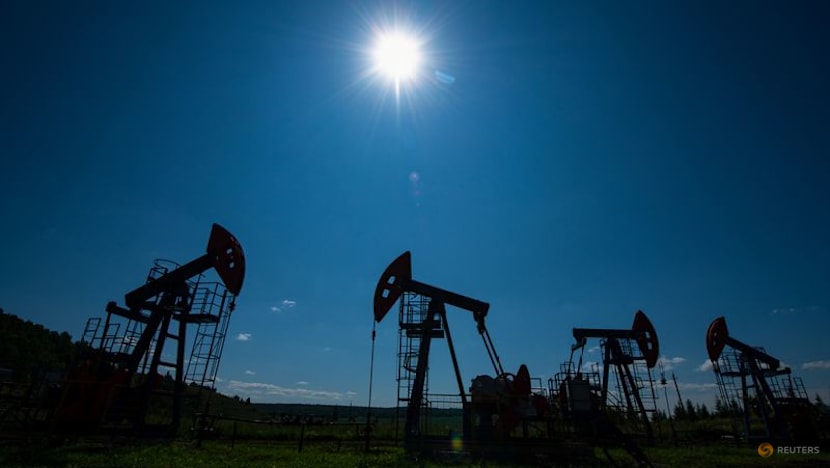
A view shows oil pump jacks outside Almetyevsk, in the Republic of Tatarstan, Russia July 14, 2025. REUTERS/Stringer
HOUSTON, Dec 4 : Oil prices settled up on Thursday on investors' expectations for the Federal Reserve to cut interest rates, while stalled Ukraine peace talks tempered expectations of a deal restoring Russian oil flows.
Brent crude settled up 59 cents, or 0.94 per cent, to $63.26. U.S. West Texas Intermediate settled up 72 cents, or 1.22 per cent, to $59.67.
U.S. crude futures briefly rose more than $1 a barrel earlier in the session as global shares rose, powered by expectations that a U.S. rate cut will support the world's largest economy and oil demand, after data showed employment is slowing.
The dollar was lower, poised for its 10th straight day of losses against a basket of major currencies, making crude cheaper for buyers using other currencies.





“I think the potential for a rate cut is overshadowing everything right now and driving crude prices up,” said Phil Flynn, senior analyst with Price Futures Group.
Escalating tensions between the U.S. and Venezuela were also supporting prices, analysts said, on concerns of a drop in crude supplies from the South American country.
"Benchmark crude oil prices could be impacted significantly by escalating military tensions between the U.S. and Venezuela," Rystad Energy analysts said in a note on Thursday, noting that U.S. President Donald Trump's administration is ratcheting up pressure on Venezuelan President Nicolás Maduro, "signalling the possibility of a U.S. incursion."
UKRAINE PEACE TALKS STALL
The perception that progress on a peace plan for Ukraine was stalling also supported prices, after Trump's representatives emerged from peace talks with the Kremlin with no breakthroughs on ending the war.
"War and politics, balanced against comfortable stocks, expected supply surplus, and OPEC’s market-share strategy, keep Brent in the $60–$70 range for now," said PVM analysts.
Previously, expectations of an end to the war had pressured prices lower, as traders anticipated a deal would allow Russian oil back into an already oversupplied global market.
Ukraine hit the Druzhba oil pipeline in Russia's central Tambov region, a Ukrainian military intelligence source said on Wednesday, the fifth attack on the pipeline that sends Russian oil to Hungary and Slovakia. The pipeline operator and Hungary's oil and gas company later said supplies were moving through the pipeline as normal.
"Ukraine’s drone campaign against Russian refining infrastructure has shifted into a more sustained and strategically coordinated phase," consultancy Kpler said in a research report.
"This has pushed Russian refining throughput down to around 5 million barrels per day between September and November, a 335,000 bpd year-on-year decline, with gasoline hit hardest and gasoil output also materially weaker," the report added.
U.S. crude and fuel inventories rose last week as refining activity picked up, the Energy Information Administration said on Wednesday.
Crude inventories rose by 574,000 barrels to 427.5 million barrels in the week ended November 28, the EIA said, compared with analysts' expectations in a Reuters poll for an 821,000-barrel draw.
Fitch Ratings on Thursday cut its 2025-2027 oil price assumptions to reflect market oversupply and production growth that is expected to outstrip demand.
Saudi Arabia set the January Arab Light crude oil official selling price to Asia at $0.60 a barrel above the Oman/Dubai average, its lowest level in five years, according to a pricing document reviewed by Reuters.
Meanwhile, Kazakhstan's oil and gas condensate production declined by 6 per cent in the first two days of December, an industry source said on Thursday, following a Ukrainian drone attack on the Caspian Pipeline Consortium's (CPC) Black Sea loading facility.
(Additional reporting by Shadia Nasralla in London, Mohi Narayan in New Delhi and Colleen Howe in Beijing. Editing by Jane Merriman, Bernadette Baum, David Gregorio, Deepa Babington and Diane Craft)





