Stocks rise as dollar dips after Trump's walk-back of Greenland threats
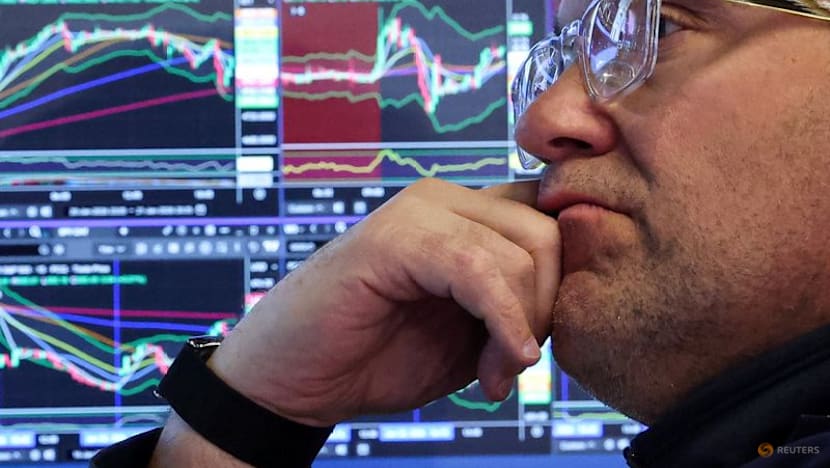
A specialist trader works at his post on the floor at the New York Stock Exchange (NYSE) in New York City, U.S., January 21, 2026. REUTERS/Brendan McDermid
NEW YORK/ LONDON, Jan 22 : MSCI's global equities gauge rose on Thursday and the dollar dipped as investors leaned into riskier bets a day after U.S. President Donald Trump dropped tariff threats against eight European countries and ruled out seizing Greenland by force.
Trump said on Thursday that the details of a U.S. agreement over Greenland are still being worked out after he stepped back from threats to seize the Danish territory.
In an interview on Fox Business Network from the World Economic Forum in Davos, Trump said any deal would allow the U.S. "total access" to Greenland, including for the military, "at no cost."
U.S. ECONOMY GREW FASTER THAN EXPECTED
Data from the Commerce Department's Bureau of Economic Analysis showed the U.S. economy grew a bit faster than initially thought in the third quarter, and corporate profits were also revised higher.
The upwardly revised 4.4 per cent annualized growth rate in U.S. GDP was the fastest pace since the third quarter of 2023, while U.S. consumer spending increased solidly in November and October.
The number of Americans filing new applications for unemployment benefits increased marginally last week, suggesting the labor market likely maintained a steady pace of job growth in January.
After the sharp selloff in U.S. stocks earlier in the week on Greenland concerns, Wall Street indexes erased most of their losses for the second straight day of gains as investors took U.S. economic data in stride on Thursday, as they digested Trump's turnaround.
"Overwhelming all other news is the Greenland story, and the suggestions that are now withdrawn of military action or tariffs," said Rick Meckler, partner at Cherry Lane Investments in New Vernon, New Jersey. "The market tends to react to emergencies, and it seems the emergency aspect of this is over for now."
Meckler said, however, that Thursday was "more a relief rally ... than an understanding whether there's a material change in the world economic order and how the U.S. is going to interact with its traditional trading partners."
On Wall Street, the major indexes closed higher. The Dow Jones Industrial Average rose 306.78 points, or 0.63 per cent, to 49,384.01, the S&P 500 gained 37.73 points, or 0.55 per cent, to 6,913.35 and the Nasdaq Composite rose 211.20 points, or 0.91 per cent, to 23,436.02.
MSCI's gauge of stocks across the globe rose 7.38 points, or 0.72 per cent, to 1,036.03.
Earlier, the pan-European STOXX 600 index closed up 1.03 per cent.
In currencies, the safe‑haven dollar slipped on Thursday, while risk‑sensitive currencies such as the euro and sterling firmed after Trump's turnaround helped calm a jittery market.
The dollar index, which measures the greenback against a basket of currencies including the yen and the euro, fell 0.61 per cent to 98.29.
The euro was up 0.61 per cent at $1.1753, while against the Japanese yen, the dollar strengthened 0.09 per cent to 158.39.
Sterling strengthened 0.57 per cent to $1.3501 while the Australian dollar strengthened 1.17 per cent versus the greenback to $0.6839.
In U.S. Treasuries, yields were a mixed bag with shorter-dated rates edging higher and longer maturities slipping, as investors braced for bouts of volatility and awaited further clarity on the Greenland framework deal negotiated by President Trump with European leaders.
"A little bit of the policy shock has been taken off the table, but only for the moment. And it is a relief, but at the same time, it increased the market's wariness around the potential for this to happen again," said Tony Rodriguez, head of fixed income strategy at Nuveen.
The yield on benchmark U.S. 10-year notes fell 0.4 basis points to 4.249 per cent, from 4.253 per cent late on Wednesday, while the 30-year bond yield fell 2.7 basis points to 4.8427 per cent from 4.87 per cent.
The 2-year note yield, which typically moves in step with interest rate expectations for the Federal Reserve, rose 1.5 basis points to 3.612 per cent, from 3.597 per cent.
In energy markets, oil prices fell more than $1, reversing the previous session's gains, after Trump softened threats against Greenland and Iran, and while investors hoped for progress on a solution to end Russia's war in Ukraine.
U.S. crude settled down 2.08 per cent, or $1.26 at $59.36 a barrel, and Brent settled the session at $64.06 per barrel, down 1.81 per cent, or $1.18.
In precious metals, safe-haven gold pushed past $4,900 per ounce for the first time, powered by ongoing geopolitical tensions, a softer U.S. dollar, and expectations of Federal Reserve interest rate cuts, while silver and platinum prices also hit fresh record highs.
Spot gold rose 1.83 per cent to $4,924.49 an ounce. U.S. gold futures gained 1.57 per cent to $4,907.90 an ounce.
In cryptocurrencies, bitcoin fell 0.83 per cent to $89,450.21. Ethereum declined 2.81 per cent to $2,945.75.