







US dollar advances after recent fall; sterling dips after GDP data
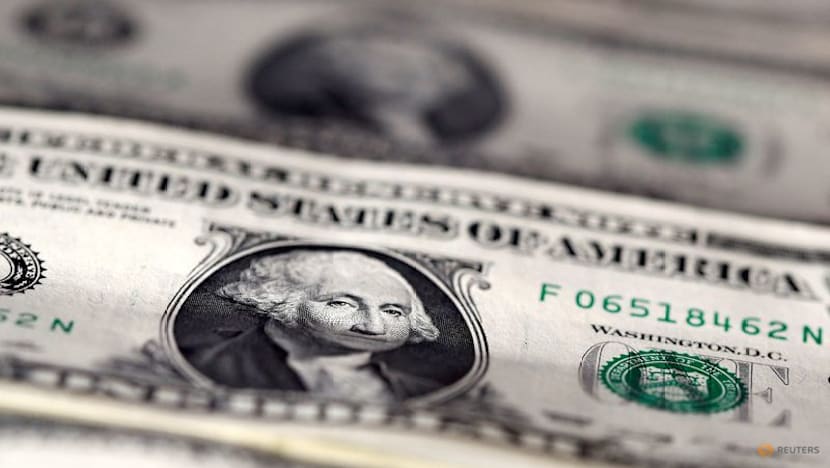
FILE PHOTO: U.S. dollar notes are seen in this November 7, 2016 picture illustration. REUTERS/Dado Ruvic/Illustration/File Photo
NEW YORK, Dec 12 : The U.S. dollar rose against major currencies on Friday after falling in recent sessions, but was still on track for its third straight weekly drop amid the prospect of interest rate cuts by the Federal Reserve next year.
Sterling also eased after data showed the UK economy unexpectedly shrank in the three months to October.
The euro was flat at $1.1735 after hitting a more than two-month high on Thursday.
The dollar index, which measures the U.S. currency against six others, rose 0.1 per cent to 98.44, rallying from a two-month low hit on Thursday but still on track for its third weekly decline with a 0.6 per cent fall. For the month of December, the greenback has been 1.1 per cent weaker so far.





The index was also down more than 9 per cent this year, on pace for its steepest annual drop since 2017.
"It's Friday fatigue. The dollar is down on the week and it's pretty much down the whole month," said Bob Savage, head of markets macro strategy at BNY in New York. "And is it because the Fed cut rates? Yes partially."
Against the yen, the dollar rose 0.2 per cent to 155.93 yen ahead of next week's Bank of Japan meeting, where the broad expectation is for a rate hike. Markets are focused on comments from policymakers on how the rate path will look in 2026.
Reuters reported that the BoJ would likely maintain a pledge next week to keep raising interest rates, but stress that the pace of further hikes would depend on how the economy reacts to each increase.
The pound edged down 0.2 per cent against the dollar to $1.3375, but not far from a seven-week peak hit on Thursday, after economic data that was likely to boost expectations for Bank of England interest rate cuts.
Both sterling and the euro are poised for their third straight week of gains against the dollar.
UNCERTAINTY OVER U.S. MONETARY POLICY NEXT YEAR
The Fed cut rates as expected this week but comments from Chair Jerome Powell and the accompanying statement were viewed by investors as less hawkish than expected and reinforced dollar-selling momentum.
"That was a neutral cut," said BNY's Savage, disagreeing with market participants describing the Fed's move last Wednesday as a some form of "hawkish" easing.
"Yes, the board is divided and we saw that in the dissents, But it's not fair to say that the Fed is going to raise rates like what the other central banks are talking about like the ECB (European Central Bank) and RBA (Reserve Bank of Australia)."
Douglas Porter, chief economist, at BMO wrote in a research note that the dollar index has fallen about 7 per cent from its January peak. He expects it "to soften another 2 per cent-to-3 per cent in 2026, as the Fed eases further—our call is for another 75 bps (basis points)—while many others head the other way."
Investors face uncertainty over the path of U.S. monetary policy next year as inflation trends and labor market strength remain unclear, with traders pricing in two rate cuts in 2026 in contrast with policymakers who see only one cut next year and one in 2027.
Fed officials who voted against the U.S. central bank's interest rate cut this week said on Friday they are worried that inflation remains too high to warrant lower borrowing costs, particularly given the lack of recent official data about the pace of price increases.
How monetary policy evolves will hinge on economic data that is still lagging from the impact of the 43-day federal government shutdown in October and November. The U.S. is heading into a midterm-election year that is likely to focus on economic performance, with President Donald Trump urging sharper rate reductions.
Also in the spotlight for markets is the question of who will become the next Fed chair and how that will affect the growing worries about the central bank's independence under Trump.
Across the Atlantic, sterling slipped on the back of data showing gross domestic product contracted by 0.1 per cent in the August-to-October period. Economists polled by Reuters had forecast a flat reading.
The latest data cemented bets that the BoE will cut rates next week, though such a move has been nearly fully priced in for weeks.
In other currencies, the Swiss franc steadied at 0.7951 per U.S. dollar, after rising to an almost one-month high on Thursday after the Swiss National Bank left its policy rate unchanged at 0 per cent and said a recent agreement to reduce U.S. tariffs on Swiss goods had improved the economic outlook, even as inflation has somewhat undershot expectations.
Currency bid prices at 12 December 08:20 p.m. GMT
Description RIC Last U.S. Close Previous Session Pct Change YTD Pct High Bid Low Bid
Dollar index 98.357 98.332 0.04 per cent -9.34 per cent 98.529 98.294
Euro/Dollar 1.1744 1.174 0.04 per cent 13.44 per cent $1.175 $1.172
Dollar/Yen 155.8 155.57 0.15 per cent -0.98 per cent 156.025 155.57
Euro/Yen 182.97 182.6 0.2 per cent 12.1 per cent 183.15 182.54
Dollar/Swiss 0.7958 0.7949 0.12 per cent -12.3 per cent 0.7965 0.7944
Sterling/Dollar 1.337 1.3385 -0.1 per cent 6.92 per cent $1.3399 $1.3343
Dollar/Canadian 1.3765 1.3772 -0.05 per cent -4.28 per cent 1.3794 1.3755
Aussie/Dollar 0.6651 0.6665 -0.15 per cent 7.55 per cent $0.6677 $0.6634
Euro/Swiss 0.9345 0.9336 0.1 per cent -0.53 per cent 0.9347 0.9324
Euro/Sterling 0.878 0.8765 0.17 per cent 6.13 per cent 0.8792 0.876
NZ Dollar/Dollar 0.5803 0.5807 0 per cent 3.77 per cent $0.582 0.5788
Dollar/Norway 10.1271 10.0581 0.69 per cent -10.9 per cent 10.1548 10.0603
Euro/Norway 11.8934 11.8115 0.69 per cent 1.06 per cent 11.9173 11.8085
Dollar/Sweden 9.2678 9.2415 0.28 per cent -15.88 per cent 9.2991 9.2413
Euro/Sweden 10.8836 10.8591 0.23 per cent -5.09 per cent 10.9085 10.8494





