Tsunami advisory lifted after magnitude 6.9 earthquake hits Japan's northeast region
The quake struck off the coast of Aomori prefecture with a depth of 20km, after a bigger 7.5-magnitude earthquake hit the same region late on Monday.
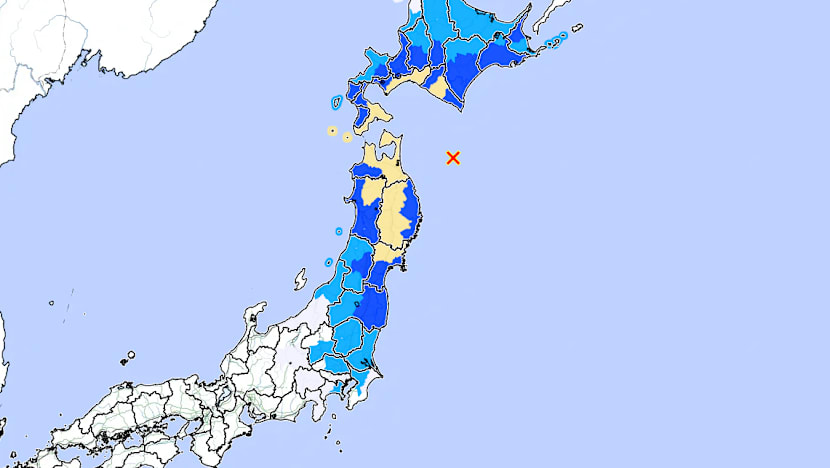
A screengrab of the Japan Meteorological Agency's earthquake information map from its website on Dec 12, 2025. (Image: Japan Meteorological Agency)
TOKYO: Japan has lifted a tsunami advisory issued after an earthquake with a magnitude of 6.9 hit the country's northeastern region on Friday (Dec 12), the Japan Meteorological Agency (JMA) said.
The JMA earlier put the earthquake's preliminary magnitude at 6.7.
The quake struck at 11.44am (10.44am, Singapore time) off the coast of Aomori prefecture with a depth of 20km, after a bigger 7.5-magnitude earthquake hit the same region late on Monday.
Two 20cm waves had so far been recorded, one in the town of Erimo on the main northern island of Hokkaido at 12.35pm, and another three minutes later in the Aomori region, the agency said.





Broadcaster NHK said there was no obvious change at either of the ports.
The United States Geological Survey (USGS) also said that the quake measured 6.7 and was 130km off the city of Kuji in Iwate prefecture on the main island of Honshu.
After Monday's earthquake, which injured at least 50 people, the government issued a special advisory warning residents across a wide area, from Hokkaido in the north to Chiba, east of Tokyo, to be on alert for an increased possibility of a powerful earthquake hitting again within a week.
The tremor on Friday measured 4 on Japan's 1-7 seismic intensity scale.
NHK said that the level of shaking was less than the bigger 7.5 tremor late on Monday, which knocked items off shelves, tore apart roads, smashed windows and triggered tsunami waves of up to 70cm.
The Nuclear Regulation Authority said on Friday there were no immediate signs of abnormalities at the region's nuclear facilities.
The region is haunted by the memory of a massive 9.0-magnitude undersea quake in 2011, which triggered a tsunami that left around 18,500 people dead or missing.
In August 2024, the JMA issued its first special advisory for the southern half of Japan's Pacific coast, warning of a possible "megaquake" along the Nankai Trough.
The 800km undersea trench is where the Philippine Sea oceanic tectonic plate is "subducting" - or slowly slipping - underneath the continental plate that Japan sits atop.
The government has said that a quake in the Nankai Trough and subsequent tsunami could kill as many as 298,000 people and cause up to US$2 trillion in damage.
The JMA lifted last year's advisory after a week but it led to panic-buying of staples like rice and prompted holidaymakers to cancel hotel reservations.
Japan sits on top of four major tectonic plates along the western edge of the Pacific "Ring of Fire" and is one of the world's most seismically active countries.
The archipelago, home to around 125 million people, experiences around 1,500 jolts every year.
The vast majority are mild, although the damage they cause varies according to their location and depth below the Earth's surface.