







Cycle Around Japan - An Autumn Ride through Yamaguchi
Cyclist Bobby Judo rides through Yamaguchi’s straits, islands, mountains and historic towns, meeting fishermen, farmers and potters who preserve the region’s enduring samurai spirit.

This audio is generated by an AI tool.
A 200 kilometre autumn cycling journey through Yamaguchi reveals samurai heritage, terraced rice fields and the warmth of coastal and mountain communities.
Japan’s mountains, coastlines and farmlands offer a world of quiet stories beyond the cities. In this autumn chapter of the Cycle Around Japan series, a cyclist pedals into Yamaguchi, a prefecture shaped by its samurai heritage and a resilient spirit that has weathered centuries of change.
The episode captures the changing of the seasons, with fields ripened to gold and the landscape feels rich with memories that run from the sea to the mountains. The journey begins in Shimonoseki, Yamaguchi’s largest city, home to 260,000 people and long a gateway between the islands of Honshu and Kyushu. The Kanmon Straits here narrow to only 500 metres, making this channel an important trade route since ancient times. Beneath the water runs the Kanmon Tunnel, the world’s oldest undersea tunnel with a passage for both vehicles and pedestrians. Emerging from it is the cyclist for this ride, Bobby Judo, who says, “I have just crossed from Kyushu to Honshu through this underwater tunnel.”
Originally from Florida, Bobby has lived in Kyushu for 11 years and loves exploring Japan by bicycle and by appetite. In Shimonoseki he pauses beside a row of replica cannons, reminders of the 1864 battle fought here, and looks up at the great suspension bridge that towers over the straits. The history prompts him to wonder aloud, “What are the people from this area like? What is their history like?”
North along the Sea of Japan, the road clings to rugged coastline. After three and a half hours he sees Tsunoshima, a small island connected to the mainland by a 1.7 kilometre bridge opened in 2000. As he approaches the span he exclaims, “Fantastic!” and says its long straight line reminds him of the bridges of the Florida Keys. Riding across it feels as though he is floating above the ocean.
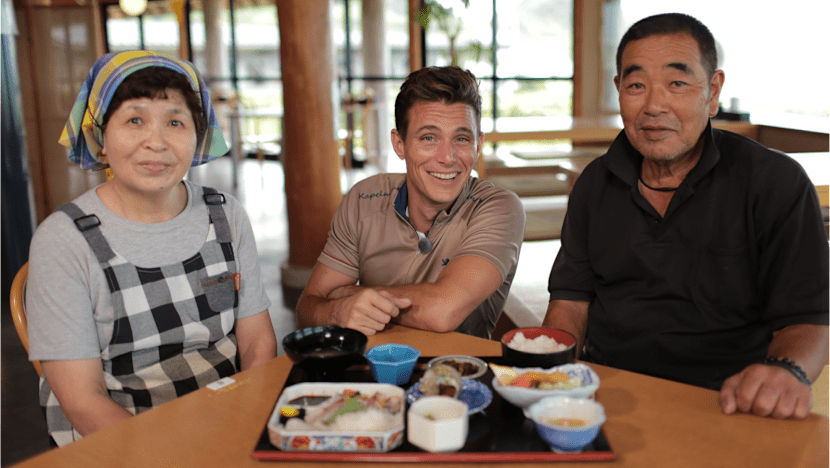
Tsunoshima, with only 900 residents, has long relied on both fishing and farming. At the harbour Bobby meets fisherman Hideyuki Nakano, who has “just got in from harvesting abalone and other sea snails.” Nakano also runs a small seafood shop, selling fresh catch to tourists. He recalls that when the bridge was built he realised visitors would come looking to buy fish, yet the island had no shop. “We were an island of fishermen with no fish shop,” he explains, adding that tourists arriving to find nothing available “would be disappointed.” He decided to sell live fish, but summer heat meant that “sometimes over half of them would die overnight.”
Through patient experimentation he learned to regulate the water temperature and air supply, eventually finding the balance that kept his fish healthy. Inviting Bobby to follow him, Nakano speeds off on his motorbike with Bobby shouting, “He’s going too fast! Wait, wait!” The morning’s catch is delivered to a small restaurant run by island women. Chef Kiyomi Tsujioka praises the fish, saying, “Wonderful! So big and fatty.” Bobby then tries their autumn speciality, hiramasa sashimi, saying, “That’s really, really good. Ah, perfect sweetness and perfect texture.”
Night falls as he reaches the Tsunoshima lighthouse. “It was a long day of riding and we covered a lot of ground,” he says, “but to make it here and sit down, it’s just so peaceful.”
The second day begins with a ride eastward along a coast road that rises and dips. Red higanbana flowers flank the path, signalling autumn. Inland he enters the terraced rice fields of Higashi Ushirobata, where steep slopes have been carved into narrow steps over generations.
Farmer Kanji Ota greets him warmly. His family have tended rice here for generations and he shows Bobby how the heavy heads of grain bend towards harvest. As they walk along the narrow terraces, Bobby notes how tight the spaces are, and Ota confirms, “Our farm machinery only just fits.”
Ota offers him a rice ball made from the new harvest. Bobby bites into it and says, “Ah, that’s really, really good,” savouring its natural sweetness. Ota speaks of the terraces with affection, explaining, “These terraces are part of my life. I can’t imagine not having them.” In spring, he says, the water-filled paddies reflect the lights of fishing boats offshore, transforming the landscape into a field of shimmering mirrors.
Further inland Bobby climbs towards Yumoto Spa, a 600 year old hot spring town. After the long ride, the bath gives “that wave of relaxation” and dinner showcases local ingredients such as jidori chicken, ayu and autumn vegetables. It is a quiet close to a day of steep roads and generous hospitality.
The final day’s route leads deeper into the mountains toward Hagi. Some climbs rise suddenly, “15–16 percent incline,” before opening onto the limestone plateau of Akiyoshidai. Looking across the jagged terrain formed from ancient coral reefs, Bobby says, “You feel like you’re riding through the top of the world.”
In the settlement of Sasanami he explores historic streets that once served as a post-station for samurai travelling between Hagi and the capital. Resident Sasuke Hayashi explains that one restored building “used to be an inn for travellers,” and points out the old stone paths that remain from the era.
Hagi itself reveals elegant samurai residences with white plaster and black timber walls, much as they appeared 400 years ago. Bobby cycles around the massive stone foundations of Hagi Castle, the only remnants of a once impressive keep.
He then visits the workshop of Akira Yoshika, a potter specialising in Hagi ware, one of Japan’s most respected ceramic traditions. Yoshika demonstrates how firing alone produces different colours. “During firing, if a lot of oxygen is supplied, the mugs oxidize and turn out red,” he says, while those deprived of oxygen emerge blue. He shows mugs that have changed through long use as a fine crackling develops on the surface. “See how the surface changes with use, and becomes more beautiful?” he says. Yoshika honours tradition while also innovating, explaining, “You keep a culture alive by cautiously trying new approaches while preserving the important things.”
At the end of his ride Bobby looks back across the prefecture’s past and present. “This is the land of the last samurai,” he reflects. “Everyone that we met along the way still very much exemplifies that pioneering Yamaguchi spirit.”
It is a fitting closing note for a three day journey through a region defined by resilience, craft and the quiet determination of those who live close to the land and sea.




