







Cycle Around Japan - Wakayama: Journey through a Sacred Landscape
Cyclist Michael Rice rides 370km across Wakayama, from persimmon orchards and Koyasan’s temples to Ryujin’s artists, Minabe’s ume and Kumano’s holy river, falls and shrines.

This audio is generated by an AI tool.
Cyclist Michael Rice pedals Wakayama’s sacred routes, tasting persimmons, plums and mountain stillness.
Wakayama appears first as a sweep of ocean and sky, the kind of view that makes you forget you are meant to be travelling with purpose. From an observation point in the prefecture’s far north, cyclist Michael Rice looks out over the Pacific and says: “Wow, it’s such a beautiful place.” A veteran rider from Colorado who has lived in Japan for 29 years, he is here in early autumn for a 370-kilometre ride that threads coast, valley and deep mountains, then finishes in the spiritual heartland of Kumano.
He sets off with the practical cheer of someone who knows a long day in the saddle begins with the basics. “It’s a beautiful day today. The weather is nice, and not too hot, but it’s pretty hot. Hotter than I expected,” he says, before adding that he has brought a new bike for the trip into remote terrain: “I have no idea what’s going to come up there.” Soon he reaches the mouth of the Kinokawa River, pausing to admire the shifting colours in the water. “Nice. The water’s a green color and an aqua color,” he notes, with Wakayama city sitting off to one side.
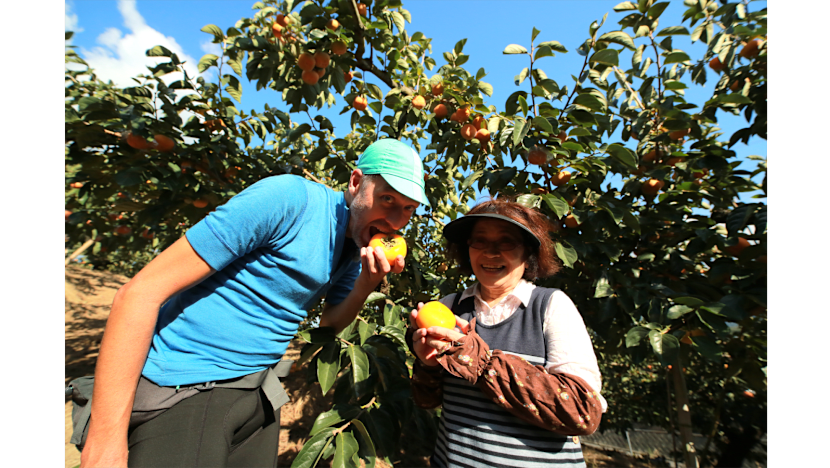
The ride turns inland towards Katsuragi, where the hills are heavy with orange fruit. “Ah, this hill, it’s all covered with kaki. One of my favorite fruits, kaki,” Michael says, spotting persimmons all the way up the slope. At an orchard he meets grower Fukuko Doi, who confirms the area’s standing when he asks if it is known for persimmons: “We grow the most in Japan.” Doi has been growing persimmons since she married into the area, “so I’ve been growing persimmons for 50 years,” she says. The fruit is picked by hand, and in an average year her family harvests over 50,000 persimmons. Michael’s delight is immediate. “Wow, these are big!” he exclaims, then looks down the rows and adds: “Wow, so many. It’s a tunnel of persimmons.” When fruit hangs just out of reach, he offers help with a grin: “If you need help, I have long arms.” Doi takes him up on it: “OK. Can you get those for me?”
From the fruit valley, the road climbs towards Koyasan, an old Buddhist site 800 metres up in the mountains, with 117 temples spread across an area six kilometres east to west and three north to south. Michael arrives wide-eyed. “Wow, look at that. Massive, massive gate,” he says, then points out the small things that make the town feel alive: “Ah, love this streams going through the town, and the little wooden bridges. The temples. The leaves are just starting to change red. So much history here.”
At a temple lodging, a monk greets him and explains the threshold with gentle clarity: “So, here shoes are okay. This is the border.” Inside, Michael takes in the hush of tatami rooms and asks about a building above them. The monk tells him it is the meditation hall and adds: “We teach meditation every day, both in Japanese and English.”
Michael’s guide to meditation is Sesshu Kondo, a monk who was ordained at the age of nine and is now 35. He begins with breath, simple and deliberate: “Start with three deep breaths. Breathe in through your nose and breathe out through your mouth.” Later, speaking about his home, Kondo reflects on how distance can sharpen appreciation. “I grew up here, so I took everything for granted,” he says, before concluding: “Yes, I think this place has a power that everyone feels.”
Dinner at the shukubo follows the rules of shojin cuisine, where meat and fish are replaced by vegetables, seaweed and beans. Michael tastes, pauses, then sums it up: “Very simple ingredients, but the flavor is very intense.” Even the rice seems altered to him. “Maybe it’s just me. Because I did the meditation and the deep breathing, and talking with the temple priest,” he says. As he tries to explain the pull of places like this, he lands on the idea of a journey that deepens with every climb. “And so I understand why people travel great distances, climb up the mountain to get here. Because they have the entire experience,” he says. “This entire experience is the meditation.”
Day two begins with speed and laughter. “Another downhill! Yeeehaaaaaaah!” Michael whoops as he drops out of Koyasan on an “exhilarating 800-meter descent” into Ryujin. There, rivers run clear through dense mountain forest. Michael leans over the water and says: “Oh, what a beautiful river. The water is so clear. Can’t believe how clear the water is.”
Ryujin has turned that landscape into a magnet for makers. Thirty years ago, faced with a declining population, it promotes itself as a place for artists to live and work, and purpose-built homes come with workshops attached. Michael stops at one and meets sculptor Yusuke Shibata, who makes wooden works using local materials. Shibata explains why he never seems short of inspiration: “I find so many ideas just walking around. Ryujin’s mountains and rivers are full of treasures.”
Another artist Michael visits speaks of turning love of wildlife into advocacy for the area. “I’ve always loved wildlife, but my aim is to promote the nature we have here in Ryujin,” he says. Michael responds by tracing everything back to the river itself: “Water is the source of life. With such great water, the wildlife must be amazing.”
In a nearby studio, maker Makoto Okuno works with washi paper, reviving a craft that once filled farmers’ quiet season before demand declined and the tradition died about 70 years ago. Okuno shows Michael paper made in the village about 90 years ago, and explains why he keeps returning to the old methods. “When we talk about the land, it’s not just nature,” he says. “There’s also the history of all our human activities… So it’s important to keep such memories alive.” By the time Michael leaves the mountains, the programme notes he has already travelled 100 kilometres that day.
In Minabe, the story of living off the land centres on ume. Michael arrives as Hirofumi Hirano tends trays of umeboshi, plums pickled in salt and sun-dried. Hirano explains the rhythm of the work: “In fine weather, four days. Two for each side.” He offers a taste with a warning, “They’re very sour,” and Michael obliges. His verdict comes with a wince and a smile: “Very salty and sour. I love this flavor, actually.” Hirano then puts Minabe’s economy in stark terms. “We’re the number one producer of ume in Japan,” he says, adding: “About 80 per cent of the people here have jobs that depend on ume. So ume is everything in this town.” Nearby, a family elder speaks with the fatigue and pride of someone who has spent decades in harvest time. “Sometimes I feel a little tired of it, but growing ume has given us a good living,” she says. “I plan to keep bringing in the harvest till I die.”
On the final day, Michael heads into Kumano, where pilgrims have walked the Kumano Kodo for over a thousand years. He spots a sign and says, half to himself, half to the road: “Ah, here’s a sign. ‘Kumano Kodo’.” The path is the kind that invites a rider to slow down and listen. “Ah, I can hear the birds in the trees,” he says, then through the forest he catches his first glimpse of the falls: “Look through the trees here. I can see the waterfall. Wow. Incredible view of the waterfall.”
At Nachi Falls, 133 metres of water plunges down a cliff and is worshipped as a deity. Michael tries to describe the atmosphere in plain, instinctive language: “You can feel it’s a really holy site. Just the whole vibe. The whole vibe here is really amazing… This really is a god coming down from the mountains, from the sky.”
He follows the Kumano River upstream and notices a small boat. “I see a little boat over there. I think I’ll go down and see what that boat is,” he says, then asks the boatman, Yoshikazu Tanigami, what he does. “I take people sightseeing on the river,” Tanigami replies, and Michael asks: “Can you take me?” Tanigami answers: “Sure, come aboard.” As the sail catches, Tanigami explains the river’s daily wind shift and its purpose. “For us it acts more like a road than a river. It’s a road carrying people up to the shrine,” he says. Michael watches the sail pull them along and marvels: “Wow. Yeah, the wind is really pushing the sail… It’s almost like the wind wants to take you up to where the gods are, at the shrine at the top.”
When Michael asks who built the boat, Tanigami answers with quiet pride: “I made it all myself.” Later, asked what the river means to him, he does not romanticise it. “The simplest way to say it is it’s my friend,” he says, before adding the line that feels like a life’s vow: “The river is my life, and I feel a duty to look after it.”
The road delivers Michael to Kumano Hongu Taisha, believed to have been a sacred site for over 2,000 years. He arrives breathless and triumphant. “My goal for this trip. I made it! I made it!” he says, then steps into the calm and lets the effort fall away. “It’s so cool and quiet. After rushing by bicycle to get here, and then arriving. I feel so relaxed,” he says. Standing still, he repeats what the place seems to press into him: “Amazing place. I can feel the energy here… It’s so peaceful. So peaceful.”
By the end of the ride, Michael has his own way of tying Wakayama’s scattered lives together, from orchard to temple to workshop and riverboat. “If I was asked what I really learned from this trip, I learned about life. If I had to say one word, ‘life’,” he reflects, listing the different paths he has met along the way. “But each one of them has a life together with nature… and it just makes me want to say ‘arigato (thank you)’.”




