







3 factors can threaten efforts to keep a large common space: Shanmugam
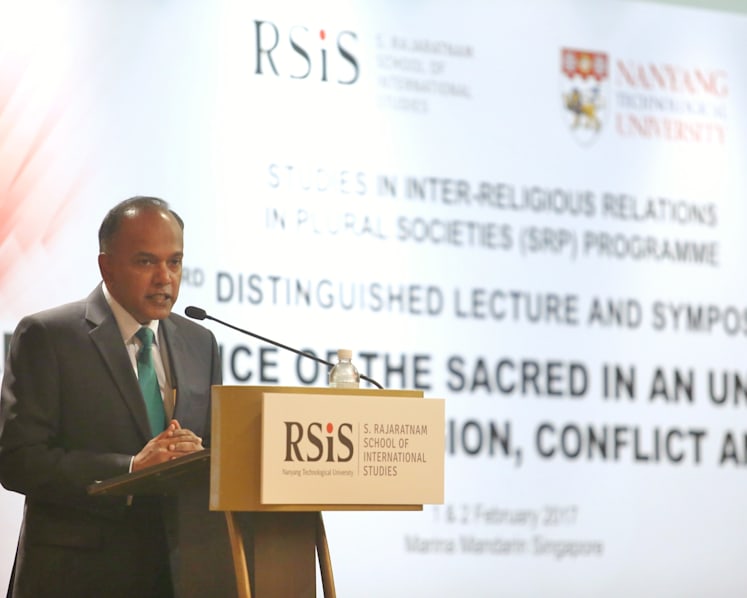
Law and Home Affairs Minister K Shanmugam addressed the question of how Singapore can resist the global tide of populism and xenophobia at the third Studies in Inter-religious Relations in Plural Societies symposium on Feb 1, 2017. Photo: Koh Mui Fong/TODAY


SINGAPORE — While the Republic has hitherto managed to avoid the sort of backlash against minorities that populism sweeping some Western countries has wrought, it would be dangerous to assume such things would never happen here, warned Minister for Home Affairs K Shanmugam on Wednesday (Feb 1).
He called on religious leaders to play a role, not just in promoting their respective religions but in advocating and working at enlarging the common space. They should push back against polarisation and champion the cause of integration and interaction, rather than create greater differences, he added.
Mr Shanmugam noted that given the stark racial demographics in Singapore, majoritarianism could easily take hold unless the Government and the majority continue to commit to not engage in racial politics.
He cited rising religious extremism, "disconcerting" trends in the region such as mass demonstrations in Indonesia with somewhat religious undertones, and polarisation as three factors that could threaten the Government’s approach to “keep as large a common space as possible”.





On polarisation, he said some segments within minorities or the majority may push for certain issues. “And if everyone pushes, the centre collapses, that will be bad for Singapore.”
Addressing an audience of academics, diplomats and students at a symposium organised by the S Rajaratnam School of International Studies centering on religion, conflict and peacebuilding, Mr Shanmugam said he was not originally scheduled to speak.
“But events around the world give cause for pause and reflection,” he said, referring to the political surprises around the world last year and what appears to be a change of course by the United States under its new President Donald Trump.
Leaders in some Western countries have had to adjust to anti-immigrant sentiments of their electorates by calling on immigrants to “behave normally or go away”, but such a reaction can go too far and empower extremist forces on all sides, said Mr Shanmugam.
Although Singapore can easily face a similar situation with 85 per cent of the population that is non-Muslim and 74 per cent of the population that is Chinese, it has so far avoided such a backlash against minorities.
Mr Shanmugam said this is because of three core principles of equality of opportunities, accepting differences among communities and celebrating diversity, and preserving a large common space.
The Government is activist in its approach, such as through its ethnic integration policy in public housing estates that has prevented ghettos from forming. Schools are racially mixed and children interact with one another.
Laws are also in place that penalise individuals who make offensive remarks about other religious and racial groups.
“We have our share of religious leaders who make offensive remarks about other religions, ISD (Internal Security Department) will talk to them. We had a pastor on YouTube who said Buddhism is a superstitious religion and he went on to make other remarks… We talked to him, he apologised, and no more such remarks. Everybody understands and everybody accepts this,” Mr Shanmugam said.
He also cited another example where “some newly converted Christians felt that they needed to enlighten Muslims on the faults of the Prophet”.
“They had received various tracts from the United States which set out all the things that the Prophet was supposed to have done wrong, and they decided they would mail the tracts to Muslims whose names they found in the telephone book. They were arrested, they were charged in court and they went to jail,” Mr Shanmugam said.
“Again, the message was sent and everybody understands ... So tough laws and willingness to enforce the laws are necessary. But laws alone do not work. You need the community to work together.”
Mr Shanmugam, noting that some “well-meaning” people have called for actions such as the removal of ethnic classification from Singaporeans’ identity cards, said different ethnicities and ethnic identities will continue to influence society.
“These sort of gestures play well to the gallery. Some governments may do so to give the appearance of activity, decisiveness, openness and so on. But the realities of governance are different from theatrics.”
Amid risks to Singapore posed by what is happening in the US, Mr Shanmugam said the Singapore Government would convey a clear message that its people are all Singaporeans, and that it would guarantee the safety, security and freedom of religion to all including Muslims. But it needs the support of the majority of Singaporeans to do this, he added.




