On Braddell bridge, cycling is allowed on one side but not the other. And some cyclists are confused
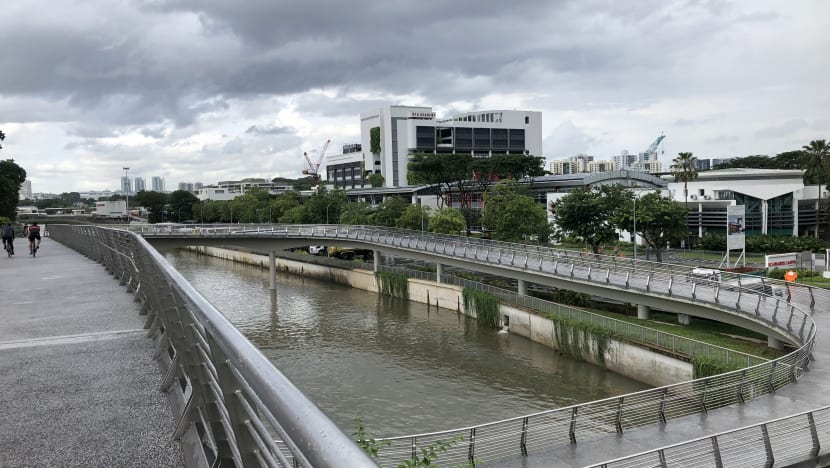
The curved ramp where cycling is allowed was opened in November.


- In November, a new curved ramp was opened that allowed cyclists to cycle down a pedestrian bridge over Braddell Road
- However, some cyclists said that being able to cycle on one ramp and not the other has made the bridge confusing to use
- Transport experts said that in dense urban areas, such compromises have to be made for the safety of pedestrians
- The Urban Redevelopment Authority said that there are plans to improve the connectivity of the stretch the bridge lies on
SINGAPORE — A new cycling ramp that connects to a pedestrian bridge over Braddell Road was opened last month as part of the authorities’ push to create a seamless cycling experience along the Kallang Park Connector.
However, a part of the bridge requires cyclists to dismount and push their bicycles, and this has confused some riders.





The bridge was initially opened in 2018 after it was rebuilt to feature two barrier-free access ramps. For the safety of ramp users such as pedestrians and wheelchair-bound persons, cyclists are required to dismount and push their bicycles.
In November, a new curved ramp north of Braddell Road was opened where cycling is allowed. The south side of the bridge, however, still has a barrier-free access ramp, and cyclists will still have to dismount and push their bikes.
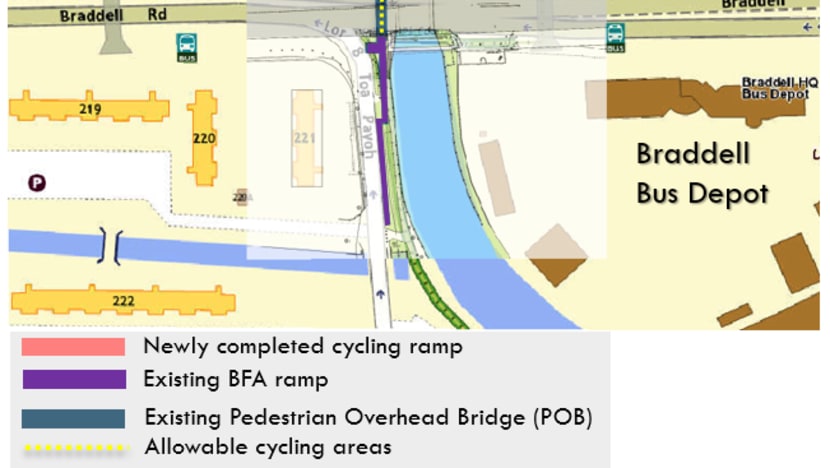
The new cycling ramp north of Braddell Road (in pink) opened in November on one side of the bridge, while on either side of the bridge there are still non cycle-able barrier-free access ramps (in purple). Blueprint: URA
CYCLISTS CONFUSED
Cyclist Christopher Chin said that he was happy at first when the curved ramp was opened, and thought that he could cycle the entire length of the bridge.
The 46-year-old manager in the pharmaceutical industry said he then noticed that he still needed to dismount his bike at one end of the bridge.
“Now I will think twice before using the bridge because I am confused as to whether I can ride on it or not,” he said. “But if I have to use it, I will follow the law.”
Mr Chin said that he was not sure whether he could even cycle on the curved ramp, as there were no signs indicating that cycling was permissible.
Indeed, when TODAY visited the bridge recently, this reporter noticed that there were signs advising against riding on the barrier-free access side, and none showing that riding is allowed on the curved ramp side.
“Can we get some answers to what is the exact design intent for the entire bridge system? It shouldn’t be split into this part and that part, it confuses people so much,” Mr Chin added.
Agreeing, a 35-year-old civil servant who does not want to be named noted that in the Urban Redevelopment Authority’s (URA) 2019 Draft Master Plan of Bishan-Toa Payoh, the bridge is labelled a “cycling bridge”.
“Why can’t we cycle on a cycling bridge?” he asked. “Why wasn't it designed to have a curved slope on both sides?”
Cyclists have also said that the signs leading up to the barrier-free access ramps are clear, but coming down the ramp, the signs are not clearly visible, and cyclists going at speed may easily miss them.
Retiree M H Ng, 63, said that he does not mind pushing the bicycle up and down the barrier-free access ramps for the safety of pedestrians.
But he pointed out that many cyclists do not do this as they might not be aware that they have to dismount. The “no riding” sign on one end of the ramp is displayed on the railing parallel to the ramp and not easily spotted, Mr Ng said.
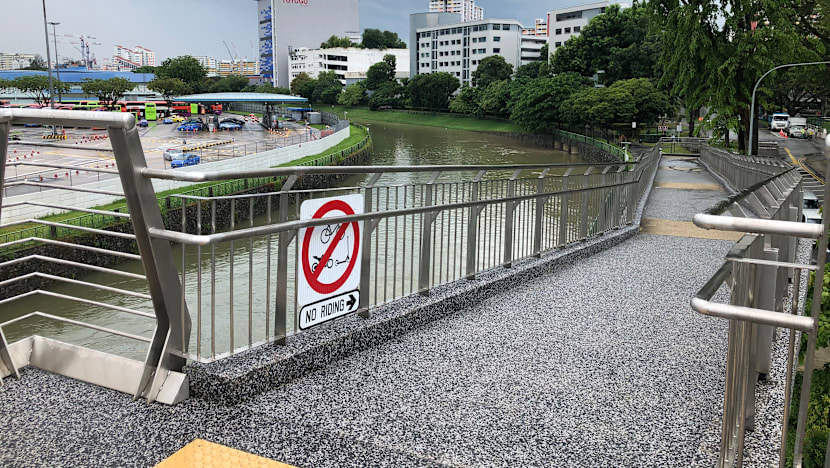
The 'no riding sign' at the top of the barrier-free access ramp is obscure and some may miss it. Photo: Justin Ong/TODAY
TODAY understands that the relevant authorities have received feedback from the public about the visibility of these signs, and are looking into the matter.
Mr Francis Chu, the co-founder of Facebook group Love Cycling SG, said that criticisms about the bridge are “an overreaction” from some cyclists, and a result of poor communication on the authorities’ part.
“It takes time for every single piece of infrastructure to be built, and it is still not yet finished,” he added.
COMPROMISES INEVITABLE: EXPERTS
Experts said that while it is common to see “100 per cent cycle-able infrastructure” in most cycling-friendly cities, a compromise will often have to be made in densely-populated cities like Singapore.
Singapore University of Social Sciences lecturer Cecilia Rojas, who is an expert in active mobility, said that when it comes to retrofitting infrastructure, “planning is not always ideal”.
“Especially in cases where the land available is not much, as in Singapore, it is common to see ‘funny’ designs,” said Dr Rojas.
Agreeing, National University of Singapore transport infrastructure expert Raymond Ong said that designing paths for cycling in urban environments is challenging “since we have to balance different stakeholders and ensure design does not compromise safety”.
In making design compromises, Dr Rojas said that the authorities have to be clear in communicating cycling rules.
“Authorities should be clear about whether this area is a bicycle path or a ramp and make clear announcements about it,” she said. “Ideally, signs should also be placed along the corridor to alert the cyclists that they are to dismount and push at some point.”
FURTHER PLANS TO IMPROVE CONNECTIVITY: URA
In response to queries from TODAY, URA said that the Bishan to city route, which the pedestrian bridge lies on, was conceptualised in 2015 to “connect interrupted stretches of the Kallang Park Connector into a seamless 10km route for cyclists and other active mobility users”.
URA said that the proposals to improve connectivity along this route were exhibited in 2017 for public feedback, and following this, it initiated “detailed engineering studies and worked with agencies and key stakeholders such as the cycling community to refine the plans further”.
The authority added that there will be further plans to improve the connectivity for both pedestrians and cyclists.
“However, to ensure prudence and to minimise inconvenience, such works will be integrated with other infrastructural improvement works along the (Kallang) river and realised progressively in the future to complete the full Bishan to city route.”