







Cabbies, delivery workers among those who can claim S$250 NTUC FairPrice vouchers if they get hurt on the job in new scheme
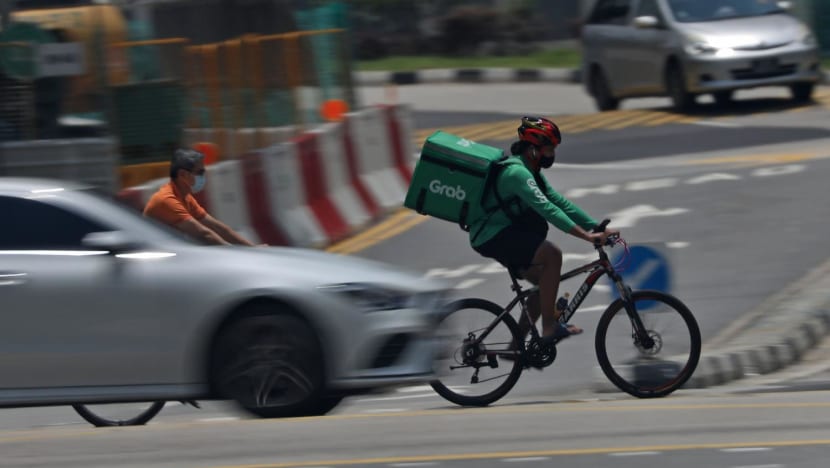


SINGAPORE — From Jan 15 next year, eligible platform workers who get injured at work can apply for S$250 of NTUC FairPrice supermarket vouchers to help them while they await more aid from other relief schemes, the National Trades Union Congress (NTUC) said on Wednesday (Dec 6).
The new NTUC Care Fund (Work Injury Relief) scheme will be available to taxi drivers, private-hire drivers and delivery riders who are members of three NTUC-affiliated organisations:
- The National Delivery Champions Association
- The National Private Hire Vehicles Association
- The National Taxi Association
All members of these associations pay the NTUC Union membership fee of S$117 a year.
This scheme will provide “crucial bridging relief” for these workers because there is currently no financial assistance schemes targeted at this group, the labour movement said in a media release.
Delivery riders, private-hire drivers and taxi drivers face inherent risks from being on the road for extended periods, which can be aggravated by working in “less-than-ideal conditions” such as during heavy rain, NTUC said.
“If they sustain injury while working, these self-employed members must wait nearly two weeks before he or she can expect to receive financial help from government or community bodies in view of the processing time.”
NTUC's secretary-general Ng Chee Meng said: “When freelance point-to-point and delivery workers come into hardship at work, their immediate concern is usually whether they are able to continue earning. For those who sustain injuries and find it difficult or unable to continue working, this becomes even more worrying."
He added: “This amount may not be much, S$250, but it can really help in the interim two weeks to sustain our members and their families.
“NTUC desires very much to give our members, especially in current situations where there’s elevated cost of living, the best we can. It’s not a very big sum, but we do our best.”
When accidents occur, these workers only have their savings to rely on, since they are not covered under the Workplace Injury Compensation Act, NTUC said.
Many may not have personal accident insurance coverage or not have sufficiently comprehensive coverage given the extent of possible injuries sustained at work. Some of these workers continue to pay for work-related liabilities such as vehicle rental fees while being unable to work, it added.
HOW IT WORKS
The scheme provides injured workers with “immediate relief” while they await the outcomes of applications for other assistance programmes or insurance claims, NTUC said.
For the first tranche of support, each of the affiliated platform worker associations has contributed S$20,000. This will be matched one-to-one by the NTUC-U Care Fund, which supports the welfare of lower-income union members and their families.
In total, S$120,000 has been committed so far, which can help around 480 workers pay for some daily necessities when they are not working due to their injuries.
The scheme will be reviewed in mid-2024 to ensure that injured workers will continue to be supported via a second tranche, NTUC said.
To qualify for the vouchers, the injured workers have to be prescribed medical or hospitalisation leave for a continuous period of five or more days.
They will then have to submit an application within two weeks from the date that the medical or hospitalisation leave is issued, or within two weeks after they are discharged from the hospital.
The issue date of the medical or hospitalisation leave must not be more than two weeks from the date of injury.
They will also have to submit proof of work and earnings for the period that the accident occurred, such as a screenshot of the delivery platform mobile application that shows the member’s name and activity status on the date of the accident.
Only one application for the vouchers can be submitted for the same accident, and members are limited to a maximum of two unique approved applications in a year. They must have maintained a minimum of three months' continuous paid membership to the three NTUC-affiliated associations at the point of application.
Members can apply for the scheme via their respective associations, which will assess the applications and disburse vouchers to members or their designated family member within 48 to 72 hours of successful application.
WHAT WORKERS SAY
Ms Suhada Abdullah, a 49-year-old single mother to five children, relies on her full-time job as a delivery driver to make ends meet.
She was unable to work when she got into two accidents this year, first from being thrown off her motorcycle when a vehicle collided into her, then a second time when a vehicle ran into her when her motorcycle was stationary on a rainy day.
Buying insurance is not something that she can prioritise while settling housing bills and instalment payments for her motorcycle, so she is glad that being a member of the National Delivery Champions Association means that she would qualify for help in case of an accident.
However, given the rising cost of living, she added that a one-off S$250 in vouchers would only go as far as funding one or two grocery trips before she would have to go back to work.
“It’s better than nothing. I would like it if (NTUC) can continually support us until we stabilise (after an accident).”
Another driver, Goh Yong Wei, 31, broke his arm in September 2020 during a head-on collision with another motorbike. He is the president of the National Delivery Champions Association.
After the accident, he was unable to work for almost half a year, which he estimated cost him up to S$30,000 in lost income.
With the vouchers, he said that the “initial difficulties” of being unable to work can be alleviated and he would still be able to “put food on the table.”
“If I have three weeks medical leave, my priority is to cover my food. Even as I rest at home, I know everything will be paid for in at least the next two to three weeks while I apply for any other assistance and insurance claims.”
Personally, he would prefer cash to vouchers, but acknowledged that the vouchers would ensure less “abuse” and it would be harder to “game the system” with them as compared to a cash payout, which requires “more accountability”.
Similarly, Ms Shanti Kaur Hari Singh Bajwa had to stop work for three months after sustaining an injury during a delivery. She is a driver with ride-sharing firm Grab and is a member of the National Private Hire Vehicles Association.
The 74-year-old said that the supermarket vouchers would be a “good start” to help platform workers in need.
On whether receiving cash instead would be preferable, she said that she would still prefer vouchers because they will be spent on only the necessities, rather than non-essential purchases that family members might spend on if it were cash.
She believes that the vouchers would help injured workers with young children and elderly parents tide over one to two weeks before insurance payouts arrive.
“When you are a Grab food delivery rider or driver you earn daily. When you do not have income, the S$250 will stretch just a bit,” she added.




