







China committed to peaceful partnership with neighbours
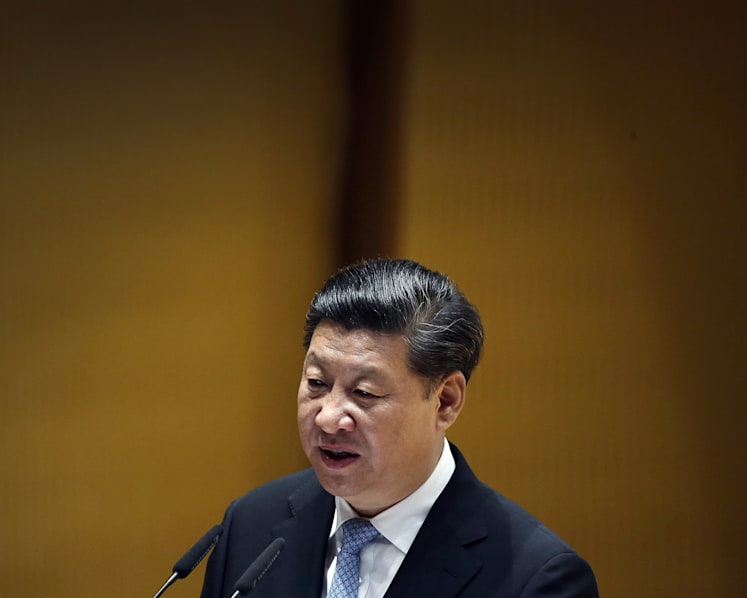
Chinese President Xi Jinping delivers his speech on "Forging A Strong Partnership To Enhance Prosperity Of Asia" at the 36th Singapore Lecture. AP photo


SINGAPORE — Chinese President Xi Jinping today (Nov 7) stressed China’s commitment to peaceful regional development, adding that countries from beyond Asia should play a constructive role by respecting the region’s constraints and realities.
Delivering the 36th Singapore Lecture at the National University of Singapore this morning, Mr Xi noted that Asia is now entering a new phase, where it will become the focal point of global development.
He said that while the outlook for the region is “stable and positive”, it faces threats such as terrorism, extremism, cyber-security, natural disaster and other transnational challenges.
Mr Xi noted that while “Asia’s way to tackling these challenges is through consensus, trust deficit between certain countries have led to conflict from time to time.”





He said that there are three ways for China and the Association of Southeast Asian Nations (ASEAN) to strengthen their ties - by working together to uphold peace and stability, jointly addressing security matters and drawing on both sides’ common Asian identity to encourage further exchanges of people and culture.
The Chinese President stated that China has a “historical responsibility” to maintain regional security and this must be done together with other countries.
“Asians must not be our (China) enemy. We must build trust and together maintain harmony in Asia, so as to create the right conditions for economic development and improving the lives of our people,” he said.
The key, according to Mr Xi, is to “make the cake for mutual cooperation bigger so that we can all benefit from it.”
He said that for the region to move forward, Asia needs to place equal importance on security and development. “We must be open and understanding towards each other and find win-win pathways,” he said, adding that critics who warn of a China threat are “ ignorant of China’s past and present, or have misunderstanding or hidden motives”.
Commenting on China’s land reclamation activities and territorial claims in the South China Sea, he said that “the islands have since historical times been Chinese territory and the Chinese government has the responsibility upholding our sovereignty and maritime rights.”
China has overlapping claims with Vietnam, the Philippines, Malaysia, Taiwan and Brunei in the South China Sea, through which US$5 trillion (S$) in ship-borne trade passes every year.
Beijing’s land reclamation work in the sea has raised concern in the region about its intentions, and last week, an American warship sailed within 12 nautical miles of one of Beijing’s man-made islands in the contested Spratly archipelago to demonstrate its rights to freedom of navigation.
“There has never been a problem in freedom of flight and navigation in the South China Sea. Neither will it become a problem in the future,” stated the Chinese president, adding that China needs freedom of passage in the South China Sea the most.
“Though some islets over which China has sovereignty have been occupied by others, China has always committed to solve the problem by peaceful negotiations,” Mr Xi said.
He said that China is committed to working with countries with a direct stake in the issue to solve the dispute “on the basis of respect of historical facts, according to international laws and through discussions and negotiations.”
China and ASEAN are negotiating a code of conduct in the South China Sea but the progress has been less than satisfactory. Among the stumbling blocks has been China’s insistence on negotiating with the individual claimant states directly rather than with ASEAN as a bloc.
In what may be an indirect reference to the United States, Mr Xi said that China welcomes countries from outside the region to participate in the peaceful development of Asia, but he hoped that they can play a positive role.
He said that a common problem faced by many Asian governments is how to maintain high rate of economic growth and in order to do this, a peaceful and stable regional environment is critical.
“This is the constraints of countries within the region. And external stakeholders should understand and respect this and be constructive,” said Mr Xi.
In his speech, Mr Xi also touched on Singapore-China cooperation, saying that China has drawn on Singapore’s practices in addressing tough challenges it encountered in its reforms and development.
“On its part, China’s development has also created tremendous opportunity for Singapore’s development. Today, there is increasing political mutual trust and deepening practical cooperation between the two countries,” he said.
He also paid tribute to Deng Xiaoping and Lee Kuan Yew – whom he described as two great statesmen - for laying a firm foundation for Sino-Singapore bilateral ties. He said he often reflected on his meetings and conversations with Mr Lee, which greatly inspired him. “His voice is still ringing in my ears”.
Mr Xi recalled how on his last visit to Singapore five years ago, Mr Lee and he officiated at a memorial for Mr Deng by the Singapore River. Mr Lee’s presence at the event reflected the friendship between the two man as one based on “intellectual compatibility and meeting of heroic minds”. He said both leaders’ legacy in building strong ties between the two countries should always be remembered.
The Chinese President is in Singapore for a two-day state visit at the invitation of President Tony Tan Keng Yam to commemorate the 25th anniversary of diplomatic relations. Mr Xi met Prime Minister Lee Hsien Loong this morning, following which both leaders witnessed a signing ceremony for several agreements on economic, education, urban governance and customs cooperation. Mr Xi will be meeting Taiwanese President Ma Ying-jeou later this afternoon, the first time both leaders are meeting after the parties split in 1949 following a civil war.




