







CID officers helped MOH identify coronavirus cluster at Paya Lebar church as police get involved in contact tracing
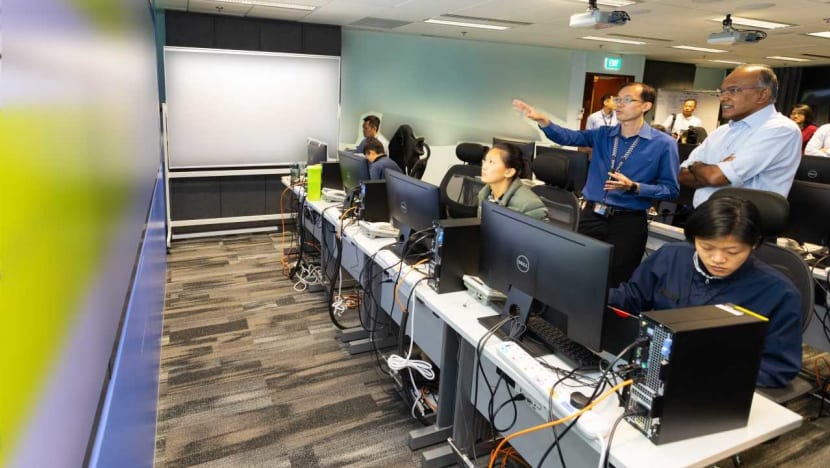
Home Affairs and Law Minister K Shanmugam (standing, right) interacting with police officers involved in contact-tracing operations.
SINGAPORE — When a couple from Wuhan, China who had entered Singapore both fell ill with a coronavirus infection, the Ministry of Health handed their data to the police so that they may help trace the people who had been in contact with the pair.
The work by the police, which included checking surveillance footage, later joined the dots to a cluster of cases involving a church in Paya Lebar, The Life Church and Missions Singapore.
Home Affairs and Law Minister K Shanmugam said at his visit to the CID Command Centre on Tuesday (Feb 11) that police officers, including some from the Criminal Investigation Department (CID), have been assigned to help staff members from MOH with contact tracing for patients who have been infected with the novel coronavirus.
Without providing a specific figure, he added that “quite a number” of police officers have been pulled out of their regular roles to do this full-time.
MOH will do the first cut in terms of interviewing patients and identifying data that can be used in contact tracing. Then, it will pass this data on to police officers who will use it to run the investigation.
For the married couple from Wuhan, they were announced on Jan 29 by MOH as Cases 8 and 9.
Both aged 56, the Chinese nationals had arrived together in Singapore on Jan 19 and stayed with their family on Lorong Lew Lian near Upper Paya Lebar Road.
Police officers used the data sets given by MOH and closed-circuit television footage to trace their movements before hospital admission.
They found that the pair had visited the church. They also discovered that other, separate confirmed cases could be traced to the same church.
Mr Shanmugam said: “The key thing here was to first identify carefully and track the movements, step-by-step, and then pick out the similarities.
“It is a lot of painstaking work, as you can imagine, because these are movements over several days to different places. Tracking each one’s movements, and then comparing against the movements of the others, and identifying the commonalities.”
The officers are now trying to do a similar sort of work for the other cases as well, he added.
SIMILAR SKILLS
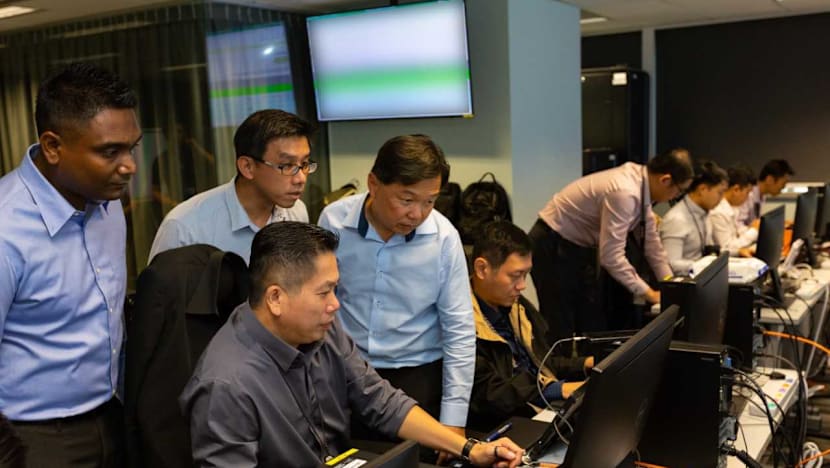
Contact tracing involves investigative work. The CID and police officers — such as those from the land divisions and Central Narcotics Bureau who were also called in to help with contact tracing — are already trained with similar skills, Mr Shanmugam said.
“When you have someone who is diagnosed as having the illness, you want to be able to trace back to all the people he or she met. Both in terms of who he or she could have got it from, and also who he or she may have passed it on to. And, you got to identify the type of contact. It’s got to be close contact.
“It requires interviewing the individual and then a lot of careful investigative work — tracking the person’s movements over a period of time,” he said.
However, contact tracing and investigating crime are still markedly different, he added.
“In the context of the investigation of a crime, it’s very focused. But here you are talking about all the contacts the person may have had, and then narrowing it down,” he said.
“You can imagine that in a place like Singapore with that frequency of movement and the frequency of contacts — a case in any city — that this is not an easy task. So they are doing it very intensely.”
Deputy Assistant Commissioner Deculan Goh, who is the assistant director of CID’s Specialised Crime Division, said: “Our officers understand that this is a whole-of-government effort, and we all need to pitch in and contribute where we can. So we have been working hard alongside MOH in the ongoing contact-tracing operations.
“Although we are doing this on top of our regular crime fighting duties, our officers are stepping up and putting in extra hours to support the national response to the coronavirus outbreak.”




