







Community police system fully rolled out
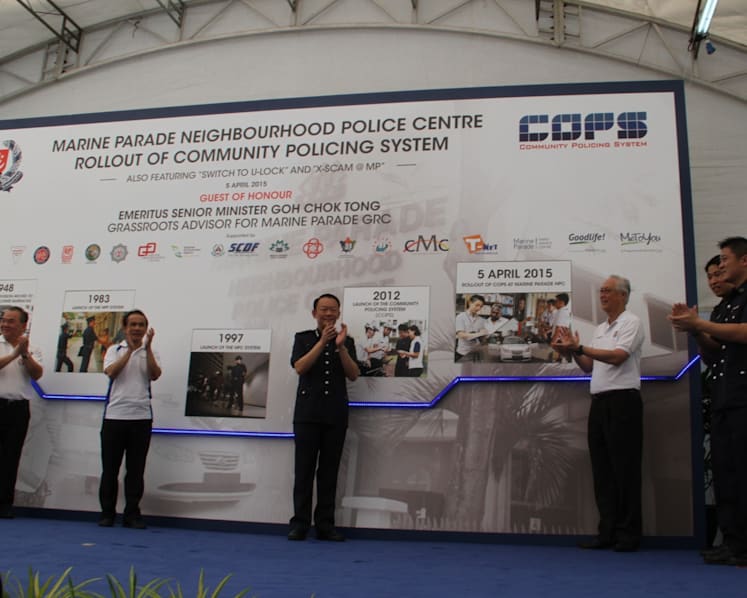
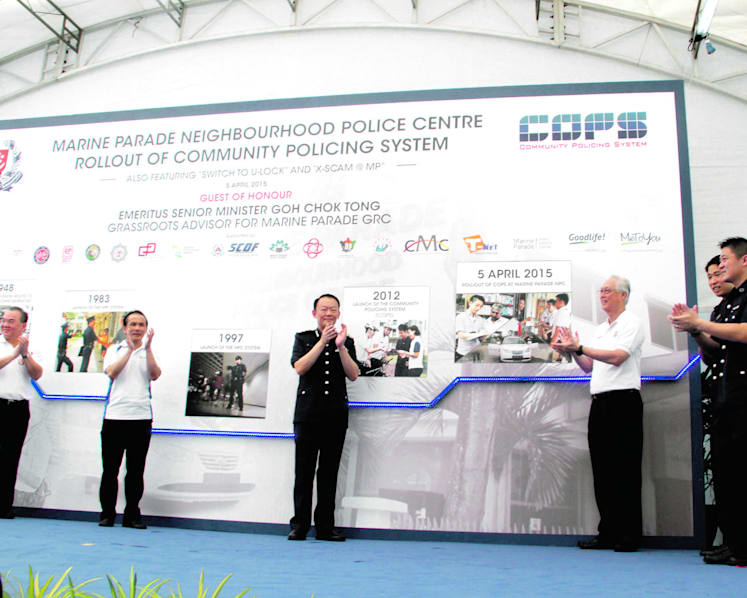
SINGAPORE — The policing strategy that aims to bring police officers closer to the community went into full swing across the island yesterday, several years after the late Mr Lee Kuan Yew first planted the seed of the idea that was to change the face of policing here.
Yesterday, the Marine Parade Neighbourhood Police Centre (NPC) got on board the Community Policing System (COPS), the last of the 35 NPCs islandwide to do so.
Paying tribute to Mr Lee’s contributions to the Singapore Police Force, an aspect which he felt had not been touched upon very much, Emeritus Senior Minister Goh Chok Tong, who is a Member of Parliament for Marine Parade GRC, revealed that the Republic’s founding Prime Minister had suggested that Singapore study the Japanese Koban system — a network of mini police stations that can be found in almost every neighbourhood throughout Japan.
Mr Lee, who died on March 23, was also the person who inculcated the importance of having top brains in the police force at all levels to outsmart the crooks, said Mr Goh, who was the guest of honour at the ceremony in Marine Parade to mark the milestone.





He recalled that many years ago, former Home Affairs Minister Wong Kan Seng, who helmed the ministry from 1994 to 2011, had put up a paper to the Cabinet on the establishment of Neighbourhood Police Posts (NPPs).
“(Mr Lee) supported the establishment of NPPs,” Mr Goh said. “And then he went further to say that just having the NPP alone would not be enough. A post meant the police would be sitting in the post, collecting information based on feedback ... and taking down complaints and investigations. So he suggested that the police should be part of the community and should be out walking around befriending the community members and therefore getting the support of the community.”
During Mr Lee’s tenure as Prime Minister, he had pushed to raise the quality of the police force, including setting up a scholarship scheme akin to what he did for the Singapore Armed Forces.
“His argument was simple: Our population was getting better-educated, the nature of crime had also changed at that time, especially white-collar crime ... If our police force had remained (the way it was), it will always be without people who can outsmart crooks. The crooks will have schemes which will be smarter than what the police could understand and therefore (they) could not catch the crooks,” Mr Goh said.
“It is not only the police scholars ... He told us that at all levels of the police force, you must have good-quality people ... and in order to attract good-quality people, you must pay them well.”
Under COPS, which was launched in May 2012, a new Crime Strike Force and an expanded Community Policing Unit were set up at each NPC.
The Crime Strike Force would allow police officers to be more familiar with local terrain and more effective in fighting localised crime, while the Community Policing Unit would bring police officers closer to the community through foot and bicycle patrols.
NPPs would also be enhanced with technology to give users round-the-clock access.
To date, police cameras have been installed at more than 4,400 Housing and Development Board (HDB) blocks and multi-storey car parks.
Plans are on track to have the cameras in all 10,000 HDB blocks and multi-storey car parks by the end of next year, said Bedok Police Division commander Alvin Moh.




