





CPI falls for 20th month, but less than expected
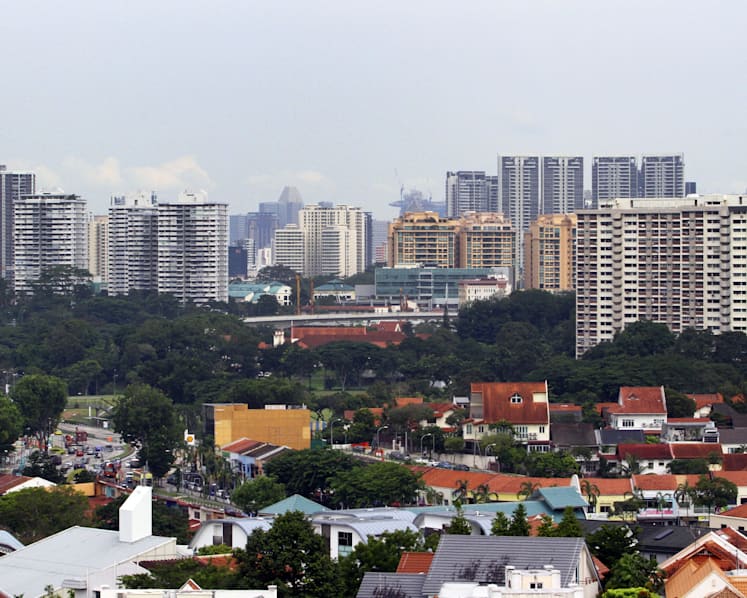
Record high prices for hotly contested land sales in the Republic this year will have a direct impact on future land sales in Singapore and will effectively lead to high housing prices, say analysts. TODAY file photo
SINGAPORE — Headline consumer prices in Singapore continued sliding in June to register the 20th straight month of decline, but the central bank is expected to leave monetary policy unchanged at its October policy meeting as the pace of deflation slowed sharply and core inflation edged higher.
The All-Items Consumer Price Index (CPI) fell 0.7 per cent year-on-year last month, narrowing from the 1.6 per cent decline in May, showed data from the Monetary Authority of Singapore (MAS) and the Ministry of Trade and Industry (MTI) yesterday. The drop was much smaller than the 1.1 per cent median forecast in surveys of economists conducted by Reuters and Bloomberg.
This was due to a smaller 3.5 per cent decline in accommodation costs, compared to the 6 per cent plunge in May when service and conservancy charge rebates to households lowered the cost of housing maintenance and repairs, the MAS and MTI said. Meanwhile, actual and imputed rental costs continued to fall amid the soft housing market.
Private road transport costs continued to fall due to lower premiums for Certificate of Entitlement (COE) for cars, but narrowed to 5.7 per cent from the 7.6 per cent decline in May, the MTI and MAS said.





“The usual suspects were again mainly responsible for the headline deflation: Accommodation costs and private road transport, although they recorded smaller declines in June compared to the preceding month,” said UOB economist Alvin Liew.
Core inflation, which excludes the costs of accommodation and private road transport, increased to 1.1 per cent last month after rising 1 per cent in May, broadly in line with economists’ forecasts. This was mainly due to services inflation picking up slightly to 1.6 per cent from 1.5 per cent in the previous month, reflecting rising holiday expenses and telecommunications fees. Meanwhile, food inflation dipped to 2.1 per cent from 2.2 per cent a month ago, as price increases for prepared meals, such as hawker food and restaurant meals, moderated, the MAS and MTI said.
“We believe that the MAS will keep its current monetary stance of a zero appreciation of the Singapore dollar nominal effective exchange rate unchanged in their upcoming policy meeting in October ... We do not think that the MAS will further weaken the Singapore dollar via a one-off reduction in the mid-point, as core inflation has been on an upward trend in recent months as reflected in June’s inflation report,” said Mr Liew.
The MAS had unexpectedly eased its policy in April, guiding the Singapore dollar to a neutral stance against those of its major trading partners as growth in the first quarter stalled.
At the release of the central bank’s annual report yesterday, MAS managing director Ravi Menon said: “Unless there is a marked deterioration in the global economy or significant shift to the inflation outlook, there is no need to change the monetary policy stance.”
The MAS and MTI are maintaining their forecast for headline CPI inflation in the range of minus 1 per cent to zero and core inflation to average around 1 per cent this year.