







As dengue cases surge, NEA calls for urgent community effort to reduce mosquito breeding habitats

A worker fogging a housing estate in Singapore to kill mosquitoes.


SINGAPORE — The National Environment Agency (NEA) on Thursday (March 10) warned that an urgent community effort is needed to drastically reduce mosquito breeding habitats, in order to slow a sharp rise in dengue cases in Singapore.
In a media release, NEA said that 264 dengue cases were reported in the week ending March 5 — an increase of 65 cases compared to the week before.
The agency warned that the weekly number of dengue cases this year has “climbed steadily” in the past eight weeks.
As of last Saturday, there have been more than 1,500 reported dengue cases so far this year.





“A contributing factor and key concern is the high Aedes aegypti mosquito population detected in the community, which has increased by about 9 per cent in January 2022 compared to the same period last year,” NEA said.
“If left unchecked, the current high Aedes aegypti mosquito population — together with circulation of the previously uncommon dengue virus serotype 3 (DENV-3) and sizeable proportion of people still staying in and working from home — may lead to a surge in dengue cases in the coming months," it added.
NEA therefore urges members of the public and other stakeholders to stay vigilant and not let their guard down, as dengue remains a serious public health threat.
“NEA therefore urges members of the public and other stakeholders to stay vigilant and not let their guard down, as dengue remains a serious public health threat.”
The statutory board urged residents and premise operators to check its website regularly and to use the myENV mobile application to receive notifications on areas with higher Aedes aegypti mosquito population.
“Residents living at these areas… are advised to be vigilant and take preventive measures against mosquito breeding, including doing the Mozzie Wipeout at least once a week to remove stagnant water,” NEA said.
THE 5-STEP MOZZIE WIPEOUT
- Change water in vases, bowls or containers on alternate days
- Turn over all water storage containers when not in use
- Remove water from flower pot plates on alternate days, loosen hardened soil to prevent the accumulation of water and scrub off any mosquito eggs on the plates
- Cover laundry bamboo pole holders when not in use to prevent rainwater from collecting in there
- Clear blockages and put Bacillus thuringiensis israelensis or BTI insecticide in roof gutters monthly
NEW ALERT BANNERS
In an effort to increase public awareness, NEA said that it will soon deploy new alert banners at areas with “persistently high” Aedes aegypti mosquito population in the coming weeks.
“These areas form a subset of locations with higher Aedes aegypti mosquito population, which NEA currently updates monthly on its website,” it said.
“The intent is to alert residents, community partners and key stakeholders at such areas to take preventive measures against mosquito breeding, in order to reduce the risk of dengue.”
The new purple-coloured banner will be added to NEA’s existing Dengue Community Alert System — which already display green, yellow or red colour-coded banners — to inform residents and members of the public about the dengue situation in their estates.
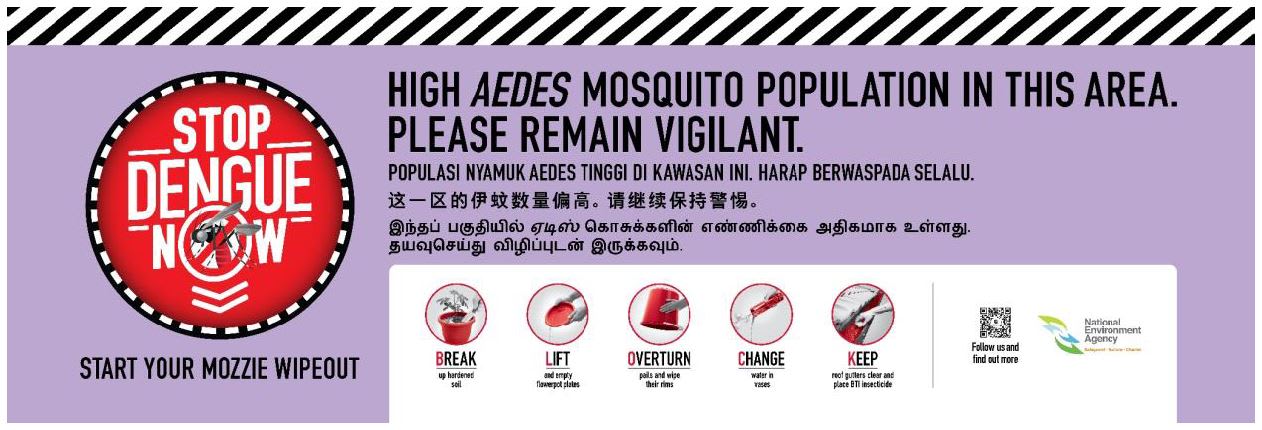
Mr Chew Ming Fai, NEA’s deputy chief executive officer and director-general of public health, said that the statutory board’s dengue prevention efforts “are not only focused on dengue cluster areas, but include non-dengue cluster areas that have higher Aedes aegypti mosquito populations”.
“The new purple alert banners will serve as useful visual reminders for stakeholders, partners and residents to take pre-emptive measures to reduce potential mosquito breeding habitats, lower the risk of dengue transmission and prevent clusters from being formed,” he said.
“Taking a preemptive approach in heightening dengue awareness and mobilisation of the community for dengue prevention efforts, is key to our vector control strategy.”
To check on dengue clusters in housing estates, go to NEA's website. Steps and prevention measures that the community can take are also found on its webpage.




