







DSTA tests tech that can withstand terror blasts
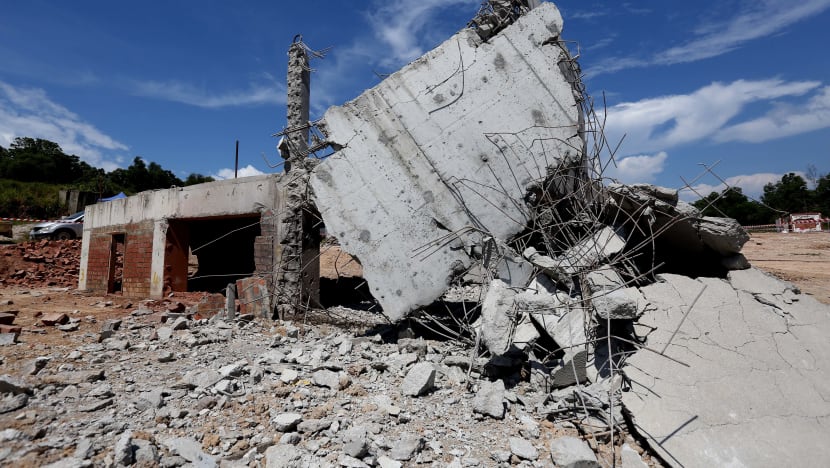
A structure that sustained a blast was used to assess the vulnerability of structures in an indoor explosion. The test is part of the Explosive Testing of Structural Components (ETSC) held every few years. Photo: Nuria Ling/TODAY


SINGAPORE — Against the backdrop of a growing terror threat, the Defence Science and Technology Agency (DSTA) is conducting a series of blast tests on an offshore island to assess protective technologies that can cope with the aftermath of a suicide bombing situation or a suitcase bomb.
The Explosive Testing of Structural Components exercise started on Monday and is being conducted at Pulau Senang over two weeks. It covers five test areas that feature fibre-reinforced-polymer retrofitted walls and steel-reinforced walls, among others.
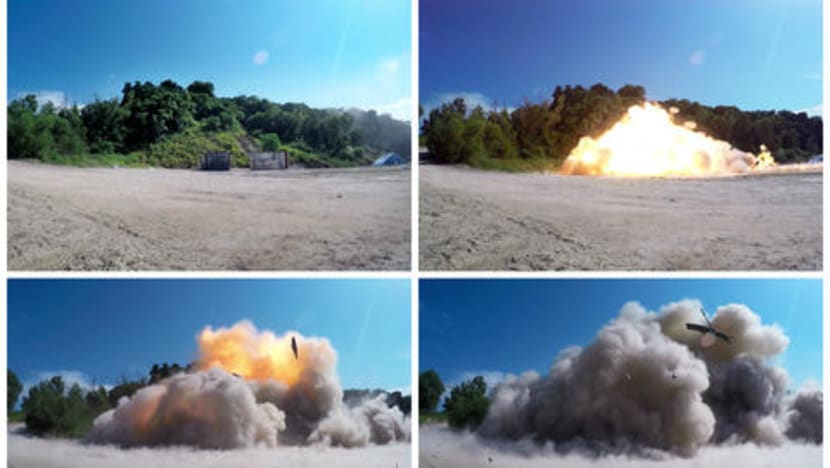
Together with officials from the Ministry of Defence and Singapore Armed Forces, Defence Minister Ng Eng Hen toured the site on Wednesday and witnessed a blast test being carried out on a reinforced concrete wall and brick wall.
A 100kg bare charge was set off 1.6m away from these walls, which saw concrete and bricks crumbling from the force of the blast. However, prior tests showed that the same walls — after being lined with fibre-reinforced polymer — were two-and-a-half times more resistant to blast effects, and were still largely intact after the bombing.





Explaining how these technologies could be applied outside military zones, Mr Lee Eng Hua, director of DSTA’s Building and Infrastructure Programme Centre, said: “(Improvised explosive devices) are threats that are coming at us. (The fibre-reinforced polymer) is a good way to retrofit old buildings that might not be built as strong previously. The alternative is to make the wall thicker, but with existing buildings, some might not be possible.”
Another test was also done to assess the effects of fitting a steel jacket on a reinforced concrete column, typically found in high-rise buildings.
The impact of a bomb blast on a column without a steel jacket was drastic: The concrete surface and the internal structure bars were blown off.
On the other hand, damage to the retrofitted column was contained.
DSTA researchers also blew up a building, meant to simulate a five-room flat or a small office, to gather data on the blast effects and resulting debris. Tests results will be put through modelling and simulation software to predict weapon effects on buildings and other critical assets.
Mr Lee said: “With the models, we are able to predict vulnerabilities of buildings and critical assets more accurately and efficiently. The models also allow us to evaluate a wider range of scenarios, while reducing the frequency of explosive tests.”
This has been the sixth exercise so far, since the DSTA started conducting large-scale tests in 1994. Before this, it had collaborated with research agencies in Norway, Sweden and the United States to conduct other large-scale trials on protective technologies for counter-terrorism and ammunition storage.
In a Facebook post on Thursday (May 18), Dr Ng said that the information collected from the exercise would provide the authorities with better options in building public housing: “This information will be used to build homes and bomb shelters that can better protect civilians. For example, using better designs and materials, bomb shelters can have thinner walls or shorter set-backs (zoning restrictions) and yet remain just as survivable.”




