







Eligible students will get places despite mergers, fewer JCs, says Minister
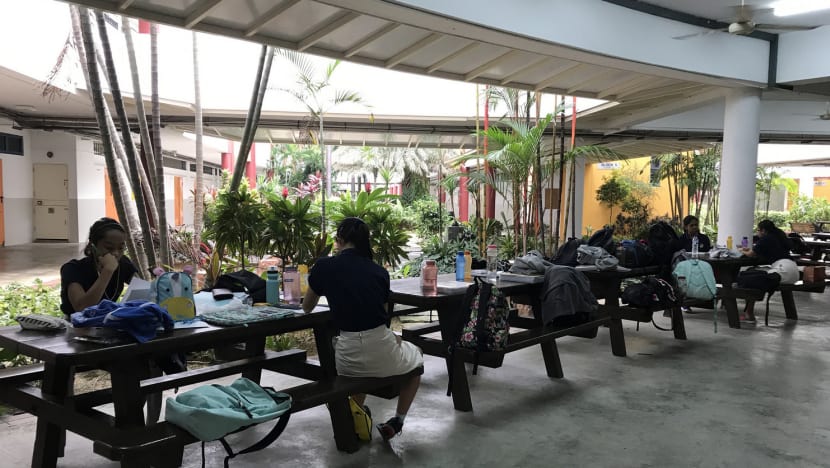
Students at Serangoon Junior College, one of the schools that will be merged with another in 2019 due to low birth rates and shrinking cohort sizes. TODAY file photo


SINGAPORE — Even with junior colleges (JCs) being merged and fewer of them around, all eligible students who opt to go to one will still be able to do so, Minister of State for Education Dr Janil Puthucheary said yesterday
But with low birth rates and demographic shifts, he said more mergers in the next decade cannot be ruled out “difficult though they may be”.
He was speaking in response to seven Members of Parliament who posed questions about the Government’s announcement in April of the biggest schools merger exercise to date.
Due to low birth rates and shrinking cohort sizes, the Ministry of Education (MOE) said three pairs of secondary schools and seven pairs of primary schools will merge in 2019.
Mergers will extend to JCs for the first time, with Serangoon, Jurong, Tampines and Innova JCs to be subsumed by Anderson, Pioneer, Meridian and Yishun JCs, respectively.
Yesterday, Dr Puthucheary outlined other options considered by the Government and explained why the mergers only involved “government non-IP JCs”.
These are government schools that offer the Integrated Programme (IP) — in which secondary school students can go on to JC without taking the GCE O-Level examinations.
Some observers had wondered if the JCs affected were chosen because they were “neighbourhood schools” not among the elite.
Dr Puthucheary said the merged schools were decided after considering several factors, “especially student choice and the enrolment patterns of the JCs”. Other factors were the geographical spread and “compatibility of merger partners”.
“After the mergers, we would preserve good geographical distribution of government non-IP JCs, with one each in the west, north, north-east and east regions,” he said.
Involving government-aided schools in the exercise would pose more challenges due to different governance frameworks, and the Government felt this “was not needed at this point in time”, he added.
The MOE considered retaining schools even with “very low” enrolment and bringing together students from various schools to take part in educational programmes at either a cluster or regional level.
However this would have caused operational challenges such as constraints in timetabling, and increased commuting time for staff members and students.
Next year, the ministry will increase the intake of first-year students for the remaining JCs, and Dr Puthucheary said that there is enough capacity to ensure that all eligible students will get a place.
Students who score 20 points or less in their O Levels may enrol in JCs, with extra criteria applying to some. Mr Zaqy Mohamad, Member of Parliament (MP) for Chua Chu Kang, asked if the mergers would result in higher aggregate scores for JC admission.
Dr Puthucheary said the MOE does not pre-determine JC cut-off points, which vary year-to-year depending on students’ choices.
But he added that there may be more variation in cut-off points in next year’s Joint Admission Exercise due to the changes.
Non-Constituency MP Leon Perera said the changes appear to diminish choice and increase travel times for JC-bound students who score 10 points and above, but Dr Puthucheary replied that “there’s no deliberate attempt to put the burden of this school closure on a particular segment of the population”.
Mr Zaqy also asked about the implications for the future workforce with the drop in number of places in JCs, and whether the ministry will review the JC experience for students.
Dr Puthucheary said that the authorities anticipate the proportion of students opting for JCs will remain roughly the same. “I think if there’s an opportunity for the JCs to think about how they can improve their provision of a student experience, because of competition for students to go down alternative pathways, that can also only be a good thing to improve our education landscape.”




